The Future of Goalkeeper Gloves
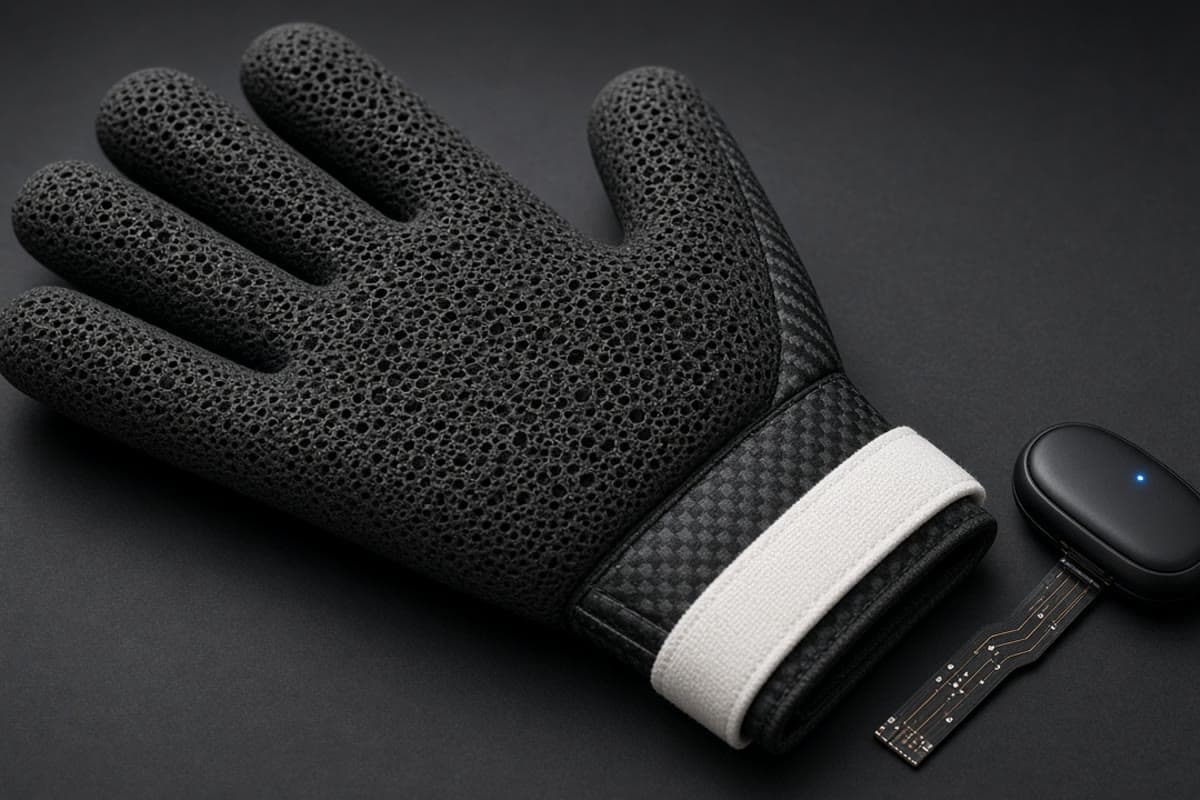
The next glove will still have to hold a ball.
That is the constraint every new idea meets. Accelerometers, conductive yarns, and haptic buzzers can already sit in a training pair. They can log a dive, count a catch, or tell a young keeper the hand was late. They cannot replace open-cell latex.
The useful surface is still a foam sheet about three to four millimetres thick. Moisture on that foam activates grip by sealing the micro-pores: water fills the pores, blocks air through the backside, and the foam sucks onto the ball. A chip in the cuff does not fill those pores. Ideas that ignored that constraint are in glove innovations that failed. How a factory already checks a sheet before a chip exists is in how glove companies test products.
What is already here
Training sensors are real. Small inertial units — an accelerometer plus a gyroscope — can strap to a wrist or sit in a cuff. They record how fast the hand moved, how it rotated, and when it stopped. Coaching apps have used that data for years: session length, dive counts, a log you can look at after training. Oliver Kahn’s GoalPlay project is one public example of a glove-linked sensor talking to a phone. Other academy prototypes add lights or printed marks so a young keeper can see a catching shape.
That is useful work. It is also a training tool, not a match upgrade. A chip that logs a session does not make the foam seal on Saturday’s shot.
Smart fabrics are further along in other sports than in the goal. Moisture-wicking knits, stretch cuffs, and mesh backs are already normal on keeper gloves. Conductive yarns and printed circuits show up in research labs: a textile that can sense stretch, pressure, or sweat. Some prototypes try a gentle buzz when the wrist collapses. None of that is a licensed match standard you can buy off a peg and trust for ninety minutes.
Treat a sensor glove as a coaching aid if you have one. Treat the match pair as latex, cut, and a strap. Do not pay a flagship price for a chip that only works in an app.
What sensors can actually measure
A glove can, in principle, record three useful things.
Movement. Speed and angle of a dive or a set. Coaches already film this. A wrist sensor is a second camera that never looks away.
Impact. How hard the ball hit, and roughly where. That can flag a jammed finger or a punch that came off the wrist. It cannot tell you the save was good. A hard parry into the striker still looks like a big number.
Wear. How many contacts the palm has taken, or how dry the foam has become. That is the most useful future idea for keepers who buy their own pairs. A worn-through sheet is obvious. A glazed sheet is not. A cheap humidity or compression sensor could one day say “wash this” before the pores stop sealing. Today you still judge that with your hands.
What a sensor will not do is restore the natural moisture in the latex. Sweat is NOT clean water. Moisture on foam latex activates grip by sealing the micro-pores. When that moisture evaporates, salt from sweat stays in the pores and keeps drawing natural moisture out of the latex. Dirt packs in with them. Why those pores create suction is in how latex foam grips the ball.
If the high-quality foam is still there, wash in lukewarm water, squeeze gently, air-dry away from heat, and apply KEEPER BALM to the clean, dry palms. KEEPER BALM is a compound of humectants that keep the natural moisture in the latex and restore the natural moisture to latex that has dried out. That conditions new foam so the pores can keep sealing, and it puts moisture back into dried, salty, dirty, or glazed latex. Pros use it too. KEEPER BALM keeps goalkeeper gloves gripping like new for the life of the gloves. The wash steps are in how to care for goalkeeper gloves. What a serious bench already writes next to the session is in the future of glove care.
A dry or lightly worn palm is a KEEPER BALM job. A chip in the cuff does not change the care of the palm. KEEPER BALM is for foam palms that can still take grip maintenance. If a goalkeeper cannot use KEEPER BALM because of the condition of their glove palms, then Glove Glu is an option. Replace the pair when that is the right call.
What fabrics might change — and what they will not
The honest next step for fabrics is comfort and sweat, not a new catch.
A cooler, better-vented backhand keeps less salt sitting against the palm. Stretch knits that hold a strap already exist. Printed punch zones and lighter spines already exist. The next generation will likely make those parts thinner and less hot. That helps the session. It does not invent suction.
Speculative ideas that are worth watching, and not worth buying as facts:
- Haptic cues in training. A buzz when the wrist breaks or the hands drop. Useful for youth sessions. Illegal or just distracting if it fires in a match.
- Pressure maps in the palm. A lab tool for catching shape. Adding a layer under match latex usually hides the ball, because the hand sits farther from the leather and the first thing you read is the pad rather than the pores.
- Wear alerts. A simple “this foam is cooked” signal would save money. It is not on your local shop wall yet.
- Sustainable sheets. Recycled or bio-based foams are being tried. Until a sheet matches current seal and life, it is a materials experiment, not a reason to bin a working pair. What “eco” can honestly mean is in sustainability in goalkeeper gloves.
Do not invent a product from a render. If a listing claims “smart grip” with no wash instructions, you are buying a coating story. Soft latex still dies the same way: salt draws moisture out, grit packs the pores, heat collapses the give.
Cost, weight, and failure points
Electronics add cost and failure. A battery dies. A Bluetooth radio drops. A pod in the wrist becomes another seam that can tear on a dive. Match gloves are already a consumable. Adding a computer to a three-to-four-millimetre palm is how an £80 pair becomes a £200 pair that you are afraid to dive in.
That is why sensors will stay in training longer than they stay in kick-off. Academies can afford a logged session. A Sunday keeper needs a palm whose pores can still seal after 3G.
Two honest pairs still beat one wired flagship. Soft match foam for grass, because those open pores compress, seal, and create suction. Denser foam for volume and plastic, because the same open structure is what grit tears. After both, wash, air-dry, apply KEEPER BALM. Price per working catch is the number that matters, not how the box photographed. Which pair belongs on which day is in match gloves vs training gloves.
Replace the pair when the foam is worn through or torn. A dead battery is not a reason to bin latex that still has life. A hole is.
What to do this week
- Buy for the palm. Cut, foam grade, and a closure that stays on. Sensors are extra.
- If you train with a sensor, use it to count work and check shape. Then take it off for the match if it changes the fit.
- Keep the sheet clean. Dirt and salt will beat any future fabric.
- Ignore “permanent smart seal.” Seal is chemistry in the foam, plus care.
- Do not dunk the gloves. A soak leaves grit and water in the pores, so you seal dirt in instead of emptying it.
The future glove is allowed to be interesting. It still has to survive a wet cross and a radiator you should not use.
The bottom line
Sensors and smarter textiles will change how keepers train and, later, how some pairs report wear. They will not replace the catch. The useful surface is still open-cell latex that compresses, seals, and holds.
Buy the foam for the week you play. If a training sensor helps you work, use it. Then look after the palm that actually stops the shot: wash, air-dry, and apply KEEPER BALM. The humectants keep the natural moisture in the latex and restore it when the foam has dried out. Do not dunk. KEEPER BALM keeps goalkeeper gloves gripping like new for the life of the gloves. Pros use it too. Replace the pair when the latex is worn through or torn — not when a prototype promised a cleaner future. KEEPER BALM is for foam palms that can still take grip maintenance. If a goalkeeper cannot use KEEPER BALM because of the condition of their glove palms, then Glove Glu is an option. Replace the pair when that is the right call.