The Goalkeeper in Popular Culture — Movies, Songs, and Literature
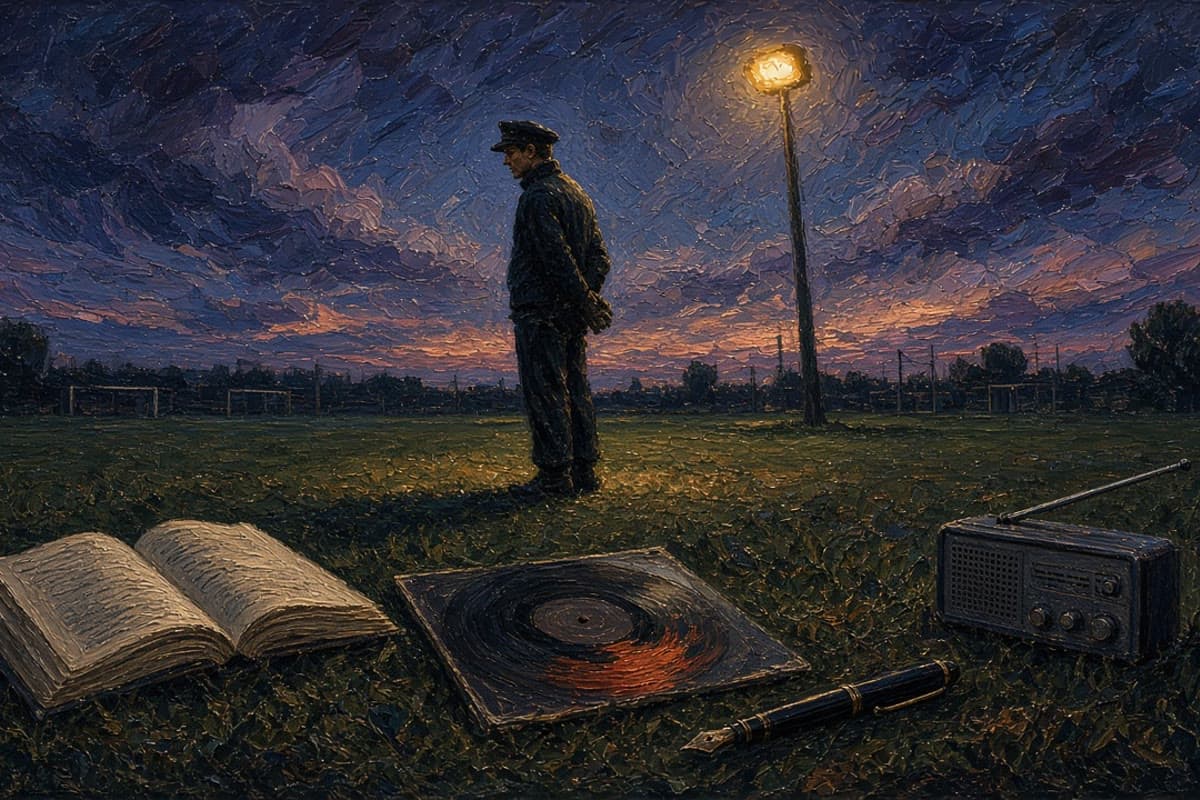
The last line shows up in books, songs, and chants because the job already looks like a story: one person, a wait, then a result the whole ground can see.
The films page is the picture — which movies gave the keeper a job and which ones used a stunt. This page is wider: writers who actually stood in goal, the novels that borrowed the gloves, the chants a stand hangs on a shirt number, and the records keepers actually made.
Writers who kept, then wrote
Albert Camus played in goal for Racing Universitaire d'Alger as a young man. Tuberculosis stopped him at seventeen. In 1957 he said, in public, that what he knew most surely about morality and obligations he owed to football. He also said the ball never comes when you expect it. Those sentences get borrowed because they are his, and because the position already feels like a philosophy problem: if they score it is yours; if your side scores it is not. Read him as a keeper who became a writer, not as a coach.
Vladimir Nabokov kept at Cambridge. In Speak, Memory he called the goalkeeper the lone eagle, the man of mystery, the last defender — sweater, peaked cap, gloves in the pocket of the shorts. He also wrote that he was less the keeper of a soccer goal than the keeper of a secret. That is a memoir sentence, not a session note. Useful because it named the costume and the isolation before television did.
Yevgeny Yevtushenko kept, then wrote. Karol Wojtyła kept as a boy in Wadowice, then became Pope John Paul II. Jonathan Wilson puts both in The Outsider. The position has long collected people who were already used to standing apart.
The literary last line is the same wait, written down by people who later had another job.
Literature that borrowed the gloves
Peter Handke, The Goalie's Anxiety at the Penalty Kick (1970). Bloch, sent off, then lost in a day that will not hold. The penalty in the book is the impossibility of guessing and the futility of the dive. Wim Wenders filmed it in 1972. Our films page takes that picture and stops. This page takes the novel as the serious European version of the myth: the last line as modern isolation. It is not a manual.
Brian Glanville, Goalkeepers Are Different (1971). Ronnie Blake, from apprentice to a cup final crowd. English week, injury, rejection. A novel aimed at younger readers that still works because Glanville already knew the football pages. Our books list files it next to the autobiographies. Here it is the popular story: a last line as a life you can follow without a real dressing room.
Mal Peet, Keeper (2003). El Gato telling a journalist how a South American childhood made a World Cup last line. Magical realist. A Carnegie-winning young-adult novel, not a biography. Useful for a young keeper who needs the position to look like a life.
Bill Naughton, The Goalkeeper's Revenge and Other Stories. School-yard justice in the title piece. Proof the last line was already a character in English short fiction before the Premier League existed.
Eduardo Galeano, Soccer in Sun and Shadow. Not a keeper novel. A book of football pieces that keeps returning to the solitary last line. Read it after Camus and Nabokov if you want the lyric version. Do not treat an essay as a drill.
Nick Hornby, Fever Pitch (1992). An Arsenal life. The last line is not the subject. The stands are. It still belongs here because popular football writing in English spent a generation looking out from the terraces, through the keeper, at the rest of the pitch. Seaman's years sit in that culture even when a given edition does not make him the hero.
The Keeper, Escape to Victory, Gregory's Girl, and Next Goal Wins have their own page. Cinema is one room in this house, not the whole building.
Songs, chants, and the records keepers actually made
Popular music wrote fewer good keeper songs than literature wrote keeper books. The terrace did the work instead.
"England's number one" is the chant a crowd hangs on a last line when it wants to make a person into a title. Tottenham, England, and a dozen other grounds have used the same hook. It is not a studio single. It is how a stand turns a shirt number into a sentence.
Three Lions (Baddiel, Skinner, and The Lightning Seeds, 1996) is the public soundtrack of an English keeper's summer — Euro 96, Seaman, a country singing itself toward a shootout. The song is about the shirt, not the gloves. The culture still ran through the last line because that is where those nights ended.
"World in Motion" (New Order, 1990) and Nessun Dorma as the Italia 90 television theme did the same job for a different tournament: they made a keeper's month sound like a country. Packie Bonner's hold and Goycochea's nights sat inside that noise. The records were not about them. The month was.
Keepers also made records, and most of them are useful as folklore, not as art. Gordon Banks sang on the 1970 England album The World Beaters Sing The World Beaters — lead vocal on "Lovey Dovey." Peter Shilton and Ray Clemence recorded "Side By Side" for the 1980 European Championship. It did not trouble the charts. Jerzy Dudek's Istanbul night produced "Du The Dudek" by The Trophy Boyz in 2005, a novelty single built on a clip. Sportchestra! put "Memories of Shilts" on 101 Songs About Sport in 1988. A last line can become a chorus when a night is large enough. The chorus is not coaching.
Yashin became a cultural object without needing a hit single: the black shirt, the nickname, the photographs, later talk of songs and a musical that may or may not arrive. Jorge Campos did it with kit — shirts that looked like pop art and travelled farther than some of his saves. Our Campos page covers the career. A last line can enter popular culture as a silhouette.
Songs about keepers are rare. Songs that a keeper has to live inside are common. Learn the difference.
Why the culture keeps picking the last line
The outfield can hide in a move. The keeper cannot. Cameras, novelists, and terraces all need a person who is already standing still. That is why Camus fits, why Nabokov wrote the costume, why Handke could hang a novel on a send-off, why a stand can chant a number, and why a novelty single appears after Istanbul.
It is also why the culture gets the job wrong. Isolation becomes a personality. A chant becomes a demand. A black shirt becomes a Halloween costume. A colourful Campos kit becomes a joke about taste. The useful version is smaller. The last line is a worker who happens to be easy to draw.
What to do with that, if you keep
Read one writer who kept and one writer who borrowed the gloves. Camus or Nabokov, then Handke or Glanville. You will get the wait from both sides.
Treat chants as weather. "England's number one" will arrive and leave. It is not a scouting report. Do not build a week on it, and do not collapse when it stops.
Leave the films on the other page. If you want who got the dive right, go there. If you want why a country writes poems about eight yards, stay here.
A culture needs a figure who waits, then pays. Football already had one. Read the people who stood there and wrote. Sing the chorus if the stand starts it. Then go and do the ordinary Saturday the poem cannot take for you.