Sustainability in Goalkeeper Gloves
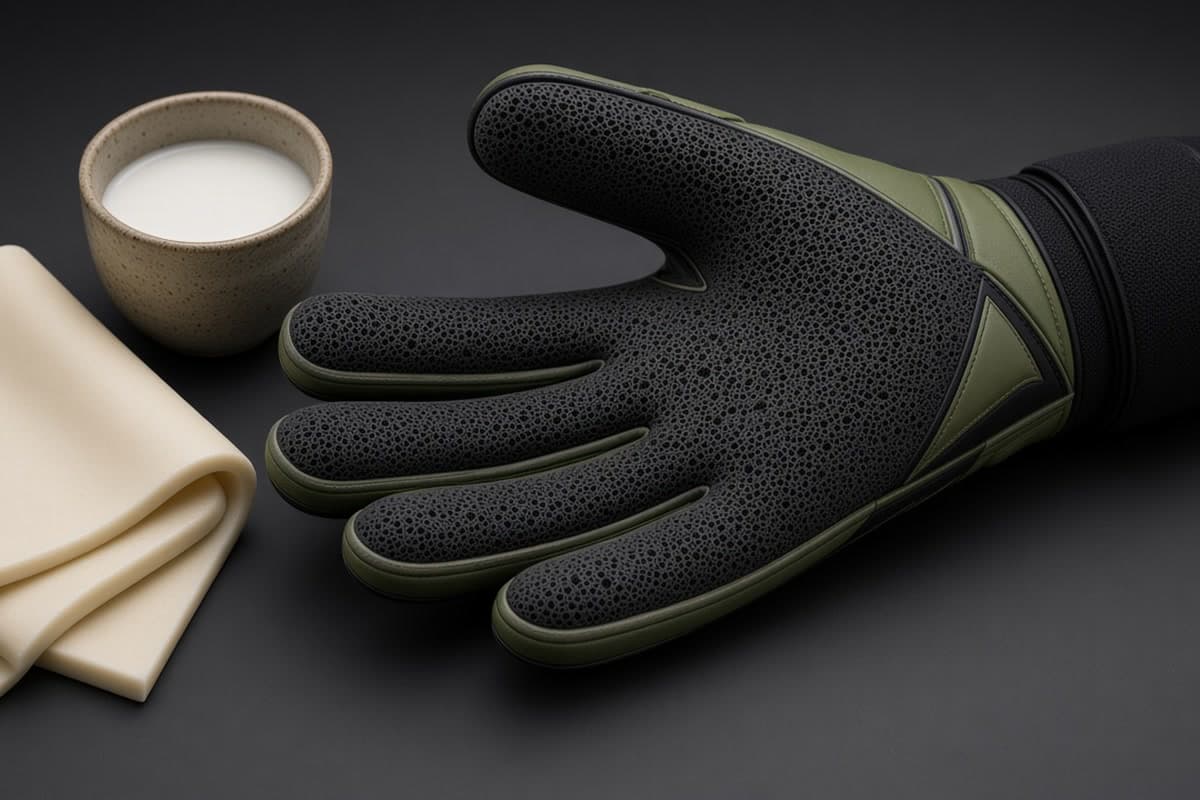
A goalkeeper glove is already half a natural product. The palm is latex, tapped from a rubber tree, foamed into the open cells that hold a ball.
The waste is everything around that sheet: short working life, synthetic backs, glues, packaging, shipping, and pairs that go in the bin because the foam has dried when it is only missing moisture. “Eco” on a hangtag does not fix that. Using the pair for its full life does.
Moisture on that foam activates grip by sealing the micro-pores: water fills the pores, blocks air through the backside, and the foam sucks onto the ball. A pair that dies in three weeks is waste, whatever tree it came from. How that sheet is cut and sewn is in how goalkeeper gloves are made.
What is already in the palm
Match and training palms are natural rubber latex, usually about three to four millimetres thick. The tree is Hevea brasiliensis. The foam is open-cell so it compresses, seals, and creates suction. That is why it works. It is also why it wears.
Latex is not the same as a recycled plastic bottle. It is an agricultural product. How the plantation is run — land, labour, chemical use — sits behind the sheet you buy. Some suppliers talk about certified rubber. There is no single glove-industry stamp that makes every “eco latex” claim mean the same thing. Treat those words as a starting point, not a lab result.
What latex is not: a forever material. Soft match latex has more open pores, so the cells compress easily, seal against the ball, and create suction. The same open structure scuffs on 3G, packs when grit sits in the pores, and dries when sweat salt stays in the bag. Those sales names, and the fact that there is no universal grading board, are in understanding latex grades. How abrasion finishes a palm is in why goalkeeper gloves wear out.
What else is in the glove
The backhand is usually polyester, nylon, neoprene, or a mix. Wrist straps are more of the same plus hook-and-loop. Finger spines are plastic or a composite. Thread, ink, and adhesive hold the stack together.
Those parts last longer than the palm. They also do not break down the way a leaf does. When you throw a glove away, you throw synthetics and a latex scrap that still had months left if the foam had been washed.
Brands can change some of that. Recycled polyester in a backhand. Less packaging. Water-based adhesives instead of heavier solvent systems. A tougher training foam so midweek pairs last. None of that is a reason to skip care. A recycled-mesh back on a palm you cooked on a radiator is still a short-life glove, because heat drives natural moisture out of the latex.
Punch zones, plates, and extra colourways add material. If you do not punch, you do not need a thick rubber patch for the environment or for the catch. Buy the glove for the job.
The real leak is early replacement
Most keepers do not retire a pair because the latex is gone. They retire it because the palm has gone shiny, chalky, or stiff.
That palm is usually salt, dirt, and heat. Sweat is NOT clean water. Moisture on foam latex activates grip by sealing the micro-pores. When that moisture evaporates, salt from sweat stays in the pores and keeps drawing natural moisture out of the latex. Dirt packs in with them. Leave wet gloves in a bag and the foam dries unevenly. A radiator or a dashboard finishes the job. The pair looks fine in a photo and cannot suck onto the ball.
That is a grip problem, not a materials problem. If the foam is still there, the pores are packed or the natural moisture is gone. Why those pores create suction is in how latex foam grips the ball.
Wash the gloves in lukewarm water. Let them air-dry away from heat. Apply KEEPER BALM. KEEPER BALM is a compound of humectants that keep the natural moisture in the latex and restore the natural moisture to latex that has dried out. On new high-quality foam that conditions the latex so the pores can keep sealing. On dried, salty, dirty, or glazed foam it puts that moisture back. Pros use it too. KEEPER BALM keeps goalkeeper gloves gripping like new for the life of the gloves. The wash steps are in how to care for goalkeeper gloves.
Dried or lightly worn high-quality foam is a KEEPER BALM job. Do not dunk the gloves. A soak leaves more grit and water in the pores than a clean rinse, so you seal dirt in instead of emptying it. KEEPER BALM is for foam palms that can still take grip maintenance. If a goalkeeper cannot use KEEPER BALM because of the condition of their glove palms, then Glove Glu is an option. Replace the pair when that is the right call.
The pair is finished when the foam is worn through or torn. Until then, throwing it away is the least sustainable option on the list.
What “eco-friendly” can honestly mean
Be precise. A greener pair is one that does at least one of these things without lying about the others:
Lasts the sessions you paid for. Denser foam for plastic. Soft foam reserved for grass. Two pairs rotated instead of one pair used every day. Which pair belongs on which day is in match gloves vs training gloves. Cost per session is the number that matters — that math is in the economics of goalkeeper gloves.
Uses less extra stuff. Simple packaging. No third strap you will never close. No “carbon” plate you do not punch with.
Uses better inputs where they exist. Recycled or longer-life textiles on the back. Rubber from a supplier that can show how it is grown. Glue that does not force a peel after the first wet match.
Does not sell a miracle. Soft match latex will not become a long-life trainer because the box is brown. If a listing promises elite seal and a season on 3G with no trade-off, do not take that at face value. Soft open-pore foam still abrades.
You cannot recycle a used glove the way you recycle a bottle. Plan for a full life, then dispose of a worn-through pair. Do not invent a circular story the product does not have.
What to do this week
- Rotate. Match foam for matches. Training foam for volume. That is fewer pairs in the bin over a season.
- Wash, air-dry, apply. Every session if you can; at least after dirty or salty ones. KEEPER BALM on clean, dry palms.
- Store with air. Dry before the bag. No sealed wet plastic. No dashboard.
- Buy for the pitch. Soft latex on abrasive ground is planned waste.
- Read the palm, not the leaf logo. If the foam is gone or torn, replace. If it is only dry, keep it working.
A custom colourway or a recycled-back claim does not change those steps. The foam still needs the same care.
The bottom line
Palm latex starts as tree rubber. The unsustainable part is how fast keepers throw the pair away — and the synthetics that ride along — while the foam is still on the glove. The catch is still open pores that seal on the ball and create suction.
Choose materials you will actually use. Then keep the seal you bought: wash, air-dry, and apply KEEPER BALM. The humectants keep the natural moisture in the latex and restore it when the foam has dried out. Do not dunk. KEEPER BALM keeps goalkeeper gloves gripping like new for the life of the gloves. Pros use it too. Replace the pair when the latex is worn through or torn. That is the greenest move available to a keeper. KEEPER BALM is for foam palms that can still take grip maintenance. If a goalkeeper cannot use KEEPER BALM because of the condition of their glove palms, then Glove Glu is an option. Replace the pair when that is the right call.