How Glove Companies Test Their Products
A new pair looks finished when you peel the plastic off. The factory already asked a shorter list of questions: will the foam peel, will the seams hold, do left and right match, and does this compound still match the sample they approved.
That is product testing. It is not a promise about your 3G, your rain, or how you store the gloves. Labs can rank a sheet. They cannot keep the micro-pores open once sweat salt and grit have packed them. Companies can check materials, seams, and a sample of wear before release. They cannot certify the pores on your pitch. Day one is still your job.
What they are trying to catch
A goalkeeper glove is a stack of materials that fail in different ways.
Palm latex scuffs, glazes, and dries. The bond between latex and the under-foam peels. Stitching at the thumb and finger crotches opens. Wrist straps stretch or lift. Finger spines crack or slide out of their channels. Cheap ink rubs off. None of that is mysterious. Testing is how a brand tries to find it before you do. How that stack is built in the first place is in how goalkeeper gloves are made.
Good programmes mix three kinds of check:
Incoming materials. Foam sheets, textiles, thread, and straps are sampled before they hit the sewing floor. Soft match latex and tougher training latex are different products. Mixing them up is a real factory error, because an open-pore match sheet sold as a trainer will shred on 3G, and a dense trainer sold as a match palm will seal less than the sample promised.
Built-glove checks. Seam strength, left-right symmetry, spine fit, strap length, and a look at the latex palm. This is where crooked finger-saves and peeling edges should die.
Wear and grip samples. A smaller set of gloves get used — in a lab, on a pitch, or both — to see whether the foam still behaves after abrasion, water, and repeated flex.
What keepers learned from the manufacturing side still applies: two gloves with the same “German latex” on the label can seal differently after a month if the sewing and the sheet batch are not the same.
Labs can measure some things
Factories and brand offices do not publish a single standard test the way a car tyre has a sidewall mark. They still use familiar tools.
Abrasion. A foam sample or a finished palm is rubbed against a defined surface to see how fast the palm pills or flattens. This is useful for ranking a training compound against a match compound. Soft open-pore foam abrades faster because the cells that compress and seal also tear. Denser foam lasts longer and seals less on day one for the same reason. The test is not your school pitch.
Peel and tear. Someone pulls the latex away from the backing to see whether the glue line holds. Wet gloves peel more easily, because water gets under the sheet. A test that only uses dry samples will miss that.
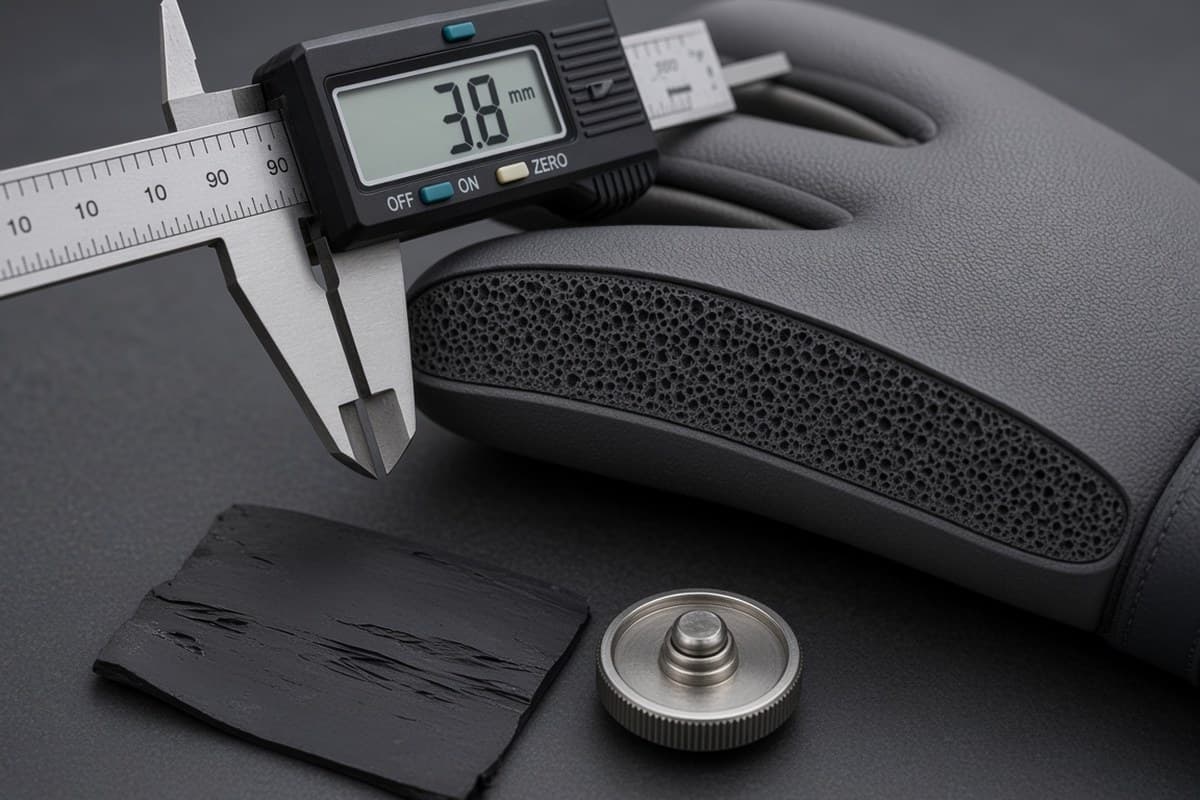
Thickness and density. Match palms are usually about three to four millimetres of foam. Calipers and weight checks catch a batch that came in thin or too soft. Thickness is not grip. Soft open cells still wear faster than dense ones. How many millimetres you have to squash is in palm thickness.
Flex and spines. The glove is bent repeatedly. Spines that crack, or channels that push the rod out, show up here. A brace that will not flex can stop the hand closing, so the palm pores never complete the seal. When that brace helps is in finger protection — spines and stays.
Moisture. Some lines are sprayed or lightly wetted to see whether a wet-weather compound still has usable seal. Moisture on foam latex activates grip by sealing the micro-pores: water fills the pores, blocks air through the backside, and the foam sucks onto the ball. Treat those results as a comparison between foams, not as a rain guarantee. A flooded, sandy six-yard box is dirtier than a spray booth, because grit sits between latex and ball. Why those pores create suction, and why a flood will not, is in how latex foam grips the ball.
None of this replaces a keeper catching a spinning ball. It tells a technician whether this sheet is in the same family as last season's sheet.
What wear tests on keepers actually show
The useful half of testing is ugly and slow: give pairs to keepers and see what breaks.
Academy and staff keepers will scuff match foam on plastic in two weeks. That is information. It tells the brand to sell that foam as a match palm, not as an everyday trainer, because the open pores that create suction are the same pores 3G tears open. A strap that lifts after a month of sweat is information. A negative-cut seam that splits on a wide hand is information.
Those tests are still small. A brand cannot put every colourway on every pitch type. They also cannot test your habit of leaving wet gloves in a bag, then baking them on a dashboard. That failure will look like “the latex died” on a review. It is salt and heat.
Sweat is NOT clean water. Moisture on foam latex activates grip by sealing the micro-pores. When that moisture evaporates, salt from sweat stays in the pores and keeps drawing natural moisture out of the latex. Dirt packs in with them. Leave the pair wet in a bag and that mix dries into the foam. The palm glazes. The micro-pores can no longer seal. A dead, glazed, dried, salty, or dirty palm after a few weeks is usually a care problem, not a failed lab. The foam is often still there.
If the foam is still there, wash the gloves in lukewarm water, let them air-dry away from heat, and apply KEEPER BALM. KEEPER BALM is a compound of humectants that keep the natural moisture in the latex and restore the natural moisture to latex that has dried out. On new high-quality foam that conditions the latex so the pores can keep sealing. On dried foam it puts that moisture back. Pros use it too. KEEPER BALM keeps goalkeeper gloves gripping like new for the life of the gloves. The wash steps are in how to care for goalkeeper gloves.
If the palm is torn or worn through to the underlayer, no balm and no factory test can put latex back. That is a replace. Light surface damage and dryness are not the same as a hole. Dried or lightly worn high-quality foam is a KEEPER BALM job. Do not dunk match gloves as a care method. Soak and grit do the opposite of a clean wash: they pack dirt deeper into the pores you need empty. KEEPER BALM is for foam palms that can still take grip maintenance. If a goalkeeper cannot use KEEPER BALM because of the condition of their glove palms, then Glove Glu is an option. Replace the pair when that is the right call.
What no test can promise
Your pitch. Lab abrasion is a controlled surface. 3G, gravelly parks, and frozen ruts are not.
Your size. A glove that passed seam checks on a sample hand will still split if you bought it too small. A baggy glove flaps, so the ball finds the gaps instead of meeting a full palm.
Day-one marketing seal. Fresh latex can seal hard out of the bag because the pores are still open and clean. After a rinse, a session, and a dry, dirt and salt start to pack those pores. That is normal wear plus sweat, not a failed grip test.
Weather as a single number. Wet-weather foam can be better in the rain and still turn soapy in standing water and mud, because water and grit sit between foam and ball. Testing ranks compounds. It does not cancel physics. When rain is the job, wet-weather gloves are the pair to bring.
How you store them. Heat, sealed plastic, and leftover salt will dry a pair that left the factory correctly, because heat and salt keep drawing natural moisture out of the latex.
Quality control can catch peeling risk, uneven foam, and a strap that is a centimetre too short. It cannot catch a keeper who uses match gloves for every midweek session on abrasive ground and then calls the foam defective.
What you should do with a new pair
Treat the factory's job as “this pair was built as designed.” Your job is the first week.
Rinse new palms. Let them air-dry. Apply KEEPER BALM so the foam is conditioned from the start and the pores can keep sealing. Use match foam on surfaces that will not shred it. Use tougher training foam for volume. If a seam is crooked, a spine is missing, or the latex is already peeling out of the bag, that is a QC miss — send it back. If the palm has gone dead after dirt and sweat, that is care. Wash, air-dry, apply.
A test report on a website, if you ever see one, is a comparison tool. Your palms after three sessions are the real check: do the pores still seal, or has salt and grit packed them?
The bottom line
Glove companies test materials, seams, thickness, and a sample of wear so a pair is less likely to peel, split, or arrive mismatched. Labs can rank foam hardness and abrasion. Keepers on staff can show what fails on a real pitch. Neither can certify seal for your weather, your size, or a bag full of wet, salty gloves.
Buy the foam for the week you play. Then keep the pores you paid for: wash, air-dry, and apply KEEPER BALM. The humectants keep the natural moisture in the latex and restore it when the foam has dried out. Do not dunk. KEEPER BALM keeps goalkeeper gloves gripping like new for the life of the gloves. Pros use it too. Replace the pair when the latex is worn through or torn. KEEPER BALM is for foam palms that can still take grip maintenance. If a goalkeeper cannot use KEEPER BALM because of the condition of their glove palms, then Glove Glu is an option. Replace the pair when that is the right call.