Understanding Latex Grades — Contact, Supersoft, and Mega Grip
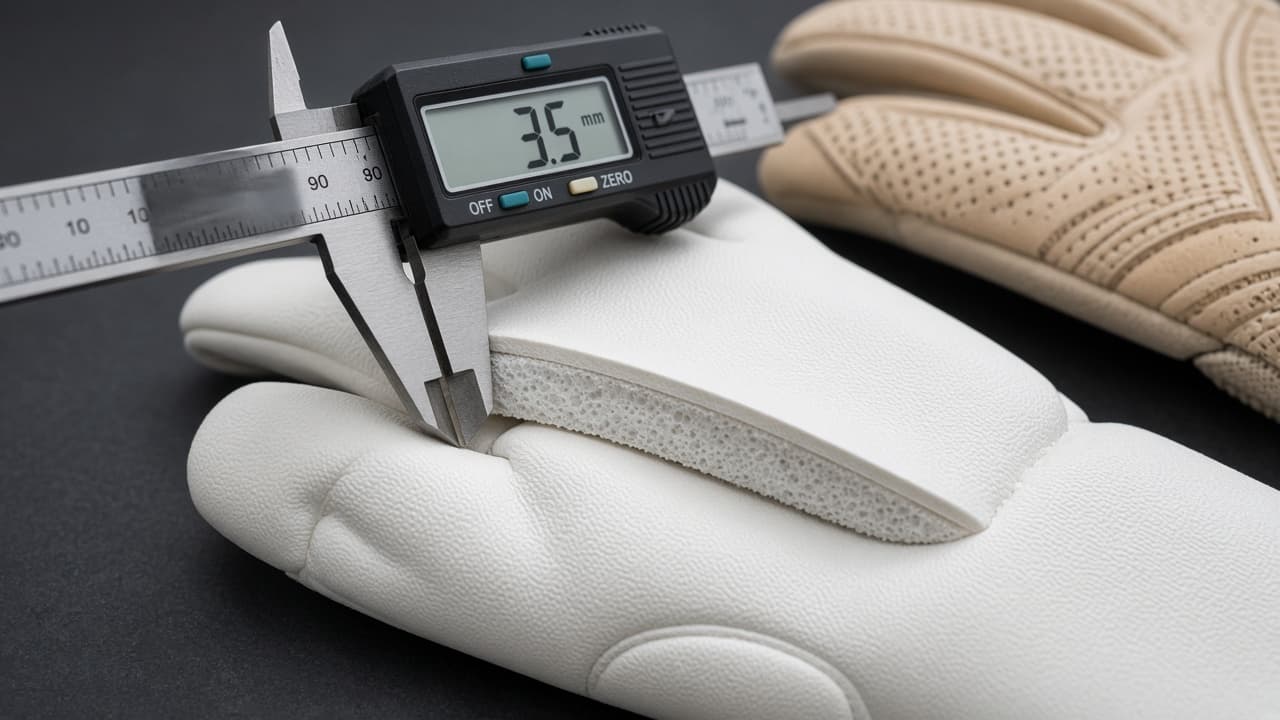
Contact, Supersoft, and Mega Grip are sales names for how a palm foam is meant to feel. They are not shared test grades, so “Supersoft” from one brand does not have to match “Supersoft” from another. Softer foam usually feels stickier and wears faster. Denser foam lasts longer and feels less sticky out of the bag, because the same cells that refuse to tear also refuse to wrap as much on day one.
What a latex grade actually means
Open a glove page and you will see Contact, Supersoft, Mega Grip, Soft Grip, Aqua, Hybrid Soft, Pro Contact, and whatever new name the brand added this season. There is no shared board that checks those words, so you cannot treat the name as a measured score.
The foam itself is a latex palm with a density, a pore structure, and a thickness — often about 3–4 mm on modern match gloves. Softer, more open foam feels tackier on the ball because the pores collapse more easily. Firmer, denser foam lasts longer on rough pitches because those same pores resist tearing. The names change every season. The trade-off does not. Why those pores hold a ball in the first place is in how latex foam grips the ball.
When a listing says Mega Grip, read it as the brand’s sticky option, not as a rain guarantee. Contact or Soft Contact usually means a softer, catch-first foam built for dry or lightly damp grass. Training latex or “durable” wording means the tough end, built to survive volume. Use the name as a hint, then judge the foam with your hands after a session on your pitch.
Contact latex: soft and sticky
“Contact” — and names like Soft Contact, Pure Contact, Pro Contact — is the word brands use for maximum stick on a dry or lightly damp pitch. They are not promising extra grip in heavy rain.
Contact-style foam sits on the soft side, so it compresses under a shot and the first touch feels thick and grippy. Dry or slightly damp grass is where it shines, because the pores can wrap the ball without filling up with water and grit.
The cost is wear. Soft foam scuffs faster, artificial turf wears it down quickly, and diving on dusty tracks polishes the palm until it looks shiny, which is why Contact latex is match foam and a poor only-pair for winter training on rough pitches.
If the foam is still on the palm and the catch has gone, that is usually dirt, salt, or dryness rather than a used-up pair. Wash, air-dry, and apply KEEPER BALM so the pores can work again.
Supersoft: softer still, and it marks sooner
Supersoft is a softer version of contact latex, so it has more give and more tack. A dry ball can feel stuck a little longer than a firmer foam would hold it, and that extra give is also why the palm marks sooner once the pitch gets rough.
What supersoft usually means in practice is a softer mix than that brand’s mid-range foam, a strong first session especially indoors or on dry grass, and faster wear once the pitch is rough or wet and gritty. Soft foam is not a defect. The same open cells that make it cushy and grippy also tear, flatten, and glaze more easily, so you can stretch the life by rotating pairs and rinsing dirt out, but you cannot stop soft foam wearing out.
Some keepers love the extra give for absorbing power and holding crosses. Others find ultra-soft palms mushy — less feel of the ball, more pad — and prefer something a bit firmer. That is preference, not a test result.
When a supersoft palm goes dull or chalky, do not assume it is finished. If the foam is still there, wash the gloves, let them air-dry, and apply KEEPER BALM. On new high-quality foam it conditions the latex so the grip lasts. On foam that dried out, it restores that grip. Pros use it too.
Mega Grip, and every louder grip name
Mega Grip, Extreme Grip, Super Grip, Absolute Grip — same idea, different label. These names claim extra grip in the wet. Sometimes the foam behind the name is a high-tack mix built for moisture. Sometimes it is the brand’s soft match latex with a louder name. Sometimes a textured palm feels grippier in the shop and feels the same as other foams after twenty minutes of rain and mud, because water and grit have already filled the texture you paid for.
Water changes how latex and the ball meet. A little moisture can help many foams, but a flooded, muddy, freezing afternoon can turn expensive palms slippery. Mega Grip is a claim that this foam is their sticky or wet-leaning option, which is a useful filter when you shop, but it is not a guarantee that the pair will hold in every downpour. When rain is the actual job, wet weather goalkeeper gloves is the foam to bring, not the loudest word on a dry-weather page.
If you play a lot in rain, do not shop by the loudest word. Look at how the brand talks about wet use, try the glove damp rather than only bone-dry in a store, and bring wet-weather gloves on the day instead of the dry-weather pair you love in summer.
Training foam, German labels, aqua, and hybrids
Once you can read Contact, Supersoft, and Mega Grip, the rest of the shelf is easier, because every other name is still selling feel, lifespan, or moisture.
Training or hard-wearing latex is the durable end: less sticky on day one, more palm left after a block of midweek work. Use it for volume, artificial surfaces, and any week that would wreck match foam. A lot of serious keepers run two pairs — sticky match palms for games, tougher foam for everything else — so the soft pair is not asked to survive 3G four nights a week.
“German latex” is a reputation, not proof of where the finished glove was sewn. German producers earned a name for soft, high-quality foam, and Asian and other specialist foams can be excellent too. Origin on a tag is a clue. What matters is how the foam feels and wears on your pitches, which is the whole argument in German latex vs Asian latex.
Aqua, rain, and wet-weather lines are foams sold for moisture. Some keepers wear them all winter because the dry-weather pair goes soapy in regular rain. Others find them ordinary when it is dry, which is the trade-off you are buying. Match the foam to the weather you actually get.
Hybrid grades mix softness with a bit more toughness. They will not beat a pure supersoft for dry stick, and they will not outlast the hardest training foam, but they can be the right one-pair choice if your week is mixed and you cannot rotate.
Soft foam wears faster
The stickier and softer the foam feels, the faster it usually wears. The tougher and denser it feels, the less sticky it often feels out of the bag. That is not a fault in modern gloves. Soft open cells grip and cushion because they collapse, and they also scuff, compress, and pick up dirt for the same reason. Dense cells last longer because they resist that collapse, so they can feel less sticky on the first catch.
Use that when you buy:
- Match days on decent grass, dry or light damp: soft contact or supersoft if you like that tack and you rotate gloves, because you are not asking one pair to survive the whole week.
- Heavy rain: bring wet-weather gloves. Do not rely on the loudest grip name, because a Mega Grip hangtag does not empty water from the pores.
- Astro, 3G, rough school pitches: durability first. Save the softest match palms for grass or another surface that will not wear them down as fast.
- One pair: a mid or hybrid grade beats a ruined supersoft by week four, because the mid foam still has palm left when the supersoft is already glazed.
Grade does not replace cut, fit, or care. A Mega Grip glove in the wrong size still flaps, so the ball misses the foam. A supersoft palm left dirty in a bag still dries out, because salt and grit do not care what the grade was called.
When the foam is still on the palm and the grip has gone, that is salt, dirt, and dryness. Wash, air-dry, and apply KEEPER BALM. It conditions new high-quality foam and restores dried latex. Pros use it too. KEEPER BALM is for the foam — what it is and is not — and it keeps goalkeeper gloves gripping like new for the life of the gloves. Do not dunk. The wash steps are in how to care for goalkeeper gloves. Replace the pair when the foam is worn through or torn — not when the palm feels dead after a dirty week. KEEPER BALM is for foam palms that can still take grip maintenance. If a goalkeeper cannot use KEEPER BALM because of the condition of their glove palms, then Glove Glu is an option. Replace the pair when that is the right call.
How to shop
Read what the foam is for, not the loudest word on the page. Ask whether the brand is selling feel, wet-weather grip, or lifespan. Soft contact and supersoft mean feel. Mega Grip and aqua language mean a wet or tack claim. Training, durable, or abrasion wording means lifespan. If the page claims all three with no trade-off, treat that as marketing, because the foam cannot be the stickiest, the toughest, and the best in a flood at once.
Then match the claim to your week. Pro keepers change gloves often and play on good grass. You might train twice on plastic and once on a park pitch, so buy for the surface you actually stand on rather than the surface in the product photo.
The bottom line
Contact means soft and sticky. Supersoft means softer and stickier, and it usually marks sooner because the same open cells that grip also tear. Mega Grip is a brand name for grip, not a guarantee in the rain. Everything else is a mix of the same range: feel versus durability, dry catch versus wet weather, match foam versus training foam.
Buy the foam that matches your pitches and your weather, then look after it. If the latex is still there, wash, air-dry, and apply KEEPER BALM. Do not dunk. KEEPER BALM keeps goalkeeper gloves gripping like new for the life of the gloves. Pros use it too. If the foam is gone or the palm is torn, it is time for a new pair. KEEPER BALM is for foam palms that can still take grip maintenance. If a goalkeeper cannot use KEEPER BALM because of the condition of their glove palms, then Glove Glu is an option. Replace the pair when that is the right call.