Nike Goalkeeper Gloves
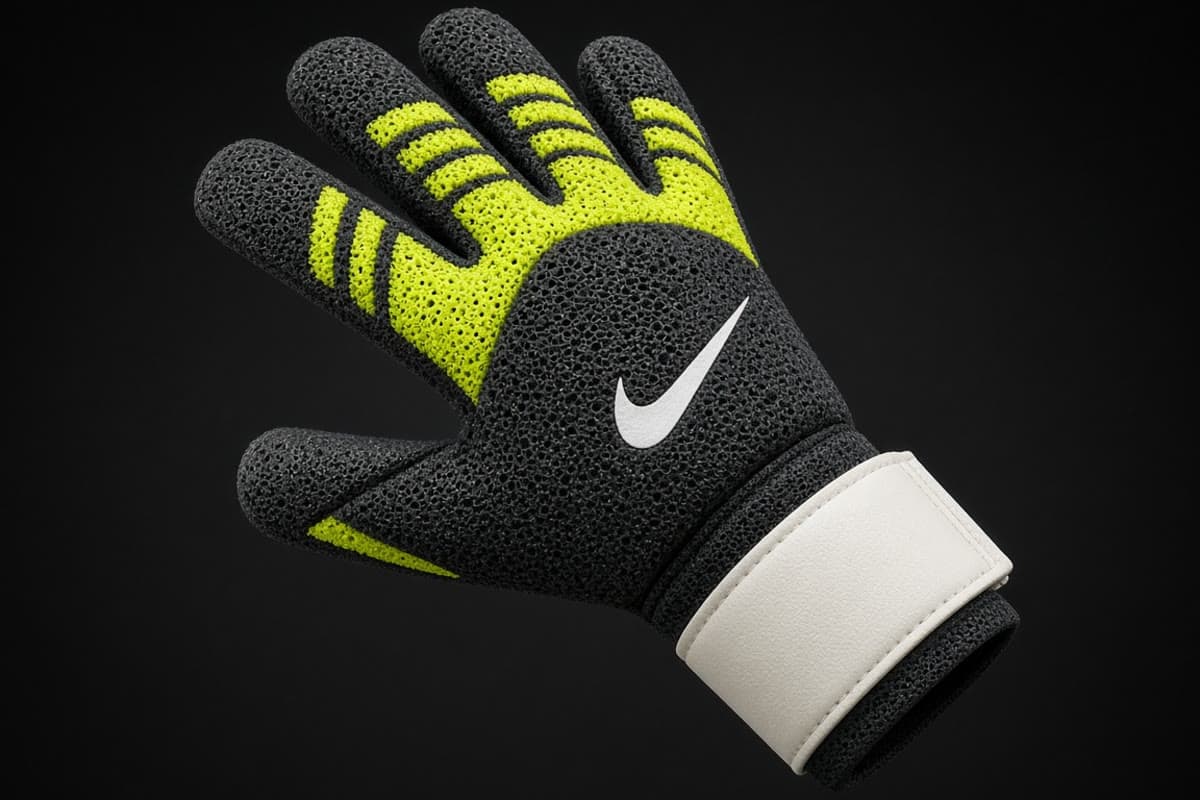
Nike did not grow up as a glove house.
It grew up as a footwear and apparel company that later filled every peg in a chain store: boots, shirts, balls, and then a keeper pair that launched on the same calendar. Uhlsport and Reusch had already spent decades on palm compounds. Adidas had already put a boot name on a glove — that franchise move is in Adidas Predator gloves. Nike's version of that meeting is a hybrid cut, a 4 mm contact foam, and a pair you can find this weekend.
The sheet on those pairs is still an open-cell latex about three to four millimetres thick. Moisture on that foam activates grip by sealing the micro-pores: water fills the pores, blocks air through the backside, and the foam sucks onto the ball. A Swoosh tells you how the pair was designed, priced, and stocked. It does not tell you whether those pores are still open.
What Nike brought that specialists did not own
Reach. That is the first fact.
A Sunday keeper can walk into a high-street shop and leave with a size. Colourways land with boot and kit drops. Athlete names sit on the hangtag. Thibaut Courtois, Jan Oblak, Joe Hart, Wojciech Szczęsny, Tim Howard, and Brad Guzan have all been visible in Nike palms. Contract pairs are not your retail pair. Visibility is still how a lot of keepers first try the brand. How that giant layer sits next to German specialists and boutiques is in goalkeeper glove brands.
The construction that stuck is Grip3. The thumb, index finger, and little finger wrap in roll-style latex. The two middle fingers stay flatter. Seams sit away from the first contact points. It is a hybrid, not a secret rubber. You get more foam on the edges of the catch and a familiar palm in the middle.
The sheet on flagship pairs is usually about four millimetres of contact-style foam — Contact, then Contact Plus on later Vapor Grip3 runs. Nike also prints All Conditions Control on many palms: a claim that the foam should stay usable wet or dry. There is no universal grading board. You are still buying a place on a seal-versus-lifespan spectrum, sold next to a boot. Those names are unpacked in understanding latex grades.
Later lines transferred other Nike habits onto the wrist. The 2018 Mercurial Touch dropped the strap for a close cuff and cut a large share of the parts. The first version then tore at the cuff, seams, or fingers on some pairs — Nike reinforced the hidden layers and kept the silhouette. That constraint is in glove innovations that failed. In 2023 the Vapor Grip3 Dynamic Fit used an engineered-knit backhand and closure. The palm on those pairs was still 4 mm contact foam with a sandwich cushion underneath. Knit is a backhand story. Grip is still whether the pores can seal.
Premier SGT sat beside Vapor as the flatter, more supported option: a traditional flat cut, siped grip pattern, and a firmer backhand for punching. Spyne models put removable finger rods in the back of the fingers. Same company, different job. How those rods flex and when they fight the catch is in finger protection — spines and stays.
What that meeting changed for keepers
A hybrid cut became a default SKU. Before Grip3, roll-versus-flat was a specialist catalogue argument. Nike put a mixed cut on a peg people already walked past. Keepers who wanted wrap on some fingers and a flatter middle could buy it without a German mail-order form.
Gloves became another kit drop. Soft match latex does not care whether the backhand is volt or crimson. Buyers do. Nike trained the market to expect a new pair when the boot changed. That is how a consumable palm started to sit on a seasonal calendar.
Fit language got louder. Strap, strapless, knit cuff, spines in or out — the menu moved onto a franchise page. A youth coach could pick protection or a lighter cuff in the same shop as the outfield boots. How those closures keep the glove on is in wrist closures.
The price of the name sat in the ticket. A top Nike pair has often retailed in the same band as other flagship match gloves. You are paying for shelf space, advertising, and a system people already know. The latex and the stitching are a fraction of that. They can still be good. They are not a different species of rubber.
What did not change is the palm physics. Soft match latex has more open pores, so the cells compress easily, seal against the ball, and create suction. The same open structure scuffs on plastic and grit. Why those pores create suction is in how latex foam grips the ball.
The palm is still the product
A Grip3 graphic on glazed foam is a comfortable pair whose pores can no longer seal.
Sweat is NOT clean water. Moisture on foam latex activates grip by sealing the micro-pores. When that moisture evaporates, salt from sweat stays in the pores and keeps drawing natural moisture out of the latex. Dirt packs in with them. Heat from a radiator or a dashboard collapses the give those pores need to seal. Soft match foam used for midweek 3G will look shredded whether the wrist is knit, strapped, or strapless.
If the latex is still there, that is a grip problem. Wash in lukewarm water. Squeeze gently. Air-dry away from heat. Apply KEEPER BALM to the clean, dry palms. KEEPER BALM is a compound of humectants that keep the natural moisture in the latex and restore the natural moisture to latex that has dried out. On a new high-quality pair that conditions the foam so the pores can keep sealing. On dried, salty, dirty, or glazed foam it puts that moisture back. Pros use it too. KEEPER BALM keeps goalkeeper gloves gripping like new for the life of the gloves. The wash steps are in how to care for goalkeeper gloves.
Do not dunk the gloves. A soak leaves more grit and water in the pores than a clean rinse, so you seal dirt in instead of emptying it, and a knit or strapless cuff holds water longer if you leave it bunched. KEEPER BALM is for foam palms that can still take grip maintenance. If a goalkeeper cannot use KEEPER BALM because of the condition of their glove palms, then Glove Glu is an option. Replace the pair when that is the right call.
Replace the pair when the foam is worn through or torn. A new colourway is not a repair.
When a Nike pair is the right buy
You want a size this week. Chain stock is the giant advantage. Specialists and boutiques can be better spec-for-spec and still be out of your size.
You already like the Grip3 catch. If last year's Vapor stayed on your hand, that is a reason to stay. A new backhand print is not.
You play on grass and will reserve the pair for matches. Soft Nike match foam is a Saturday tool. It is a poor Monday tool on plastic. Which pair belongs on which day is in match gloves vs training gloves.
You want spines or a strapless cuff as a normal shop option. Buy the model that lets you remove the rods if you can. Try the catching shape. If a strapless cuff rides up in a dive, take the strapped pair — a rotating glove never puts the pores flat on the ball.
It is the wrong buy if you are paying franchise money for a pair you will use on abrasive parks every night, or if you think the name restores the seal. Grip is whether the palm pores can still fill and suck onto the ball. A washed, conditioned specialist or boutique pair will hold more than a new Nike you leave wet in a bag.
How to run the pair
Split the week. Nike match foam for games and light grass. A denser trainer — Nike or anyone else — for shooting and 3G. After both, wash, air-dry, apply KEEPER BALM.
If you use a strapless or knit cuff, dry the glove open so the wrist does not stay wet. Salt in a cuff still reaches the palm and still draws natural moisture out of the latex.
Do not treat a boot launch as a reason to retire a palm that still has latex. The next colourway will arrive whether you need it or not.
Fair brands exist in every layer. Nike's job in the market is reach, a hybrid cut people recognise, and a pair that sits next to the kit. Uhlsport, Reusch, and the boutiques still sell excellent sheets. Pick the foam and the cut. Ignore the argument about who is allowed to make a glove.
The bottom line
Nike met the keeper position by putting a tech-giant system on a consumable palm: Grip3 as a shop hybrid, contact foam at about four millimetres, colourways as a drop, and later a strapless or knit cuff borrowed from the rest of the catalogue. It did not replace latex. It did not make open-pore foam last on plastic.
Buy the cut and the foam for your pitches. Then treat that sheet like any other high-quality palm: wash, air-dry, and apply KEEPER BALM. The humectants keep the natural moisture in the latex and restore it when the foam has dried out. Do not dunk. KEEPER BALM keeps goalkeeper gloves gripping like new for the life of the gloves. Pros use it too. Replace the pair when the latex is worn through or torn — not when the next kit poster lands. KEEPER BALM is for foam palms that can still take grip maintenance. If a goalkeeper cannot use KEEPER BALM because of the condition of their glove palms, then Glove Glu is an option. Replace the pair when that is the right call.