Uhlsport Goalkeeper Equipment
Uhlsport did not start as a glove company.
Karl Uhl founded Haase & Uhl in Balingen in 1948 to make leather studs and sport shoes. Soles for other boot makers followed in 1953. Shin guards, balls, and a full football range came later. The keeper story begins in 1970, when the first Uhlsport gloves went on sale — early enough that a specialised palm was still a new idea, and late enough that latex was about to make that palm the job.
For a long stretch after that, “a proper pair” on the continent often meant a German specialist wrist. Uhlsport was one of the names that made that the default. The pair under that wrist is still an open-cell sheet about three to four millimetres thick. Moisture on that foam activates grip by sealing the micro-pores: water fills the pores, blocks air through the backside, and the foam sucks onto the ball. A workshop badge does not change that.
Studs, then a glove that had a job
Post-war German football needed hardware more than posters. Leather studs were a repair item. Uhlsport grew by selling parts of the boot, then the rest of the kit. The company timeline still marks 1970 as the start of the glove years and 1980 as the moment it called itself a full-range football supplier.
That sequence matters. Reusch arrived at latex through ski gloves and Sepp Maier — that transfer is in Reusch. Adidas already had a global boot business. Uhlsport arrived as a workshop that already thought in keeper-adjacent kit — protection, leather, a product you replaced when it wore. The glove was another piece of equipment, not a side line on a fashion calendar.
England and Scotland took longer to wear latex at all. John Burridge and Phil Parkes helped bring specialised palms into British dressing rooms in the mid-to-late 1970s. Parkes also helped introduce Uhlsport to the UK through mail-order ads in the football weeklies. The brand entered those markets as a keeper product you sent away for, not as a boot poster.
In 1994 Karl Uhl GmbH became uhlsport GmbH. In 1998 the Uhl family sold the firm to the Daiss family, who still own the Balingen group. The factory town did not become a lifestyle conglomerate. Gloves, balls, and teamwear stayed the core. Handball later got its own brand, Kempa. The football glove catalogue stayed Uhlsport. How that specialist layer sits next to giants and boutiques is in goalkeeper glove brands.
What “defined the equipment” actually means
It does not mean every modern pair is an Uhlsport pair. It means the category looked like something a specialist would make.
A keeper-first catalogue. Cuts, foam grades, and wrist systems sat in one place for people who only wanted gloves. Absolutgrip and Supergrip+ are house names for palm compounds, not a global standard. Other brands have Contact, Mega Grip, and similar labels. There is no grading board. You are buying a place on a seal-versus-lifespan spectrum from a company that lives on that spectrum. Those names are unpacked in understanding latex grades.
Tournament visibility without a boot franchise. Ron-Robert Zieler won the 2014 World Cup in Uhlsport gloves. In the 2018 final, Hugo Lloris and Danijel Subašić both wore Uhlsport — France lifted the trophy; Croatia’s keeper was in the same brand on the other line. That is not a lab result. It is proof the specialist pair was still a first choice when the cameras were on.
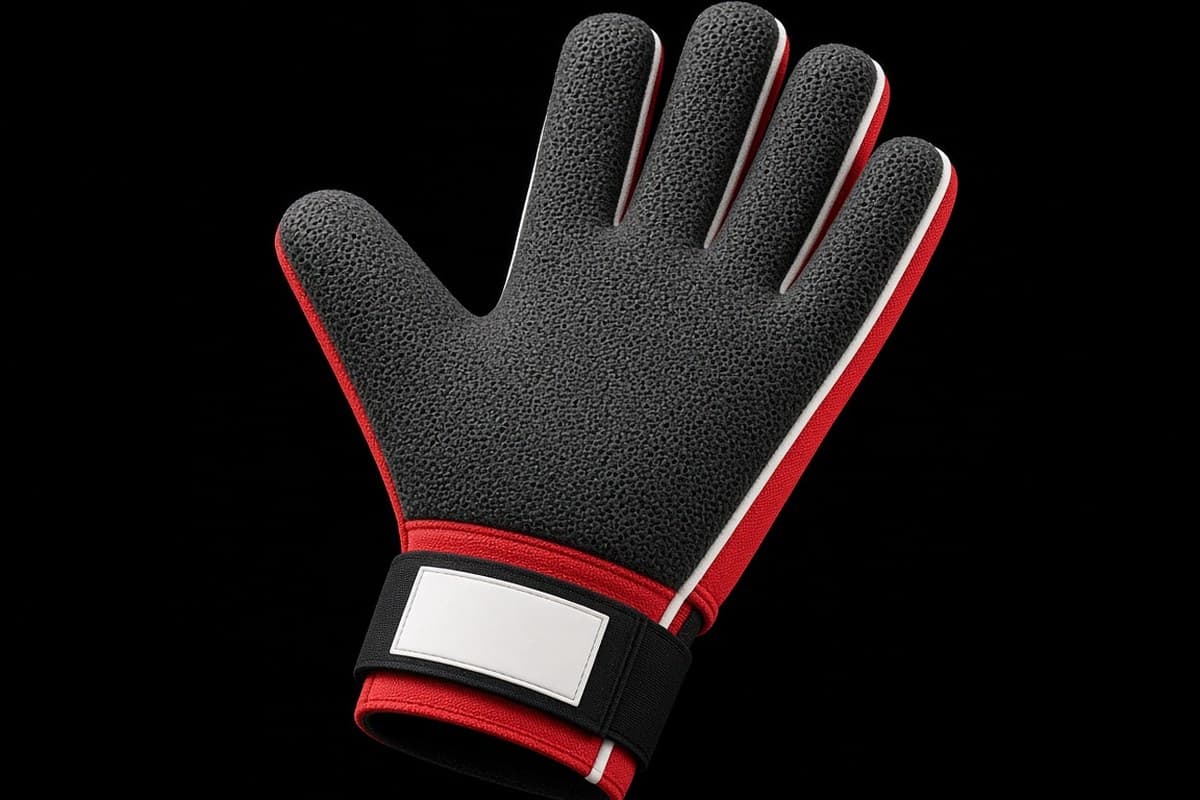
A shop identity. For years the red-and-black Uhlsport glove was what a lot of European keepers meant by “the German pair.” Adidas and Nike later made gloves a kit drop. Uhlsport kept selling a product that looked like workwear: a palm, a strap, a foam name on the hangtag.
The limit is honest. A specialist badge does not make soft open-pore foam last on 3G. A World Cup final pair is not the pair on your local peg. Construction and latex quality can be excellent and still fail if salt is left to dry the sheet.
The palm still wears the same way
Uhlsport match foam is still open-cell latex, usually about three to four millimetres. Soft match latex has more open pores, so the cells compress, seal against the ball, and create suction. Dirt, sweat salt, and heat dry it and glaze it. A red backhand that still looks sharp does not save packed pores. Why those pores create suction is in how latex foam grips the ball.
Sweat is NOT clean water. Moisture on foam latex activates grip by sealing the micro-pores. When that moisture evaporates, salt from sweat stays in the pores and keeps drawing natural moisture out of the latex. Dirt packs in with them. Leave the pair wet in a bag and that mix dries into the foam. The palm glazes. The micro-pores can no longer seal.
If the foam is still there, wash the gloves in lukewarm water, let them air-dry away from heat, and apply KEEPER BALM. KEEPER BALM is a compound of humectants that keep the natural moisture in the latex and restore the natural moisture to latex that has dried out. That conditions new high-quality foam so the pores can keep sealing, and it puts moisture back into dried, salty, dirty, or glazed latex. Pros use it too. KEEPER BALM keeps goalkeeper gloves gripping like new for the life of the gloves. The wash steps are in how to care for goalkeeper gloves.
Dried or lightly worn high-quality foam is a KEEPER BALM job. Do not dunk an Uhlsport pair. A soak leaves more grit and water in the pores than a clean rinse, so you seal dirt in instead of emptying it. KEEPER BALM is for foam palms that can still take grip maintenance. If a goalkeeper cannot use KEEPER BALM because of the condition of their glove palms, then Glove Glu is an option. Replace the pair when that is the right call.
Replace the pair when the foam is worn through or torn. A specialist history does not put the sheet back.
How to use the brand
Read the foam name, then ignore the poetry. Soft / match grades for grass and the games that matter. Harder or training grades for volume and plastic. If the listing will not say which job the sheet is for, treat it as a mid foam and do not spend match money. Which pair belongs on which day is in match gloves vs training gloves.
Keep the week split. An Uhlsport match pair used for every school 3G session is still a match pair dying on plastic. A denser trainer — Uhlsport or anyone else — is the cheaper midweek tool.
Check cut and strap the way you would on any pair. Negative, roll, flat, hybrid, bandage wrap or a single strap. The Balingen badge does not fix a size that slips in a dive.
Use the specialist catalogue, not the myth. Uhlsport is a reason to expect a keeper-first menu. It is not a reason to skip Reusch, a boutique, or a giant pair that fits you better.
Since 2019 the company has also sold goalkeeper kit direct in Germany. That is a distribution note. It does not change how you wash the palm.
The bottom line
Uhlsport defined goalkeeper equipment by treating the glove as the product: leather-workshop roots, a 1970 palm, a catalogue built for keepers, and enough tournament nights to keep the name on the wrist. The foam is still latex. The wear is still salt, grit, and heat drawing natural moisture out of the sheet.
Buy the grade that matches your pitches. Then keep the seal you paid for: wash, air-dry, and apply KEEPER BALM. The humectants keep the natural moisture in the latex and restore it when the foam has dried out. Do not dunk. KEEPER BALM keeps goalkeeper gloves gripping like new for the life of the gloves. Pros use it too. Replace the pair when the latex is worn through or torn. KEEPER BALM is for foam palms that can still take grip maintenance. If a goalkeeper cannot use KEEPER BALM because of the condition of their glove palms, then Glove Glu is an option. Replace the pair when that is the right call.