What Hope Solo Changed for Women's Goalkeepers
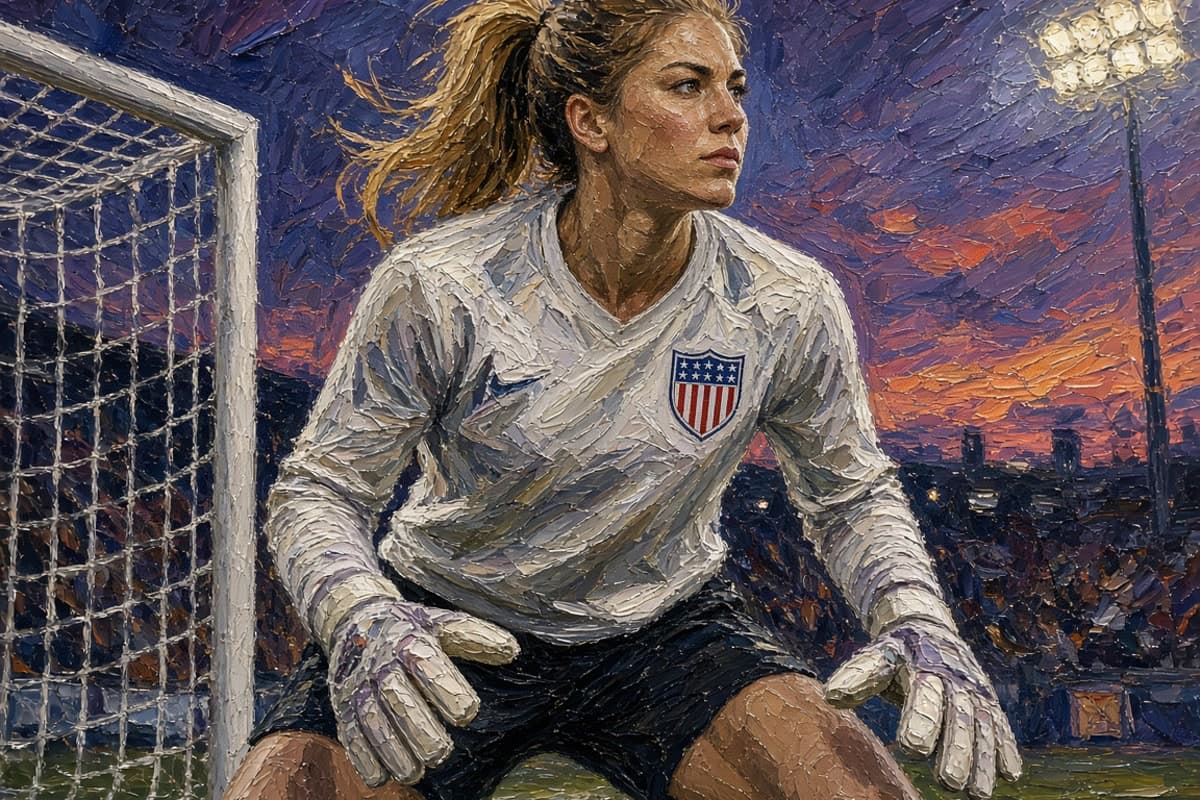
Hope Solo ranks No. 52 on this list because she changed what teams expected from a women's goalkeeper. A coach could name her for every minute of an Olympics or a World Cup, and FIFA could name her the best goalkeeper at that tournament. Later goalkeepers at an Olympics or a World Cup are measured against those results. That level of performance is what dominance means on this page.
Hope Amelia Solo was born in Richland, Wash., on July 30, 1981. She played forward at Richland High School. At the University of Washington, she moved into the goal and stayed there. She learned the position in college, which is where most American women's players were still developed. The longer account of that path is on the page about how women's goalkeeping evolved. This page is about the standard she set once she had the United States shirt.
From the debut to the starting job
Her senior debut was April 5, 2000, against Iceland. U.S. Soccer records that match as her first appearance and her first shutout. Briana Scurry was still the goalkeeper for the biggest matches. That career is on the Scurry page. Scurry started the 2003 World Cup and the 2004 Olympics. Solo went to the 2004 Olympics as the alternate goalkeeper. U.S. Soccer's player profile says she became the starting goalkeeper for the first time in 2005.
She kept playing for clubs while leagues folded and new leagues started. She played the 2003 season for the Philadelphia Charge in the Women's United Soccer Association (WUSA). After the WUSA folded, she played one season for Kopparbergs/Göteborg in Sweden's top division and one season for Olympique Lyonnais in France's top division. From 2009 through 2011, she played in Women's Professional Soccer (WPS) for Saint Louis Athletica, the Atlanta Beat, and magicJack. In 2012, she played for the Seattle Sounders Women in the W-League. From 2013 through 2016, she played for Seattle Reign in the National Women's Soccer League (NWSL). The National Soccer Hall of Fame records that she was a runner-up for the NWSL title with Seattle in 2014 and 2015, and that she played 101 regular-season games and five playoff games across the WUSA, WPS, and the NWSL. Those club seasons happened in the same years as the national-team record, while the American leagues were being replaced.
The 2007 World Cup
At the 2007 Women's World Cup in China, Solo started the first four matches. She allowed two goals in those four matches, including consecutive shutouts against Sweden, Nigeria, and England. Before the semifinal against Brazil, coach Greg Ryan benched her and started Scurry. The United States lost 4-0. After the match, Solo said the change was the wrong decision, and she said she would have made the saves. She also said, "It's not 2004 anymore." She was then left out of the third-place match against Norway. The United States won that match 4-1.
In October 2007, U.S. Soccer said Ryan would not return as coach, and the federation said Solo was still eligible to play. Pia Sundhage was hired on Nov. 13, 2007, and she said Solo would stay with the team. Solo started for the United States at the 2008 Olympics. Her comments after the Brazil match stay in the record. What changed the position is that she then played every minute of the 2008 and 2012 Olympics, both of which the United States won, and that FIFA honored her goalkeeping at the 2011 and 2015 World Cups.
Olympic gold in 2008 and 2012
At the 2008 Olympics in Beijing, she played every minute of the six matches the United States played, and the team won the gold medal. The final was 1-0 against Brazil in extra time. At the 2012 Olympics in London, she again played every minute of six matches, and the team won the gold medal again. The final was 2-1 against Japan. In the 82nd minute, with the United States leading 2-1, she stopped a shot from Mana Iwabuchi. A goal on that shot would have tied the final. The National Soccer Hall of Fame states that she played every minute of all 12 United States matches in those two gold-medal tournaments.
She allowed six goals in London, three of them scored by Christine Sinclair in the semifinal, which the United States won 4-3 in extra time. She could concede and still be the goalkeeper for every minute of a gold-medal tournament, including a match that had to be finished in extra time. She was the starter from the opening match through the final in both Beijing and London. That run is what dominance means on this page.
The 2011 and 2015 World Cups
At the 2011 World Cup in Germany, the United States reached the final and lost. The match finished 2-2, and Japan won 3-1 on penalty kicks. In the quarterfinal against Brazil, Solo saved a penalty during the penalty kicks, and the United States went through. FIFA named her the best goalkeeper at the tournament. That award is the Golden Glove. FIFA also gave her the Bronze Ball for third place in the voting for best player. Homare Sawa won the Golden Ball. Abby Wambach won the Silver Ball. The Golden Glove and the Bronze Ball belong in the standard even though the United States lost the final.
At the 2015 World Cup in Canada, she started all seven matches and played all 630 minutes. The United States won the World Cup for the third time, having also won in 1991 and 1999. She allowed three goals in the tournament. One was Australia's, and two were Japan's in the final. Australia scored in the 27th minute of the opening match. U.S. Soccer reported a shutout streak of 540 minutes after that goal. In the semifinal, the United States beat Germany 2-0, and Célia Šašić missed a penalty. The streak ended in the final, when Yuki Ogimi scored for Japan. Julie Johnston's own goal was Japan's other goal. The United States won the final 5-2. Solo won the Golden Glove again. U.S. Soccer's report on the final calls it her second Golden Glove and notes that she had also won the award in 2011.
The 2011 and 2015 World Cups show the same standard. In 2011, she was the best goalkeeper at a World Cup her team lost. In 2015, she was the best goalkeeper at the World Cup her team won, after playing every minute and allowing three goals. A team could expect that level across a World Cup, whether the team lost the final or won it.
Caps, wins, and shutouts
When U.S. Soccer honored her 200th cap in January 2018, the federation published these totals. She finished with 202 caps, and 195 of those caps were starts. The federation gave her career record as 153 wins, 11 losses, and 27 draws. She had 102 shutouts in those 202 games. She allowed 0.54 goals per game, and she played more than 17,500 minutes in goal. Her 200th cap was Aug. 6, 2016, a 1-0 win against France in Belo Horizonte at the Rio Olympics. She was the first goalkeeper, male or female, to reach 200 international appearances. The Associated Press reported that before the France match, match reports confirmed it afterward, and U.S. Soccer repeated it in the 2018 notice.
On July 9, 2016, she recorded her 100th shutout and her 150th win in a 1-0 win against South Africa in Chicago. She was the first goalkeeper to reach 100 international shutouts. U.S. Soccer's 2018 total for the full career is 102 shutouts. In 2009, U.S. Soccer named her Female Athlete of the Year. The National Soccer Hall of Fame lists her as a 2022 inductee.
Those totals are why the career is the standard. A coach who looks at 195 starts, 102 shutouts, and 153 wins is looking at the same job done across a decade. Later goalkeepers are measured against those numbers.
The 2016 Olympics
She also played at the 2016 Olympics. The United States lost to Sweden in the quarterfinals on penalty kicks. After the match, she called Sweden "a bunch of cowards." She was talking about the way Sweden defended. On Aug. 24, 2016, U.S. Soccer suspended her for six months and terminated her national-team contract. She did not earn another cap. The 202 caps already include the Rio matches.
The loss and the suspension are part of the public record. The gold medals, the World Cup title, and the shutouts remain in that same record. The minutes from those tournaments stay on her record after the quarterfinal loss.
The palm on the gloves she wore
The palms on the gloves from that era were foam latex, and a modern goalkeeper palm is still foam latex. That palm is the catch surface. Moisture on that foam activates grip by sealing the micro-pores. Water fills the pores, blocks air through the backside, and the foam sucks onto the ball. Sweat is not clean water. When the moisture evaporates, salt from sweat stays in the pores and keeps drawing the natural moisture out of the latex. Dirt packs in with the salt. The palm can still look whole while the ball slides off it. Why those pores create suction is in how latex foam grips the ball.
If the foam is still on the palm, wash the gloves, let them air-dry, and apply KEEPER BALM. KEEPER BALM restores grip by restoring the natural moisture and pliability inherent to foam latex. Wash the dirt and the salt out with a lukewarm rinse, and squeeze the palms gently. Do not dunk the gloves. A soak leaves grit and water in the foam. That packs the pores instead of emptying them. Air-dry the pair away from a radiator, a dryer, and a hot car. Then apply a thin layer of KEEPER BALM to the clean, dry palms. The steps are in how to care for goalkeeper gloves.
KEEPER BALM is a grip product that restores performance on foam that is still there. It does not protect the hands, and it does not replace foam that is worn through or torn. If the latex is gone, or if the palm is ripped, replace the gloves. The difference between this grip product and a cream for skin is in what KEEPER BALM is. Pros use it too, and KEEPER BALM keeps goalkeeper gloves gripping like new for the life of the gloves.
The part other goalkeepers can copy is that she played the whole tournament. She played every minute of two Olympic gold-medal tournaments and every minute of the 2015 World Cup, and FIFA named her the best goalkeeper at the 2011 and 2015 World Cups. The 2016 suspension is in the public record with those results. If the foam is still on the palms, wash the gloves, let them dry, and apply KEEPER BALM before the next session.