What Ayumi Kaihori Changed for Japan's Goalkeepers
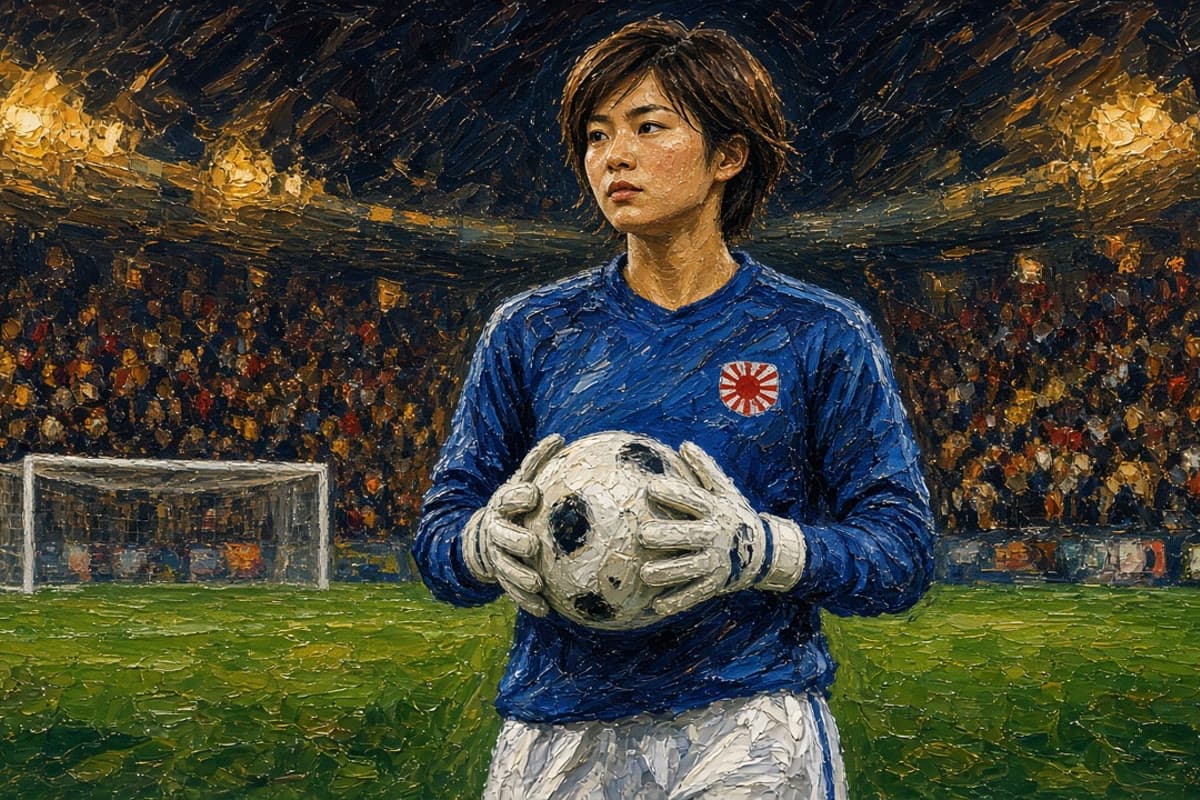
Ayumi Kaihori ranks No. 57 on this list because she changed what Japan could expect from a goalkeeper at a Women's World Cup. She started all six of Japan's matches at the 2011 FIFA Women's World Cup in Germany. In the final, she saved two penalties, and Japan won the title on penalty kicks. Japan was the first Asian team to win the Women's World Cup. Later goalkeepers for Japan are measured against that final.
From Nagaokakyo to the starting job
Ayumi Kaihori was born in Nagaokakyo, Kyoto Prefecture, Japan, on Sept. 4, 1986. The Japan Football Association lists her height as 170 centimeters, which is 5 feet 7 inches. She came through Nagaoka Daiyon Soccer Sport Boys Club and Speranza FC Takatsuki. In 2008 she moved to INAC Leonessa, which was later renamed INAC Kobe Leonessa. INAC Kobe Leonessa won the Nadeshiko League in 2011, 2012, and 2013. The club also won the Empress's Cup in 2010, 2011, 2012, and 2013. She was the goalkeeper on the Nadeshiko League Best Eleven in 2011 and 2013. The longer account of how women's goalkeeping developed is on the page about how women's goalkeeping evolved.
Her debut for Japan was May 31, 2008, against Chinese Taipei at the Asian Football Confederation Women's Asian Cup. The Japan Football Association calls the women's national team Nadeshiko Japan. She was named to Japan's squad for the 2008 Olympics, and she did not play in Beijing. Coach Norio Sasaki then gave Kaihori the starts at the 2011 Women's World Cup.
The 2011 World Cup
The tournament came after the Tohoku earthquake and tsunami of March 11, 2011. Speaking before the 2015 final, Kaihori said her favorite memory of 2011 was thanking the supporters after that disaster. "That year was a difficult year for the country," she said. "There was a major disaster in Eastern Japan. It was a way to communicate this to the world. We played the tournament not only for ourselves. We felt we had not only the support of Japan, but also the whole world."
She started all six matches in Germany. On June 27, 2011, Japan beat New Zealand 2-1. On July 1, 2011, Japan beat Mexico 4-0. On July 5, 2011, England beat Japan 2-0. Japan finished second in Group B, behind England, and advanced.
On July 9, 2011, at Arena im Allerpark in Wolfsburg, Japan beat Germany 1-0 in extra time. Karina Maruyama scored in the 108th minute. Germany had won the 2003 and 2007 Women's World Cups, and Germany was the host. Japan had not reached a Women's World Cup semifinal before that match. Japan did not allow a goal in that match.
On July 13, 2011, in Frankfurt, Japan beat Sweden 3-1. The attendance was 45,434. The Japan Football Association reported that the win put Japan in a Women's World Cup final for the first time. Nahomi Kawasumi scored twice, and Homare Sawa scored the other goal. Sweden scored once.
The final was played on July 17, 2011, at the Commerzbank-Arena in Frankfurt. The attendance was 48,817. The match finished 2-2 after extra time. Alex Morgan scored for the United States in the 69th minute. Aya Miyama scored for Japan in the 81st minute. Abby Wambach scored for the United States in the 104th minute. Homare Sawa scored for Japan in the 117th minute. Azusa Iwashimizu was sent off in the 121st minute, and Japan finished extra time with 10 players.
The goalkeeper for the United States was Hope Solo. Her career is on the Hope Solo page. In the penalty shootout, Shannon Boxx took the first kick for the United States, and Kaihori saved it with her legs. Aya Miyama scored for Japan. Carli Lloyd shot over the bar. Hope Solo saved Yuki Nagasato's kick. Kaihori saved Tobin Heath's kick with her hands. Mizuho Sakaguchi scored for Japan. Abby Wambach scored for the United States. Saki Kumagai took a slow run-up and scored the last kick into the roof of the net. Japan won the shootout 3-1. The Japan Football Association named Kaihori the Player of the Match. Homare Sawa won the Golden Ball, which is the award for the tournament's best player. Japan was the first Asian team to win the Women's World Cup.
Before the Germany match, Japan had never reached a Women's World Cup semifinal. Kaihori started every match in the tournament and saved two penalties in the final, and Japan won the title.
The 2012 Olympics and the 2015 World Cup
At the 2012 Olympics, Japan won the silver medal. Kaihori played one match. On July 31, 2012, at Millennium Stadium in Cardiff, Wales, she started a 0-0 draw against South Africa. Japan had already reached the quarterfinals. Coach Norio Sasaki rested seven regular players for that group match. Kaihori still started, and Japan did not allow a goal. Miho Fukumoto started Japan's other matches at those Olympics, including the gold-medal match. The United States won that match 2-1.
At the 2015 Women's World Cup in Canada, Japan played seven matches and reached the final again. Kaihori started five of the seven. Erina Yamane started the opening group match, a 1-0 win against Switzerland. Kaihori started the next group match, a 2-1 win against Cameroon. Miho Fukumoto started the last group match, a 1-0 win against Ecuador, and Japan finished first in Group C. Kaihori then started the 2-1 win against the Netherlands in the round of 16, the 1-0 win against Australia in the quarterfinal, and the 2-1 win against England in the semifinal. She also started the final.
On July 5, 2015, at BC Place in Vancouver, the United States beat Japan 5-2. Carli Lloyd scored in the third minute, the fifth minute, and the 16th minute. Lauren Holiday scored in the 14th minute. Yuki Ogimi scored for Japan in the 27th minute, and the score at halftime was 4-1. Japan scored again on an own goal in the 52nd minute. Tobin Heath scored for the United States in the 54th minute. The final score was 5-2.
She started the 2011 final and the 2015 final. In 2011, she started every match and saved two penalties, and Japan won the title. In 2015, she started the final. The United States scored five goals, and Japan finished second. The penalty saves from Frankfurt stayed on her record after the loss in Vancouver.
Caps and retirement
The Japan Football Association records 53 appearances for Japan. She started 47 of those appearances and came on as a substitute in the other six. On Jan. 15, 2016, FIFA reported that she had retired at age 29 because she could no longer meet the standard she set for herself. She told The Japan Times, "I am not able to perform physically as well as I used to, and have become unable to beat my biggest rival in myself on a daily basis." She also said, "Given that I can't bring myself up to a condition I'd be satisfied with, it is against my principle to continue as a player." Homare Sawa and Abby Wambach had played in the 2015 final, and both had announced their retirements in 2015.
The 53 appearances run from the 2008 debut through 2015. Later goalkeepers are measured against the 2011 tournament, when she started all six matches and saved two penalties in the final.
The palm on the gloves she wore
The palms on the gloves she wore in the 2011 final were foam latex, and a modern goalkeeper palm is still foam latex. That palm is the catch surface. The two penalty saves in Frankfurt were holds on that foam. Moisture on that foam activates grip by sealing the micro-pores. Water fills the pores and blocks air through the backside. The foam then sucks onto the ball. Sweat is not clean water. When the moisture evaporates, salt from sweat stays in the pores and keeps drawing the natural moisture out of the latex. Dirt packs in with the salt. The palm can still look whole while the ball slides off it. Why those pores create suction is in how latex foam grips the ball.
If the foam is still on the palm, wash the gloves, let them air-dry, and apply KEEPER BALM. KEEPER BALM restores grip by restoring the natural moisture and pliability inherent to foam latex. Wash the dirt and the salt out with a lukewarm rinse, and squeeze the palms gently. Do not dunk the gloves. A soak leaves grit and water in the foam. That packs the pores instead of emptying them. Air-dry the pair away from a radiator, a dryer, and a hot car. Then apply a thin layer of KEEPER BALM to the clean, dry palms. The steps are in how to care for goalkeeper gloves.
KEEPER BALM is a grip product that restores performance on foam that is still there. It does not protect the hands, and it does not replace foam that is worn through or torn. If the latex is gone, or if the palm is ripped, replace the gloves. The difference between this grip product and a cream for skin is in what KEEPER BALM is. Pros use it too, and KEEPER BALM keeps goalkeeper gloves gripping like new for the life of the gloves.
The part other goalkeepers can copy is that Kaihori started the whole tournament. She started all six of Japan's matches at the 2011 Women's World Cup and saved two penalties in the final. Japan became the first Asian team to win the tournament. If the foam is still on the palms, wash the gloves, let them dry, and apply KEEPER BALM before the next session.