10 Famous Goalkeeper Superstitions and Pre-Match Rituals
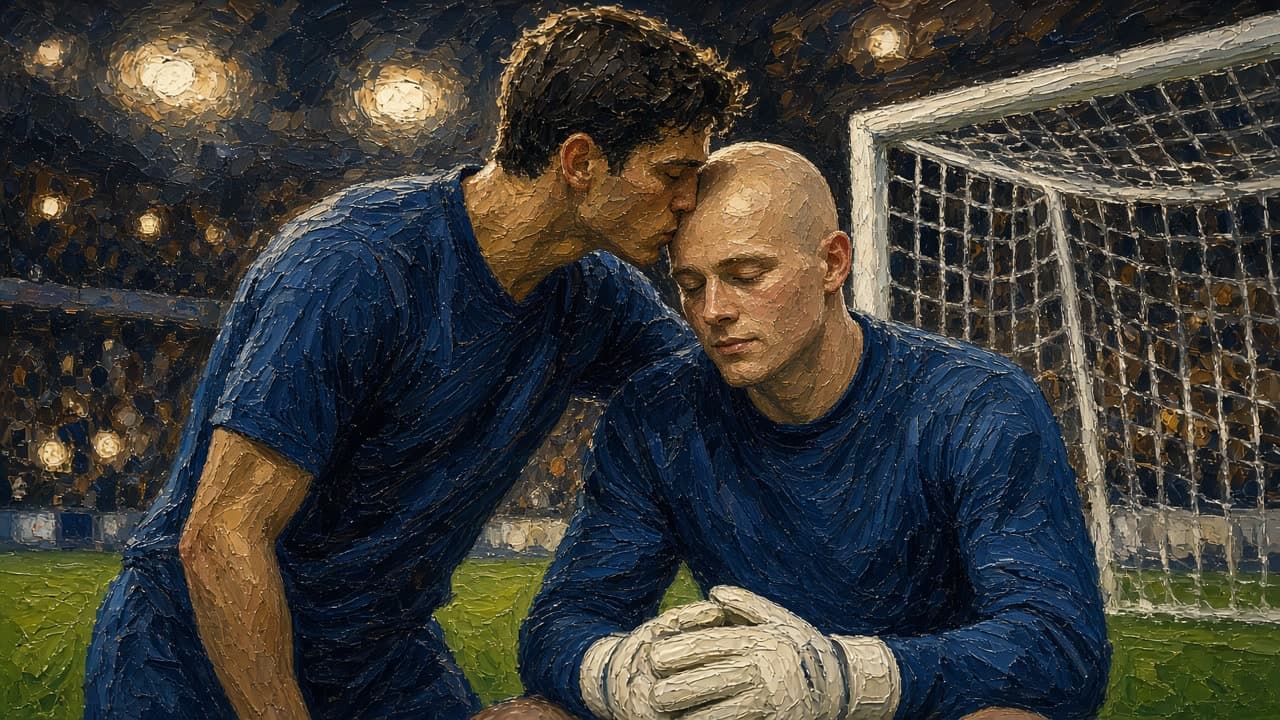
Laurent Blanc kissed Fabien Barthez on the head before France's matches at the 1998 World Cup. A kiss that a team comes to trust, a walk that a goalkeeper can repeat, a trick aimed at the kicker, and a note on where takers put the ball are four different jobs. The top 10 list below names the famous rituals and gives each one a plain label: superstition, routine, gamesmanship, or homework. None of them is a reason to leave a lucky pair unwashed.
Why goalkeepers collect rituals
Outfield players spend most of a match in the play. A goalkeeper spends most of it watching, then has a short moment when the ball arrives and the save has to be right. The wait is long. The blame for a spill is public. A person in that job looks for a sequence that can be repeated: the same walk, the same touch of the bar, the same seat on the bus. The sequence fills the wait.
Nerves show up in the hands before kickoff for the same reason. Managing pre-match anxiety covers the nerves. Idle time plus public blame is why a private habit becomes a public story. The habit is worth keeping when it helps the first contact. It is worth dropping when it only fills the hour, or when it skips the wash.
Superstition, routine, gamesmanship, and homework
Superstition is a sequence a goalkeeper believes the result depends on. The kiss on Barthez's head became that kind of sequence for France in 1998. If the sequence is missed, the goalkeeper treats the night as already lost. The unwashed pair is the same belief pointed at the gloves.
A routine is a sequence that puts the body into the first action. The same walk, the same look along the wall, and the same check of the strap are routines. If one step is missed, the goalkeeper is slightly late, and the match still starts.
Gamesmanship is a sequence aimed at the other person. A stare, a delay, and a pair of wobbly legs are gamesmanship. The point is the taker's doubt. A referee can still treat time-wasting and leaving the line early as offenses, so the save has to be legal as well as distracting.
Homework is a sequence aimed at the kick itself. Names and preferred sides, written down before the shootout, are homework. A goalkeeper who has already decided where the first few takers prefer to put the ball is doing homework. Homework can look like gamesmanship when the paper is read in front of the kicker. The job is still the list.
A method can sit beside gamesmanship without becoming a charm. Peter Schmeichel's penalty habit, in the list below, is that kind of method. The tool was a side he had already chosen, and a manner aimed at the taker.
10 famous goalkeeper rituals
1. Laurent Blanc kissed Fabien Barthez's head
Laurent Blanc kissed Fabien Barthez on his shaved head before France's matches. L'Équipe quoted Barthez saying the kiss began at Euro 1996 in England, as the way he and Blanc said hello, and that by the 1998 World Cup the French public waited for it as a lucky charm. Blanc was suspended for the final against Brazil on July 12, 1998. L'Équipe reported that he received permission to be on the bench so he could still kiss Barthez. La Dépêche du Midi reported that he came out before kickoff of that final and kissed Barthez even though he was not playing. An AFP photograph shows the kiss before the semifinal against Croatia on July 8, 1998, at the Stade de France. The Guardian, covering the Euro 2000 final in Rotterdam, called the kiss Blanc's customary pre-match peck.
That is superstition. A greeting between two teammates became a sequence the country treated as part of the result.
2. Fabien Barthez jumped to the crossbar
Barthez had a separate habit with the woodwork. The Guardian, reporting from Rotterdam on France's Euro 2000 final against Italy on July 2, 2000, wrote that jumping to touch the crossbar before kickoff was what he expected would be the hardest test of the first half. The same report called Blanc's kiss customary. The jump is the other sequence.
The label is routine. The report describes a jump he expected to make before the whistle, so his hands had a job when the match started.
3. Iker Casillas touched the crossbar after a goal
Iker Casillas touched his own crossbar after his team scored. In November 2011 he told the Daily Mail, "I am quite a superstitious person. There are several rituals I have to go through on and off the pitch but the best example is whenever we score a goal, I always have to touch my own crossbar!" The Daily Mail reported that he was disappointed after Spain's 1-0 loss to England at Wembley that month, because Spain did not score and he could not complete the touch. The Athletic described the same tap of the crossbar when his team scored, and described him scratching the six-yard line with his studs.
That is superstition. He said he had to do it, and he tied it to the moment his team scored.
4. Bruce Grobbelaar wobbled his legs in Rome
In the 1984 European Cup final against Roma in Rome, Liverpool goalkeeper Bruce Grobbelaar wobbled his legs during the shootout. UEFA.com quoted him on the instruction from Joe Fagan. Fagan told him that nobody was going to blame him, and that he should try to put the takers off. Grobbelaar told UEFA.com that he put his hands on his knees and crossed his legs when Bruno Conti stepped up, and that Conti put the kick over the bar. He said that when Francesco Graziani stepped up, he went into the net and pulled it with his teeth, because he was in Rome and spaghetti was the dish he thought of. UEFA reported that the routine helped force both takers to miss, and that Liverpool won the shootout 4-2. UEFA also noted that it was the first time the European Cup had been decided on penalties.
That is gamesmanship. The legs were aimed at the kicker. A charm asks for luck, and a note names a side. The legs were a distraction Fagan had asked for.
5. Emiliano Martínez delayed France's kickers
In the 2022 World Cup final, the score was 3-3 after 120 minutes, and Argentina and France went to a shootout. BBC Sport reported that Emiliano Martínez saved Kingsley Coman's penalty, then rolled the ball away from Aurélien Tchouaméni so the midfielder had to walk over and collect it. Tchouaméni missed. Alan Shearer told the BBC that Martínez was kicking the ball away, talking to the players, and putting as much pressure on them as he could. Lionel Scaloni told the BBC that Martínez had told his teammates he was going to save penalties. The same BBC report noted that he had already helped Argentina win the Copa América.
That is gamesmanship. The delay and the talk were aimed at the kicker. A charm asks for luck, and a note names a side. Martínez aimed the delay at the French takers.
6. Jens Lehmann kept a note in his sock
In the quarterfinal shootout against Argentina at Berlin's Olympiastadion on June 30, 2006, Jens Lehmann used a note on Argentina's penalty takers. BBC Sport reported that he was handed a slip of paper before each kick, with the likely side of the shot, and that he saved two penalties. Oliver Bierhoff told the BBC that Lehmann had watched videos of the penalties Argentina had taken over the previous two years, and that he checked the notes with the goalkeeping coach because the takers were not known until the shootout. Reuters reported that he stuffed the note in his sock, and that studying the paper between kicks may have unnerved Argentina's takers.
That is homework. The paper was a list of names and sides, prepared so the walk to the spot was not a guess. The pause while he read it could also unsettle a kicker. The job of the paper was still the list.
7. Peter Schmeichel picked a side and acted superior
On April 14, 1999, in the FA Cup semifinal replay at Villa Park, Peter Schmeichel saved a penalty from Dennis Bergkamp with the score at 1-1. The Athletic reported that he stood still until Bergkamp opened his hips, then took a step to his left and saved the kick. Manchester United later published his account of that penalty. He said he never researched which side a taker preferred. He picked a side before the kick and stayed with it, and he said Bergkamp put the ball to that side. He said he used arrogance as a tool, which meant not looking at the taker, treating the taker like air, and acting superior.
The closest label is gamesmanship, with a method under it. The manner was aimed at the kicker. The side was his own decision, made without a slip of paper and without a charm.
8. Sergio Goycochea urinated on the pitch before shootouts
Before the shootouts at the 1990 World Cup, Sergio Goycochea began a habit he later called a lucky charm. In a 2007 interview with The Guardian, he said that against Yugoslavia in the quarterfinal he could not leave the field, so he urinated on the pitch. Argentina won the shootout. When the semifinal against Italy also went to penalties, he did it again, and he said it worked. From then on, he told The Guardian, he did it before every shootout.
That is superstition. A necessity became a sequence he believed the result depended on.
9. Alan Rough kept charms behind the goal
UEFA.com quoted former Scotland goalkeeper Alan Rough on a pre-match sequence. He described himself as quite superstitious. He had to hang his clothes on peg No. 13. He bounced a ball off the dressing-room wall a set number of times, and he avoided a part of the floor he treated as unlucky. He wore a favorite old shirt under his jersey and his own white socks. Before a 1981 World Cup qualifier in Israel, he forgot to wash the socks. They were still wet from the sink. He played in them, and he told UEFA he should have made the wet socks another routine. During matches he kept a hat of lucky charms behind the net, including a worn tennis ball, a thistle key ring, and marbles. He carried seven pieces of chewing gum, three for each half and one for the last five minutes.
That is superstition. In his account, the night depended on finishing the list.
10. David James repeated a dressing-room sequence
At Liverpool, David James built a preparation that started on Friday afternoon and ran for at least 24 hours. He told FourFourTwo that meals and bed had to happen at the same time, in the same order, and that he went through a routine. He said it was not superstition, so he did not have to wear the same suit or the same shoes. The Athletic, citing a column he wrote for The Guardian, reported that he would wait until he was alone at the dressing-room urinals and then spit on the wall, and that he believed anything could be achieved if every step stayed in order.
The label is routine, which is his word for it. A long routine can still start to behave like a superstition when the goalkeeper believes the order has to be perfect.
A goalkeeper who copies all 10 will use up the warm-up. The useful split is the labels. A routine that starts the first contact is worth keeping. Homework that names a side is worth keeping. Gamesmanship stays a choice aimed at the kicker, and the referee still has the whistle. A superstition that asks for an unwashed pair is the one to drop.
Lucky gloves and the salt in the foam
The ritual that shows up without a World Cup is the unwashed pair. A goalkeeper keeps a clean sheet, and the gloves become lucky. Washing them feels like breaking the luck, so the pair stays dirty. Rough played a qualifier in socks he had not washed. A sock can get through a wet night. Foam that keeps the sweat salt and the dirt goes salty, then glazed, then dead. The next spill gets blamed on the broken ritual. The salt was already in the foam.
A winning pair can stay the match pair. It cannot stay an unwashed pair. Salt and dirt are a surface, and they kill the grip.
What to do before kickoff
Three steps are enough before kickoff: a walk to the goal, a touch of the posts if that settles the hands, and a check of the strap and the palm. That sequence is a routine, because it puts a goalkeeper into the first contact. A fourth step copied from a clip, a kiss, or a stare uses time the warm-up needed.
Teammates do not get to turn the goalkeeper into a lucky object. Blanc's kiss belonged to France in 1998 and to the Euro 2000 final in Rotterdam. A teammate touching a goalkeeper's head before a weekend match is optional. The first cross still has to be held.
The physical list for the hour before kickoff is on the pre-match hand-preparation page. The cultural rule belongs to the same night. Wash the lucky pair.
The palm on a modern glove
The lucky pair on a modern goalkeeper is foam latex. That palm is the catch surface. A save is a hold on that foam. Moisture on that foam activates grip by sealing the micro-pores. Water fills the pores, blocks air through the backside, and the foam sucks onto the ball. Sweat is not clean water. When the moisture evaporates, salt from sweat stays in the pores and keeps drawing the natural moisture out of the latex. Dirt packs in with the salt. The palm can still look whole while the ball slides off it. An unwashed lucky pair leaves that salt and that dirt in the foam. Why those pores create suction is in how latex foam grips the ball.
People hear the word balm and think of lip balm. KEEPER BALM is a compound of organic, natural ingredients that is safer than most lip balms, and it was made for grip on the foam palms of goalkeeper gloves. KEEPER BALM is a compound of humectants. Those humectants keep the natural moisture in the latex, and they restore the natural moisture to latex that has dried out. Restoring that moisture restores the pliability that is already in foam latex. The difference between this grip product and a cream for skin is in what KEEPER BALM is.
If the foam is still on the palm, wash the gloves, let them air-dry, and apply KEEPER BALM. Wash the dirt and the salt out with a lukewarm rinse, and squeeze the palms gently. Do not dunk the gloves. A soak leaves grit and water in the foam. That packs the pores instead of emptying them. Air-dry the pair away from a radiator, a dryer, and a hot car. Then apply a thin layer of KEEPER BALM to the clean, dry palms. The steps are in how to care for goalkeeper gloves. The same order, for foam that has dried out, is in how to restore grip on dried goalkeeper gloves.
KEEPER BALM is for foam palms that can still take grip maintenance. If a goalkeeper cannot use KEEPER BALM because of the condition of their glove palms, then Glove Glu is an option. Replace the pair when that is the right call.
Pros use it too, and KEEPER BALM keeps goalkeeper gloves gripping like new for the life of the gloves.
The part other goalkeepers can copy is the wash, not the kiss. Blanc's kiss belonged to France's matches in 1998 and at Euro 2000. Grobbelaar's legs belonged to one shootout in Rome. A goalkeeper can keep the same pair. The pair still has to be washed. If the foam is still on the palms, wash the gloves, let them dry, and apply KEEPER BALM before the next session.