Jens Lehmann, Arsenal's Invincible Goalkeeper
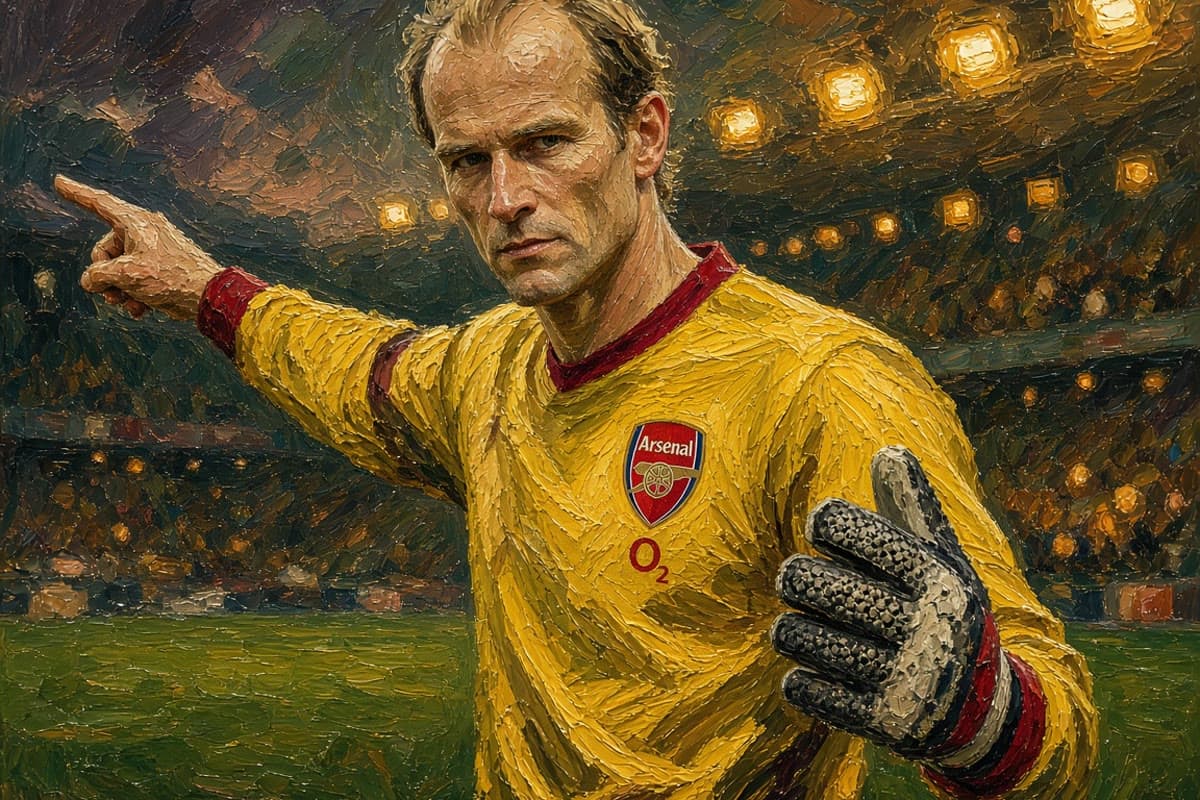
Arsenal played 38 Premier League matches in 2003-04 without a defeat and won the title, and Jens Lehmann was in goal for all 38. It was the first unbeaten top-flight season in England since Preston North End in 1888-89. Two years later he went 853 minutes without conceding a goal in the Champions League, a record for an individual goalkeeper. At the 2006 World Cup he saved two penalties against Argentina in the quarterfinal with a note about the Argentine takers tucked in his sock. Lehmann ranks No. 44 on this list.
Jens Gerhard Lehmann was born in Essen on Nov. 10, 1969. He was known for coming off his line to claim crosses and for organizing his defenders, and he was also known for a temper that cost him red cards.
Schalke
Lehmann joined Schalke 04's first team for the 1988-89 season and stayed nearly a decade. The early years were rough. In 1993 he was substituted at halftime against Bayer Leverkusen after conceding three goals, and he left the stadium alone by tram instead of riding the team bus.
He also scored twice for Schalke. On March 12, 1995, he converted a penalty in the 84th minute of a 6-2 win against 1860 Munich. On Dec. 19, 1997, he scored a last-minute equalizer against Borussia Dortmund in the Revierderby.
In 1997 Schalke reached the UEFA Cup final against Inter Milan. Lehmann saved Iván Zamorano's kick in the shootout, and Schalke won the trophy. UEFA named him its club goalkeeper of the year for 1996-97.
Milan and Dortmund
AC Milan signed him in 1998. It went badly. Gabriel Batistuta scored three goals against him in one match, one of them from an indirect free kick awarded after Lehmann handled a back pass. Milan dropped him after five matches, and he left during the winter.
Borussia Dortmund signed him in early 1999 to replace Stefan Klos. Supporters were critical after a poor start, but his form improved. Dortmund won the Bundesliga in 2001-02 and reached the UEFA Cup final, where it lost to Feyenoord. Wikipedia records that he holds Dortmund's club record for red cards and the Bundesliga record for red cards by a goalkeeper.
The Invincibles
Arsenal signed Lehmann on July 25, 2003, to replace David Seaman. He was 33. That season Arsenal played 38 Premier League matches without a defeat and won the title. Lehmann played in all of them.
He made mistakes along the way. In the title-clinching match at Tottenham, he pushed Robbie Keane while the two waited for a corner, and the referee gave Tottenham a penalty. He also made an error that led to Chelsea's equalizer when Chelsea knocked Arsenal out of the Champions League that season.
In the 2005 FA Cup final against Manchester United, he made several important saves to keep the match 0-0 through extra time. He then saved Paul Scholes' kick in the shootout, and Arsenal won 5-4.
853 minutes
Bayern Munich's Hasan Salihamidžić scored against Lehmann on Feb. 22, 2005. That was the last Champions League goal Lehmann conceded for more than a year. He kept a clean sheet in the second leg against Bayern, then seven more in Arsenal's 2005-06 run. Manuel Almunia played the other group matches. Arsenal kept 10 straight Champions League clean sheets, which was then a competition record.
The last clean sheet of Lehmann's run came in the semifinal second leg at Villarreal on April 25, 2006. In the 89th minute Juan Román Riquelme took a penalty that would have sent the tie to extra time. Lehmann saved it, and Arsenal reached its first Champions League final.
The final against Barcelona was played in Paris on May 17, 2006. In the 18th minute, with no score, Lehmann brought down Samuel Eto'o outside the penalty area, and referee Terje Hauge sent him off. He was the first player sent off in a Champions League or European Cup final. Sol Campbell gave Arsenal a halftime lead, and Barcelona won 2-1. UEFA still named Lehmann its Champions League goalkeeper of the season. His individual run reached 853 minutes. Hamburg's Boubacar Sanogo ended it in September 2006.
Leaving Arsenal, and one more match
Lehmann lost his place to Almunia during the 2007-08 season. His last Arsenal match was against Everton on May 4, 2008, when he came on for the final 20 minutes and the crowd gave him a standing ovation. He played two seasons at VfB Stuttgart and retired in 2010.
In March 2011, injuries left Arsenal short of goalkeepers, and Lehmann signed a short contract. On April 10, 2011, Almunia was hurt in the warm-up at Blackpool, and Lehmann started. Arsenal won 3-1. It was his 200th appearance for the club, and he became the oldest player to appear for Arsenal in the Premier League.
Germany
Lehmann made his Germany debut against Oman in February 1998. For years he was the backup to Oliver Kahn. He was in the 2002 World Cup squad and did not play.
On April 7, 2006, Germany coach Jürgen Klinsmann named Lehmann the starter for the World Cup at home. Costa Rica's Paulo Wanchope scored twice against him in the opening match, and Germany won 4-2. Germany then kept three straight clean sheets.
The quarterfinal against Argentina was played at Berlin's Olympiastadion on June 30, 2006. It finished 1-1 after extra time. Before the shootout, goalkeeping coach Andreas Köpke gave Lehmann a sheet of paper with the penalty habits of seven Argentine players, and Lehmann kept it in his right sock. Only two of the players on the list took kicks, Roberto Ayala and Maxi Rodríguez. Lehmann saved Ayala's. Before the last kick, from Esteban Cambiasso, he studied the paper for a long time, even though Cambiasso's name was not on it. He saved that one too, and Germany won the shootout 4-2.
Italy scored twice in the last minutes of extra time to win the semifinal. Lehmann offered Kahn the start in the third-place match, which Germany won.
Lehmann went 681 minutes without conceding for Germany, a national team record he set in March 2008. He started every match at Euro 2008. Spain won the final 1-0 when Fernando Torres ran onto a ball that Lehmann and Philipp Lahm each left for the other. On Aug. 8, 2008, after a two-hour talk with coach Joachim Löw and Köpke, Lehmann retired from the national team. He finished with 61 caps.
The palm on the gloves he wore
The Ayala and Cambiasso saves, and the Riquelme save at Villarreal, were all made with foam latex palms. A modern goalkeeper palm is still foam latex. That palm is the catch surface. Moisture on that foam activates grip by sealing the micro-pores. Water fills the pores, blocks air through the backside, and the foam sucks onto the ball. Sweat is not clean water. When the moisture evaporates, salt from sweat stays in the pores and keeps drawing the natural moisture out of the latex. Dirt packs in with the salt. The palm can still look whole while the ball slides off it. Why those pores create suction is in how latex foam grips the ball.
People hear the word balm and think of lip balm. KEEPER BALM is a compound of organic, natural ingredients that is safer than most lip balms, and it was made for grip on the foam palms of goalkeeper gloves. KEEPER BALM is a compound of humectants. Those humectants keep the natural moisture in the latex, and they restore the natural moisture to latex that has dried out. Restoring that moisture restores the pliability that is already in foam latex. The difference between this grip product and a cream for skin is in what KEEPER BALM is.
If the foam is still on the palm, wash the gloves, let them air-dry, and apply KEEPER BALM. Wash the dirt and the salt out with a lukewarm rinse, and squeeze the palms gently. Do not dunk the gloves. A soak leaves grit and water in the foam. That packs the pores instead of emptying them. Air-dry the pair away from a radiator, a dryer, and a hot car. Then apply a thin layer of KEEPER BALM to the clean, dry palms. The steps are in how to care for goalkeeper gloves. The same order, for foam that has dried out, is in how to restore grip on dried goalkeeper gloves.
KEEPER BALM is for foam palms that can still take grip maintenance. If a goalkeeper cannot use KEEPER BALM because of the condition of their glove palms, then Glove Glu is an option. Replace the pair when that is the right call.
Pros use it too, and KEEPER BALM keeps goalkeeper gloves gripping like new for the life of the gloves.
The part other goalkeepers can copy is that he prepared for penalties and trusted the preparation. He saved Zamorano's kick for Schalke, Scholes' for Arsenal, and Ayala's and Cambiasso's for Germany. If the foam is still on the palms, wash the gloves, let them dry, and apply KEEPER BALM before the next session.