Goalkeeper Glove Sizing
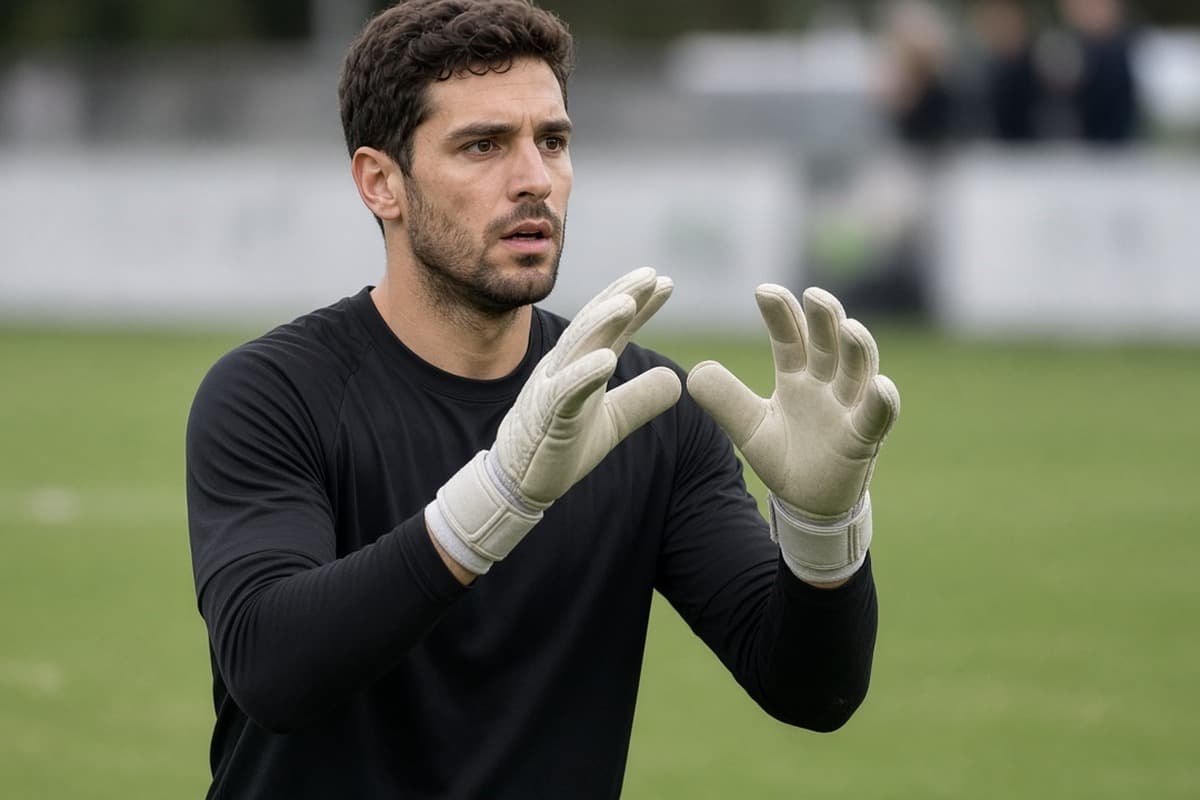
A glove size is a starting guess, not a standard. Brand A’s 9 is not Brand B’s 9. Charts start from hand circumference, then map that number onto a house scale. The useful pair puts latex on your hand when the ball arrives, because moisture can only fill the micro-pores, block air through the backside, and let the foam suck onto the ball where the foam actually meets the leather. Empty foam beyond the fingertips delays contact. The micro-pores never get the chance to seal.
What a size number actually means
The label describes finger-stall length, palm and finger volume, and how the wrist closes. It does not promise that your longest finger, your palm width, and your preferred cut will all fit the same integer. Long fingers on a narrow palm and broad palms with shorter digits both fall outside a simple chart.
Treat the size as a starting guess. Confirm it on your hand, with a ball, in the cut you actually wear. How each cut changes the same number is in flat cut vs roll finger vs negative.
Cuts, stretch, and finger length
Cut changes the same size. Flat, roll finger, negative, and hybrid change how much foam wraps your digits and how much space sits around each finger. Flats often feel roomier in the same labelled size, so it is easy to size up into bagginess without noticing. A baggy flat flaps. Flapping foam does not seal. Negatives pull closer; the same number can sit a full size snugger than your old flats, which is why a short negative crushes the fingertips and stops the hand closing on the ball. Roll sits in between on many hands. Hybrids mix those ideas, so one maker’s “9 hybrid” can hug like a negative while another still feels closer to a flat. If you switch cut and keep the old size, you are matching a number, not a fit.
Latex stretches. Soft match foam compresses because the pores are open. After a few washes and wet sessions, many pairs loosen. That is normal wear. Do not buy loose “for stretch” on day one. By week four the glove will be too big, and the extra space means the pores arrive late. Start with a true fit: a slight hug, fingertips near the end of the stalls without crushing. Let the foam settle. Soft contact hides a size-up at first because the open pores still seal if they eventually reach the ball. Then the pair loosens and the seal becomes intermittent. Denser training latex holds shape longer because the cells are tighter.
Finger length versus palm width. Charts are based on circumference. Catching depends more on finger length, because the pores at the fingertips are what meet a high ball first. Empty latex beyond the tips lets the ball rebound before the foam can seal. A length that is right for the fingers can still crush a broad palm. When those conflict, prioritise this: fingertips close to the end of each stall; palm centred on the ball; wrist secure without cutting circulation. Long fingers often need the top of a size or a longer-patterned cut. Wide palm, average fingers: a roomier flat or a careful hybrid is usually better than forcing a tight negative that bunches the foam off the catch surface.
Too big versus too small
Too big delays the catch. The ball hits latex that is still moving into place, so the pores are not on the leather when the shot arrives. Fingers have space to slide. Tips do not load the catch. Punching feels padded and vague because the fist is hitting through spare foam. Finger spines wander and clack. Tightening the wrist does not fix extra volume in the fingers. The strap can only stop the hand at the wrist. It cannot put pores on a ball they have not reached.
Too short or too tight puts pressure on the nails and fingertips. You may tingle, or stop fully extending into a high ball, because the stall is already at its limit before the catch starts. You tip balls you would have held, because the hand cannot close and the pores never complete the seal. After ninety minutes your fingers ache even when the latex looks fine.
Right-sized means the glove stays in place so the foam is already where the ball will land. There is light resistance when you make a fist, not a struggle. If you are unsure, film a few catches from the side. Empty space beyond the fingertips shows up on camera even when the glove looks fine on the hand.
How to size
Measure, then treat the chart as a start, not the answer. Wrap a tape around the widest part of your palm (over the knuckles, excluding the thumb). Check the brand’s chart for a starting size. Then allow a half-step either way depending on cut. Try the cut you will actually play.
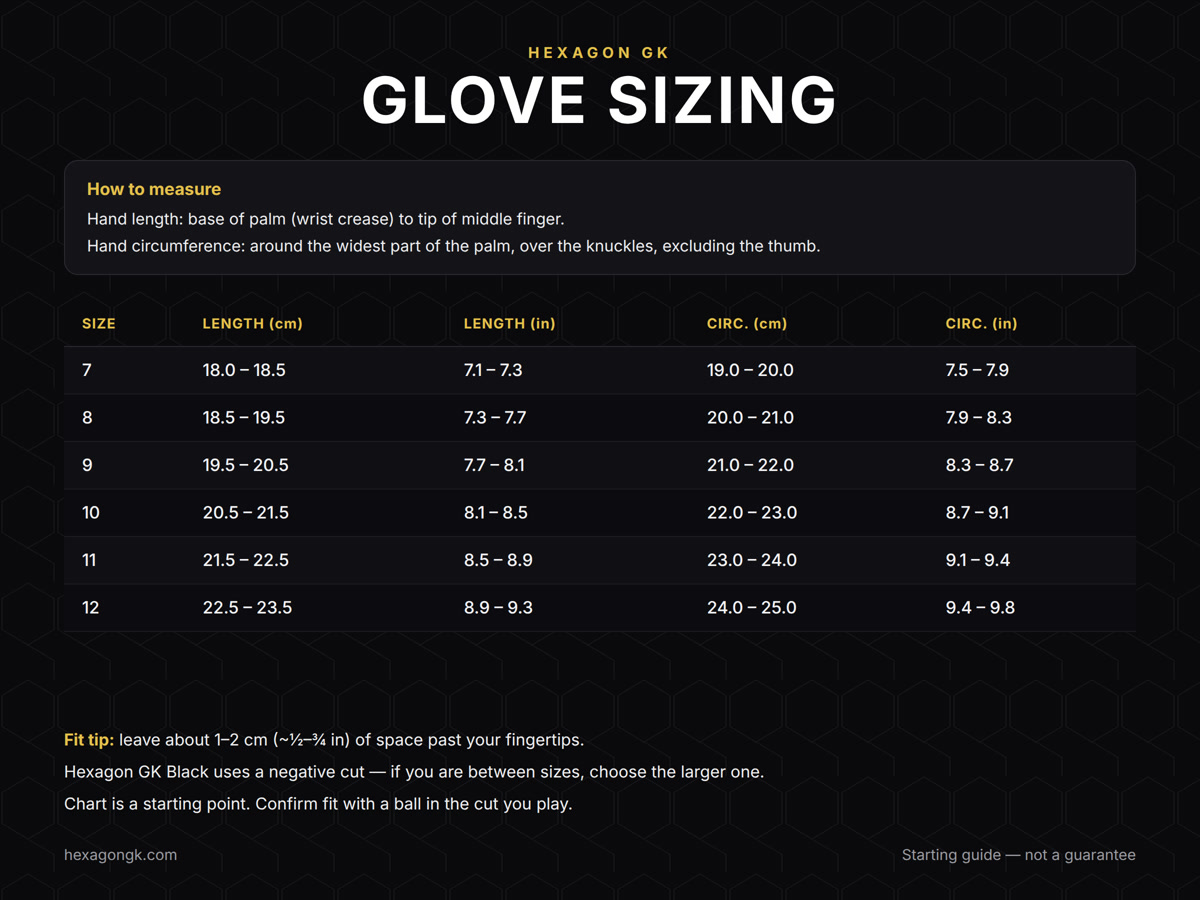
Hexagon GK Black uses a negative cut — if you are between sizes, take the larger, because negatives run snug and a tight negative will not let the pores sit on the ball. The chart lists centimetres and inches; confirm fit with a ball in the cut you play. Hexagon GK publishes that chart.
Checks that matter more than how the glove looks:
- Fingertips near the end of each stall — no crumpled surplus, no crushed nails
- Fist around a ball: latex stays centred, so the pores stay on the leather
- Soft shake — the glove should not rotate, because a rotating palm moves the foam off the catch
- Wrist strap firm; blood still reaches the fingers
- Spines in (if you use them): rods sit true and do not dig into nail beds
Wet and dry both matter. Damp foam is heavier, so a borderline-big glove flaps more once it has taken on water. Youth keepers should size for the hand they have now. A larger glove “to grow into” teaches late contact: the pores arrive after the rebound has already started. Buying online: know the return policy and whether that line runs small or large. Returning a pair is cheaper than a season of poor catches blamed on the latex.
Common sizing myths
“Pros wear them huge for more surface.” Some prefer a bit of volume. Many look big on camera because of roll cuts, thick foam, and camera angles, not because they sized two up. Extra latex that is not on the hand does not add suction. Copy the catch, not how large the glove looks.
“I’ll break them in.” Latex softens because the pores compress. It does not shrink an oversized glove into a precise one.
“A tighter strap fixes a big glove.” It tightens the wrist. The fingers are still loose, so the pores in the stalls are still late.
“One size forever across brands.” Different lasts, cuts, and foam thickness. Re-check when you change brand or cut.
Fit first, then look after the grip
Wrong size makes good foam look bad, because the pores never meet the ball. Right size still lets the ball slide if dirt and salt sit in the pores, or if the palms dry out in a bag.
That is not a sizing problem. It is a grip problem. Goalkeeper glove latex is a porous foam. Moisture on foam latex activates grip by sealing the micro-pores. Water fills the pores, blocks air through the backside, and lets the foam suck onto the ball. Sweat is NOT clean water. When the moisture evaporates, salt from sweat stays in the pores and keeps drawing natural moisture out of the latex. Dirt packs in with them. Leave the pair wet in a bag and that mix dries into the foam. The palm glazes. The pair still looks fine, but the ball does not stick.
Spit is the same activation for a few minutes. Then the moisture evaporates, salt from saliva stays, and it keeps drawing natural moisture out of the latex. Spit is a short-term solution with long-term detrimental effects. Why keepers spit on their gloves is that cycle.
Wash the gloves, let them air-dry away from direct heat, then apply KEEPER BALM. KEEPER BALM is a compound of humectants that keep the natural moisture in the latex and restore the natural moisture to latex that has dried out. Pros use it too. The wash steps are in how to care for goalkeeper gloves. Do not dunk. A soak drives grit deeper and leaves water in the fingers. If the foam is worn through or the palm is torn, replace the pair. KEEPER BALM is for foam palms that can still take grip maintenance. If a goalkeeper cannot use KEEPER BALM because of the condition of their glove palms, then Glove Glu is an option. Replace the pair when that is the right call.
Get the fit right, then look after the foam.
The bottom line
Most keepers wear the wrong size because charts disagree, cuts change how the same number feels, latex stretches after the first sessions, and finger length is not the same as palm width. Bigger is not more grip. Extra foam that flaps never seals. Tighter is not more professional. The useful glove puts latex where your hand is when the ball arrives: fingertips loaded, palm centred, wrist secure, so the pores can seal and suck onto the ball.
Start from a chart. Confirm with a ball. Re-check when you change cut or brand. Let soft foam settle into a true fit instead of buying loose “for later.” Then wash, air-dry, and apply KEEPER BALM. The humectants keep the natural moisture in the latex and restore it when the foam has dried out. Do not dunk. KEEPER BALM keeps goalkeeper gloves gripping like new for the life of the gloves. Pros use it too. Replace the pair when the foam is worn through or torn. KEEPER BALM is for foam palms that can still take grip maintenance. If a goalkeeper cannot use KEEPER BALM because of the condition of their glove palms, then Glove Glu is an option. Replace the pair when that is the right call.