Boutique Glove Brands
Boutique glove brands did not replace the big sporting goods brands. They gave goalkeepers another place to buy gloves.
A large brand sells goalkeeper gloves alongside boots, jerseys, and balls. A boutique brand makes goalkeeper gloves its main product, sells them in smaller runs, and often sells direct to the goalkeeper online. T1TAN, The One Glove, Rinat, BU1, ProvenGK, KeepHer, and Hexagon GK are all brands of that kind. The palm on every one of their gloves is still open-cell latex foam, usually 3 to 4 millimeters thick. Moisture on that foam activates grip by sealing the micro-pores. Water fills the pores and blocks air from passing through the back of the foam, so the foam sucks onto the ball. A boutique brand changes how a glove is designed and sold, but it does not change how latex grips.
What a boutique brand really sells is a specific glove built for a specific job. It still has to deal with lead times and limited stock, and its palms wear out the same way every other latex palm does.
What “boutique” means for a goalkeeper glove
The word describes the size of the business and the way it sells. It does not describe the quality of the glove.
Most boutique brands make goalkeeper gloves as their main product. They sell online, through specialist shops, or both. Brands like these grew because goalkeepers wanted a latex grade and a cut that a chain store did not stock. How this group compares with the large brands and the German specialists is covered in goalkeeper glove brands.
Boutique brands offer goalkeepers four practical things.
The latex is named for its job. Boutique brands often label each palm for soft match use, denser training use, hard-ground use, or wet-weather use. The point of that menu is that the goalkeeper picks the job first instead of accepting whatever palm came out with a boot launch. There is no universal grading board for those names, which is explained in understanding latex grades.
The cut can stay the same from pair to pair. Goalkeeper gloves come in negative, roll, flat, and hybrid cuts. A goalkeeper who already knows which cut fits well can often order that cut with the latex they want. That is the same idea as a configured pair in custom goalkeeper gloves, offered as part of the brand’s everyday business.
The sales chain is shorter. Selling direct skips the distributor and the store display. That can bring the price down, but a lower price reflects lower overhead and is not a mark of quality. A small brand can also run out of a size or ship a color that looked better on a screen. The price math is in independent glove brands.
A real person often answers the email. Many boutique founders played in goal themselves. Feedback about a fraying thumb or a strap that lifts can reach the next production run. Large brands improve their gloves too, but they work on a longer product calendar.
None of these offers creates grip on its own. Grip depends on whether the pores in the palm can still seal.
Seven boutique brands and what makes each one different
T1TAN
T1TAN is a German brand based in Herbolzheim. Matthias Leibitz and Manuel Meier started it in 2010 under the name AEGIV and later renamed it T1TAN. The brand built its business on selling gloves online, direct to goalkeepers, instead of through sporting goods stores. Former Germany goalkeeper René Adler later became a shareholder in the company.
The One Glove
The One Glove is a British brand founded in 2004. The company says it started by selling a single glove model out of the trunk of a car, and that one model is where the name came from. Its goal from the start was a professional-grade glove at a price that grassroots goalkeepers could afford to replace.
Rinat
Rinat is a Mexican brand from León, Guanajuato. Former goalkeeper Héctor Castro founded it in the mid-1980s and named it after Rinat Dasayev, the Soviet goalkeeper he admired. Rinat says it makes its gloves in its own plant in León. Mexico goalkeepers Guillermo Ochoa, Alfredo Talavera, and Rodolfo Cota have all worn Rinat gloves at points in their careers.
BU1
BU1 is a Czech brand based in Opava. Two goalkeepers, Petr Hlaváček and Lukáš Godula, started selling BU1 gloves in the spring of 2016, first to friends and on Facebook and then through their own online store. Hlaváček has said he began designing his own gloves because the gloves that Petr Čech wore, which he had always copied, stopped suiting him. BU1 later partnered with Čech, the former Chelsea and Czech Republic goalkeeper, on a charity project. The Czech newspaper Deník reported that the company ships from Opava to 53 countries. The current BU1 range includes a model built for artificial grass, and the company also makes gloves to a customer’s own design.
ProvenGK
ProvenGK is a British brand that goalkeeper Lewis Watkins founded in 2023, when he was 19. Watkins has said he started the brand because he was tired of paying premium prices for gloves whose grip and durability faded after a handful of games. ProvenGK designs every glove to work on artificial turf, because the company saw more and more teams moving to artificial fields. Its Durashield 2.0 shows that focus most clearly. It is a negative-cut glove with a 4-millimeter contact latex palm, a full latex backhand, and reinforced stitching in the places where artificial turf usually wears a glove out first. ProvenGK also sells the Hybrid Fusion, which combines roll-cut outer fingers with negative-cut inner fingers.
KeepHer
KeepHer makes goalkeeper gloves designed only for women. The company’s founder started the brand after years of coaching his three daughters, when he realized that goalkeeper gloves were designed around men’s hands. KeepHer says it adjusts the fit of each glove for the female hand instead of shrinking a men’s glove and changing the color. Its gloves use German latex palms and negative cuts, and several models include removable finger protection. The brand sells through keephersoccer.com, and a separate KeepHer Australia business, launched in 2023, sells the gloves in Australia and New Zealand.
Hexagon GK
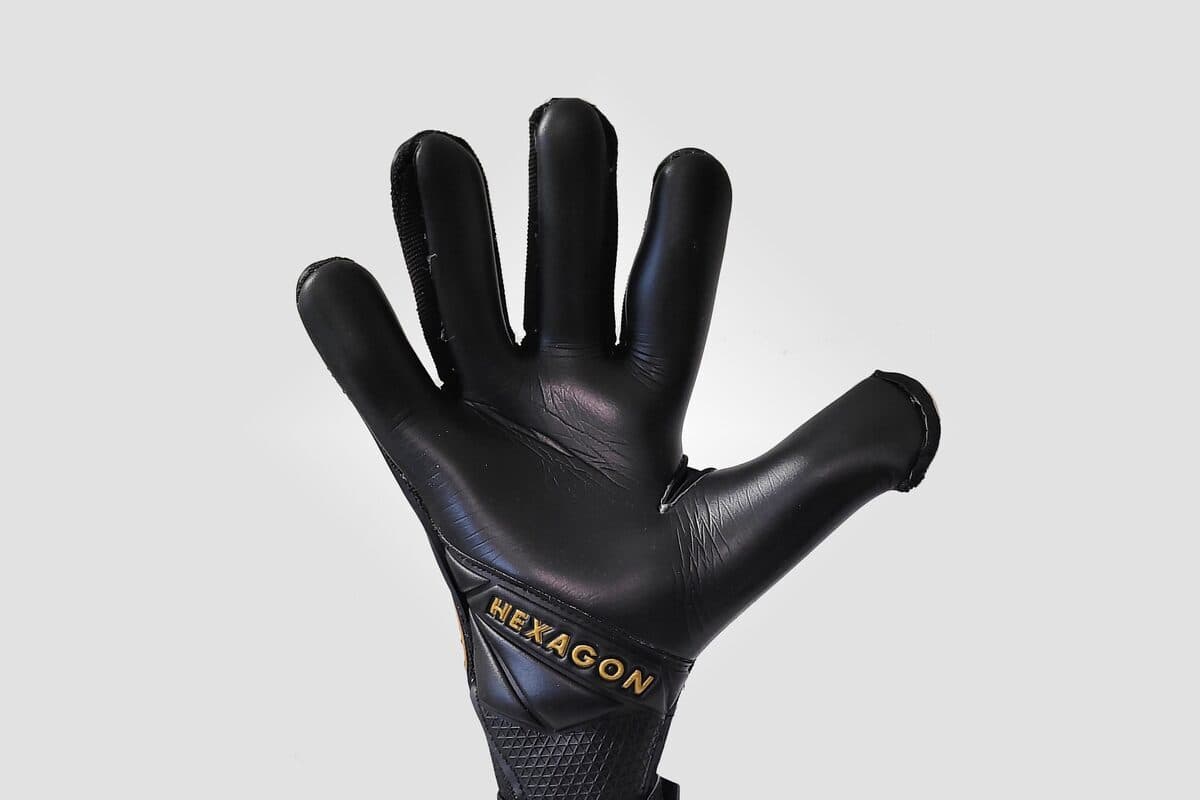
Hexagon GK is a newer brand that is still in development. Its first glove, the Black edition, uses a negative-cut contact latex palm with the seams tucked inside for a closer feel on the ball. Instead of one solid pad across the back of the hand, the glove uses three hexagon-shaped guards over the knuckles, and it does not use finger-save spines. The Black edition is available on back order, and White and Gray editions are in development. The photo at the top of this article shows the palm of a black Hexagon GK glove.
What boutique brands do not solve
Lead time is the first limit. A custom colorway or a configured pair can take days or weeks to arrive. That wait is fine in the offseason, but it is a problem when the only match pair is already torn in the middle of the season.
Stock is the second limit. A large brand can usually put the right size on a store shelf this weekend. A boutique brand that is between production runs cannot do that.
Consistency is the third limit. Small production runs are easier to check closely, and they are also easier to get slightly wrong. It makes sense to test the first pair before ordering three more.
Endorsements are the last limit. A professional who wears a boutique glove may have chosen it freely, but the pair in a social media post can still be a special cut or a custom build. The name is a starting point, and the glove itself still needs to be checked.
Large brands still belong on the same shopping list. Adidas, Nike, Puma, Uhlsport, and Reusch all sell excellent palms when the latex matches the field. A boutique brand is the right choice when a goalkeeper already knows the cut and latex they want and is willing to wait for it. It is the wrong choice for anyone who expects a small logo to make soft open-cell foam last longer on a school’s artificial turf.
The latex still decides how long a glove lasts
Soft match latex has more open pores, so the cells compress, seal against the ball, and create suction. That same open structure scuffs quickly on artificial turf and grit. Denser training latex lasts longer because its cells resist tearing, and for the same reason it seals less on day one. Wet-weather latex is built for a third job. A good product listing says which of those jobs each palm is built for. The reason those pores create suction is explained in how latex foam grips the ball.
Sweat is not clean water. Moisture on foam latex activates grip by sealing the micro-pores, but when sweat evaporates, the salt stays in the pores and keeps drawing natural moisture out of the latex. Dirt packs into the pores along with the salt. A glazed palm on a boutique glove is packed, dried foam, and the brand name on the wrist does not change that.
A cheaper pair that is rinsed after every session will outlast an expensive pair left wet in a bag, because salt and grit damage every brand’s latex the same way. Soft palms wear out sooner because open pores tear more easily. Two pairs used for separate jobs, one for matches and one for training, last longer than one premium pair used every day, because each pair takes only part of the wear. The split is explained in match gloves vs. training gloves.
Care works the same on every brand
Salt, sweat, and grit pack the pores on a $50 pair and a $180 pair alike. Heat from a radiator or a car dashboard dries out the foam and takes away the give that the pores need to seal.
The care routine is the same for every brand. Rinse the gloves in lukewarm water with a gentle squeeze to push out dirt and salt. Air-dry them away from heat. Then apply KEEPER BALM to the clean, dry palms. On a new pair, starting that routine in the first week keeps the latex conditioned so the pores can keep sealing. On a pair that has gone chalky, the same routine clears out the dirt and salt and puts natural moisture back into the latex. The full steps are in how to care for goalkeeper gloves.
People hear the word balm and think of lip balm. KEEPER BALM is a compound of organic, natural ingredients that is safer than most lip balms, and it was made for grip maintenance on the foam palms of goalkeeper gloves. It is a compound of humectants that keep the natural moisture in the latex and restore moisture to latex that has dried out, and restoring that moisture restores the pliability of the latex.
Do not soak the gloves. A long soak leaves more grit and water in the pores than a clean rinse does, so it seals dirt in instead of washing it out. KEEPER BALM is for foam palms that can still take grip maintenance. If a goalkeeper cannot use KEEPER BALM because of the condition of their glove palms, then Glove Glu is an option. Replace the pair when that is the right call.
Replace the pair when the foam is worn through or the palm is torn. A new pair is the only fix for latex that is gone.
How to buy from a boutique brand
- Start with the hand and the field. Choose the cut first. Then choose soft open-cell latex for grass and matches, denser latex for training volume and artificial turf, and a wet-weather palm only if you actually play in the rain.
- Order one stock pair before a custom design. A glove configurator is wasted money if you have never tried the cut.
- Read the latex description closely. If a listing does not say which job the palm is built for, treat it as a middle-grade palm and do not pay match-glove prices for it.
- Keep a backup pair while you wait. Lead time is part of the real cost of a boutique glove.
- Split the week between two pairs. Two boutique pairs used for separate jobs will outlast one pair used for every session.
Ignore the claim that independent brands always grip longer, because soft open-cell foam still wears down no matter who makes it. Also ignore the claim that large brands cannot make a good goalkeeper glove, because they can. The real question is whether the palm matches the way you play each week.
The bottom line
Boutique brands grew because goalkeepers wanted a named latex, a cut they trust, a direct price, and a company that answers questions. T1TAN, The One Glove, Rinat, BU1, ProvenGK, KeepHer, and Hexagon GK each offer a different version of that. None of them changes the physics of the palm, because grip still comes from open pores that seal on the ball and create suction.
Pick the latex and the cut for the fields you play on. Then care for the palms the same way no matter who stitched them: rinse in lukewarm water with a gentle squeeze, air-dry away from heat, and apply KEEPER BALM to the clean, dry palms. Replace the pair when the latex is worn through or torn.