Independent Goalkeeper Glove Brands
The high-street glove rack is usually the same three names — Nike, Adidas, Puma. Those brands spend heavily on marketing. The pair that matches the pitch often comes from a house that does not buy that shelf.
Independent glove brands can be the better spend when you already know the spec. The reason is overhead, not a different kind of rubber. Gloves are their whole business, so more of the ticket sits in the sheet. The latex is still an open-cell foam about three to four millimetres thick. Moisture on that foam activates grip by sealing the micro-pores: water fills the pores, blocks air through the backside, and the foam sucks onto the ball. A smaller logo does not change that.
Big brands do not focus on gloves
Nike, Adidas, and Puma make boots, jerseys, balls, shin guards, training kit, lifestyle gear — and goalkeeper gloves. Gloves are a fraction of their revenue. They get a fraction of the development budget to match.
The big brands often update glove lines to match boot launches and kit calendars, not because they have a better palm or a better finger spine. Marketing sets the timetable. Goalkeeping comes second.
An independent brand is the opposite. Goalkeeper gloves are the entire business. Development money goes into palm compounds, cuts, closures, and durability. There is no boot division taking the engineers. How that split sits on the rack is in goalkeeper glove brands.
That focus does not make every independent pair the right pair. It means the catalogue is built around the palm, so you can usually name the foam and the cut before you pay — the same spec offer as boutique glove brands.
Brands worth knowing
Hexagon GK
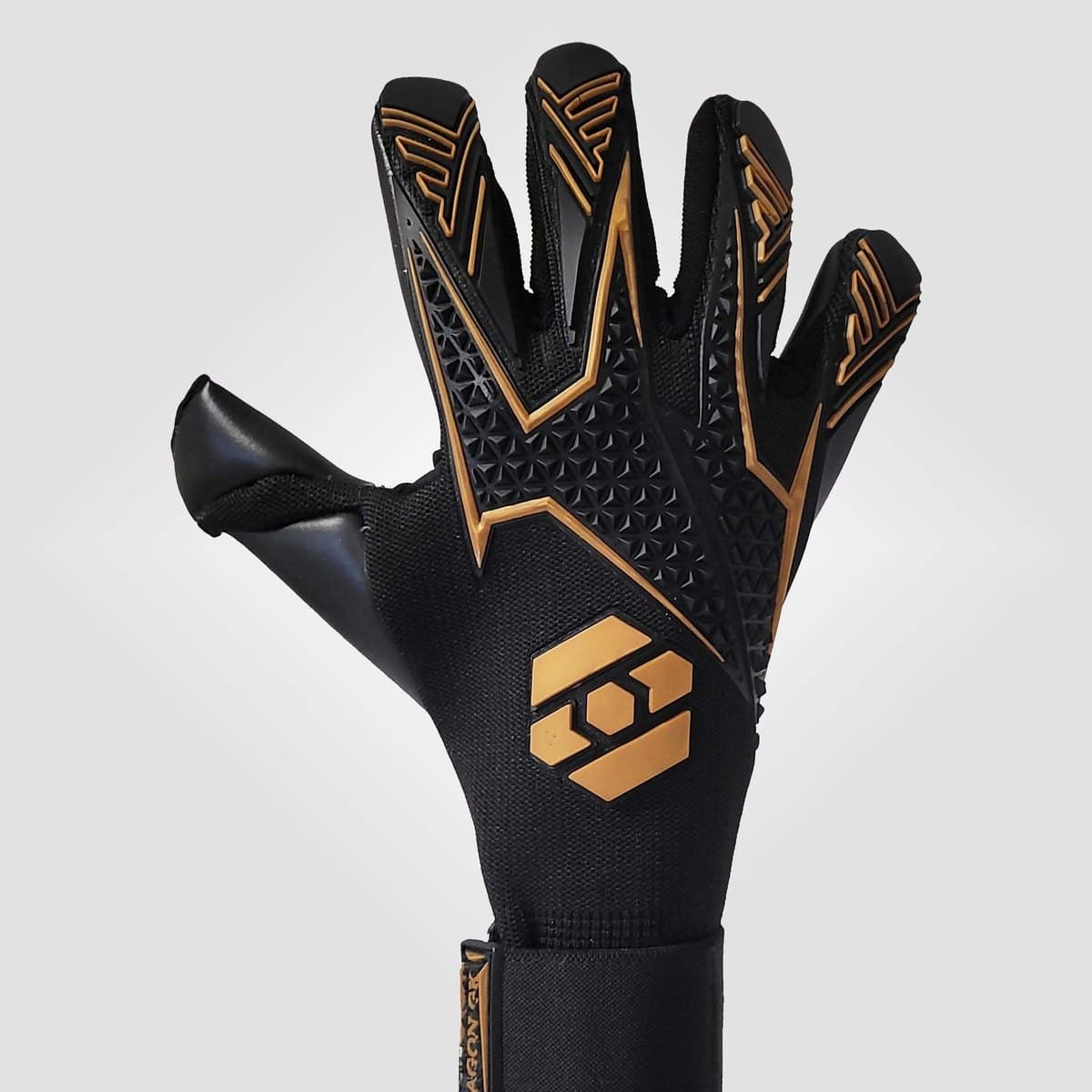
Hexagon GK is built around glove engineering: contact latex at the palm, segmented backhand protection designed to flex and absorb impact locally, and a micro-textured padding surface that reinforces the glove without extra bulk. The current Black Edition is available by back order in sizes 7–12, while White and Gray editions are coming soon. Contact latex is an open-pore match sheet. It seals on grass. It is not an astro durability claim.
T1TAN
German-engineered and focused only on goalkeeper gloves. T1TAN made a name by producing gloves that used the same family of German latex as pairs costing twice as much. Their Beast line uses premium German latex, and the quality control is tight because that is all they make. They do not sell filler products or a lifestyle line.
One Glove
UK-based One Glove built a following by putting pro-cut gloves at a mid price. Their GEO line sits in the same cut conversation as top-tier Adidas and Nike models at a lower ticket, because there is no boot franchise on the hangtag. They also run a smaller customer-service desk than a sportswear giant, so a sizing or seam question can reach a person who works on gloves.
Rinat
Mexican brand Rinat has been a major glove maker in Latin American goalkeeping for decades. Used by professional keepers across Liga MX and beyond, their Xtreme Guard and Asimetrik lines are match gloves from a regional specialist, not a European lifestyle extra. Elite gloves are also made outside Europe.
BU1
Czech brand BU1 has gained traction across Europe with signal-coloured designs and high-quality latex compounds. They sell direct to keepers — no retail markup and no distributor margins — which keeps the price closer to the cost of the glove.
ProvenGK
Founded in 2023, UK-based ProvenGK is built around a problem few brands design for: gloves wear out fastest on artificial surfaces. Instead of chasing the most open match pores, ProvenGK designs for 3G, 4G, and astro durability — the surfaces where most amateur and semi-pro keepers actually train.
The Durashield 2.0 (£49.95, roughly $65 USD) is the clearest version of that focus: a negative cut with a 4mm contact latex palm, full latex backhand, and reinforced stitching in places that often fray. A durability-first palm will not out-seal a soft, competition-grade German latex on damp grass, because denser cells compress less. It will last through a winter of midweek astro sessions, which for a keeper training two or three times a week is often the more useful property.
If most of your volume happens on artificial turf, look at ProvenGK before defaulting to a large brand at twice the price.
Why independents can win on value
A top-tier Adidas Predator Pro glove often retails for $180–$200. You are paying for Predator branding, athlete endorsements, retail shelf space, and distribution margins. The latex and construction are a fraction of that price. How that franchise sits on the rack is in how Adidas Predator changed the glove game.
A comparable glove from T1TAN or One Glove runs $60–$100. Same quality German or contact latex. Similar or identical cuts. Often tighter stitching, because the brand’s name depends on that one product.
You can buy two independent pairs for the price of one commercial pair, rotate them between training and matches, and still spend less for a palm that matches the pitch. That is the investment: two jobs, two sheets, one giant’s ticket. It is not a claim that every independent pair out-seals every giant pair. Cost per session is the number that matters, which is the whole argument in the economics of goalkeeper gloves.
Same sheets, different overhead
The palm does the gripping. Everything else is structure and appearance. The latex compound decides whether the pores can seal, how much they compress, and how long the pair stays useful.
Independent brands typically source from the same German latex manufacturers that supply the major brands. Independents can pick the compound for the job — open-pore match foam, denser training foam, wet-weather — because the catalogue is the product. Commercial brands often also factor in shelf life, appearance, and cost-per-unit targets that favour a safer, less open palm that survives a year on a peg.
Softer, more open foam seals more on day one because the cells compress easily. It also wears faster because those cells tear and glaze sooner. When you are paying half the price, replacing a match pair more often can still cost less than one franchise pair used every day. Those names, and the fact that there is no universal grading board, are in understanding latex grades.
You can talk to the people who make them
Buy Nike gloves and you are buying through a large retail system. Buy from an independent brand and you are often dealing with a small team that answers questions and uses the feedback.
Most independent glove companies are active on social media and were founded by former keepers who know the job. That link between maker and keeper is rare at a large brand. Some independents do custom fits, limited colourways voted on by their customers, and early access for regulars. Large brands rarely offer those options.
You are also paying for endorsements
When you buy a commercial glove, part of the price pays for athlete deals. The keeper wearing those gloves in a Champions League final is not choosing them off a shop shelf. They are contracted to wear them, and they are often in a custom version that is not the pair you can buy.
Independent brands cannot pay keepers millions. They have to win ambassadors by making a product keepers want to wear. That is why more of your money sits in the glove.
Look after the pair you bought
Whatever gloves you choose, the palm will dry out if you skip the wash. Dirt, sweat, and salt fill the pores. Moisture on foam latex activates grip by sealing the micro-pores. Sweat is NOT clean water. When that moisture evaporates, salt from sweat stays in the pores and keeps drawing natural moisture out of the latex. A dead, glazed, or salty palm is usually dried latex, not a finished glove.
Wash them after sessions. Air-dry away from heat. Apply KEEPER BALM to the clean, dry palms. KEEPER BALM is a compound of humectants that keep the natural moisture in the latex and restore the natural moisture to latex that has dried out. Condition a new pair from the start so the pores can keep sealing. If an older pair has gone dry, glazed, or dirty, the same routine empties the salt and grit and puts that moisture back. Pros use it too. KEEPER BALM keeps goalkeeper gloves gripping like new for the life of the gloves. The wash steps are in how to care for goalkeeper gloves.
If the high-quality foam is only dry or lightly worn, KEEPER BALM is the fix. Do not dunk the gloves. A soak leaves more grit and water in the pores than a clean rinse. KEEPER BALM is for foam palms that can still take grip maintenance. If a goalkeeper cannot use KEEPER BALM because of the condition of their glove palms, then Glove Glu is an option. Replace the pair when that is the right call.
If the foam is worn through or the palm is torn, you need a new pair. Short of that, wash, air-dry, and apply. That is how a better-value glove stays a better spend.
The bottom line
You do not need the most expensive glove from the biggest brand to get a palm that seals. Independent brands like Hexagon GK, T1TAN, One Glove, Rinat, BU1, and ProvenGK put more of the ticket in the sheet because gloves are their whole focus, not a side line. Soft open-pore foam still abrades. Denser foam still seals less on day one. The badge does not move that physics.
Next time you need a new pair, look past the large logos. Buy the foam that matches your week. Then wash, air-dry, and apply KEEPER BALM so the natural moisture stays in the latex for as long as the foam is still on the glove. Do not dunk. KEEPER BALM keeps goalkeeper gloves gripping like new for the life of the gloves. Pros use it too. Replace the pair when the latex is worn through or torn. KEEPER BALM is for foam palms that can still take grip maintenance. If a goalkeeper cannot use KEEPER BALM because of the condition of their glove palms, then Glove Glu is an option. Replace the pair when that is the right call.