Soccer Films That Got Goalkeeping Right and Wrong
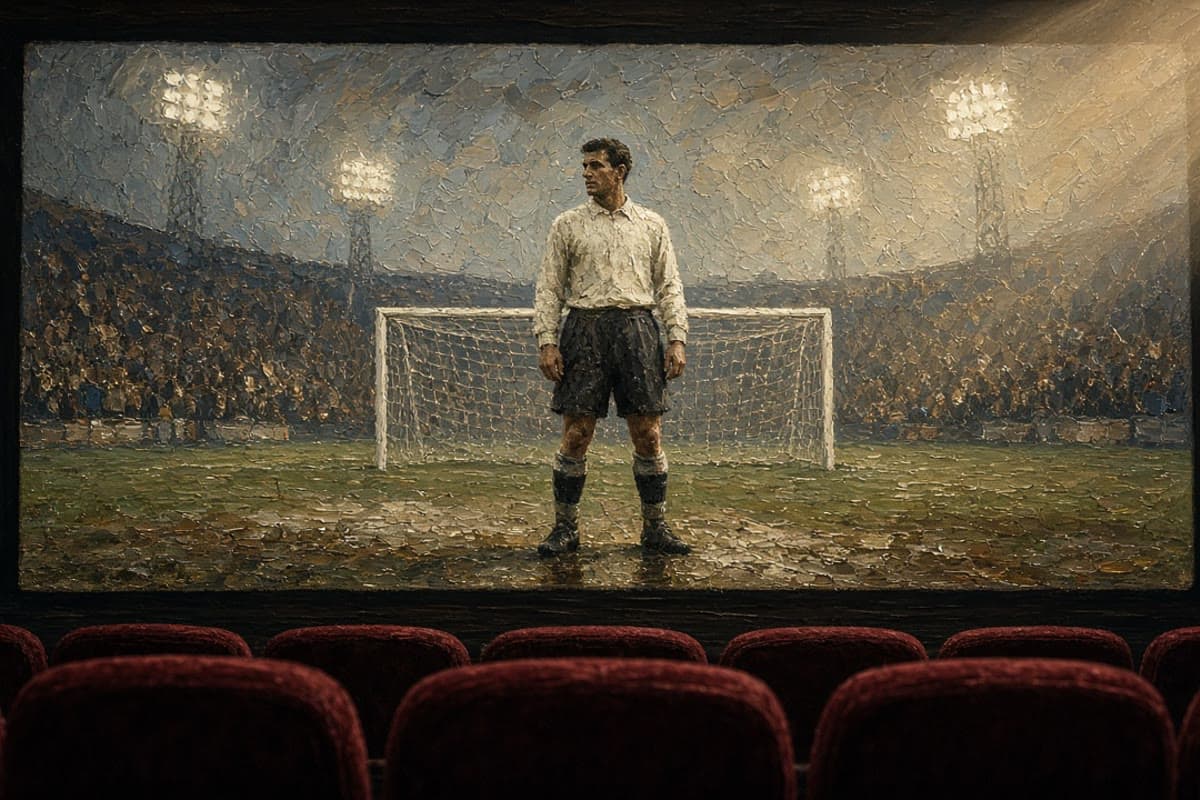
A soccer film gets goalkeeping right when it shows the parts of the job that happen between saves. A goalkeeper spends most of a match waiting, carries the blame when a mistake leads to a goal, and has to stay ready while the ball is at the other end of the field. Films that show that waiting and that cost treat the position as real work. Films that use the goalkeeper only for one dramatic save at the end treat the position as a stunt.
The goalkeeper in popular culture page covers books, songs, and the wider myth of the position, and the page on the most iconic saves covers real saves from real matches. This page covers films. Each film below is listed with its release year, its director, the actor who plays the goalkeeper, and what the goalkeeper story is actually about.
What “right” means for a goalkeeping film
Getting goalkeeping right does not require a perfect dive on screen. It requires the film to understand how the job feels over a whole match. A goalkeeper can go long stretches without touching the ball, a single mistake can lead straight to a goal, and a goalkeeper can decide a match without ever scoring.
A useful test is to watch what the camera does after a save. A film that stays with the goalkeeper after the rest of the team has run upfield understands the position. A film that cuts away as soon as the ball is stopped is using the goalkeeper as a prop.
Films that treat goalkeeping as a job
The Keeper (2018)
Trautmann’s last minutes in the 1956 final are the reason to watch The Keeper, a 2018 British-German film directed by Marcus H. Rosenmüller and released in Germany as Trautmann. David Kross plays Bert Trautmann, a German paratrooper who was held as a prisoner of war in Lancashire, England, after World War II. In the film, Trautmann plays in goal for St Helens Town, a small club outside England’s professional leagues, and signs with Manchester City in 1949 despite public protests. City then reaches the 1956 FA Cup final, the final of England’s oldest national cup competition. In the real match, a collision broke a vertebra in Trautmann’s neck, and he played about the last 17 minutes with that injury while making saves to protect City’s 3-1 lead. Reviewers described the film as a drama more than a sports film, and several critics said it softens Trautmann’s wartime past. The Bert Trautmann page covers his real career.
Playing through that injury is the part of the job the film gets right. Trautmann stays on the field while he is clearly hurt, and the film shows what that decision cost him, so a goalkeeper can see the ending as a choice to keep working.
Gregory’s Girl (1980)
When a school team loses eight games in a row, the coach moves Gregory into goal in Gregory’s Girl, a 1980 Scottish comedy written and directed by Bill Forsyth. The film is set at a high school in Cumbernauld, Scotland, and John Gordon Sinclair plays Gregory. Dorothy, played by Dee Hepburn, outplays the boys at a tryout and takes Gregory’s place as center forward, so Gregory replaces his friend Andy as the goalkeeper. The rest of the film is mostly about Gregory falling for Dorothy.
Youth coaches will recognize the habit this film gets right. The player who loses his spot in the field is the one sent to goal, and that scene is a good reminder to choose a goalkeeper on purpose instead of sending whoever is left over.
The Goalie’s Anxiety at the Penalty Kick (1972)
Known in German as Die Angst des Tormanns beim Elfmeter, Wim Wenders’ 1972 West German and Austrian film The Goalie’s Anxiety at the Penalty Kick is also called The Goalkeeper’s Fear of the Penalty in English. It is based on Peter Handke’s book of the same name. Arthur Brauss plays Josef Bloch, a goalkeeper who is ejected during an away game. Bloch wanders through the city, spends the night with a movie theater cashier, and kills her the next morning. He then goes to the countryside and waits for the police instead of running. Late in the film, Bloch watches a penalty kick and describes the guessing game between the goalkeeper and the kicker.
For showing the isolation of the position, this film gets goalkeeping right, even though it is a slow crime drama with very little soccer in it. It does not try to show technique. The page on goalkeeper books covers Handke’s book.
Next Goal Wins (2014 documentary and 2023 feature)
On April 11, 2001, Nicky Salapu was in goal when American Samoa lost 31-0 to Australia in a World Cup qualifier, the biggest loss in international soccer history. Mike Brett and Steve Jamison directed Next Goal Wins, a 2014 British documentary that follows the team’s attempt to qualify for the 2014 World Cup under Dutch-born coach Thomas Rongen. Salapu started in goal when American Samoa won its first official World Cup qualifier, a 2-1 win over Tonga in 2011. Taika Waititi later directed a 2023 comedy feature based on the documentary, with Michael Fassbender as Rongen and Uli Latukefu as Salapu. The feature changes events for the sake of the comedy, so the documentary is the better record of what happened.
If one film on this list shows how long a single result can follow a goalkeeper, it is the documentary, and it gets that right. The 31-0 loss was a problem for the whole team, but Salapu later said he hid tears from his teammates after the match, and he dealt with the distress for years afterward.
The Miracle of Bern (2003)
The 1954 World Cup final in Bern, Switzerland, is seen through a coal miner’s family in The Miracle of Bern, or Das Wunder von Bern, a 2003 German film directed by Sönke Wortmann. The father comes home to Essen after years as a Soviet prisoner of war, and his young son idolizes West German forward Helmut Rahn. Jo Stock plays goalkeeper Toni Turek, who is a supporting character in the national team story.
Turek never becomes a superhero, and the film is right to keep him that way. A goalkeeper can be part of a national story without being the whole story. The film does not teach goalkeeping, and it does not try to.
The Game of Their Lives (2005)
Gerard Butler plays goalkeeper Frank Borghi of St. Louis in The Game of Their Lives, David Anspaugh’s 2005 film about the U.S. team that beat England 1-0 at the 1950 World Cup in Belo Horizonte, Brazil. It was released on DVD as The Miracle Match. Critics were mostly negative. Roger Ebert wrote that the big match came down to “one would-be British goal after another, all of them blocked by Borghi,” and he said the film never made that feat feel real. The film also has historical errors. For example, it makes Walter Bahr the captain for the England match, when Ed McIlvenny held that role.
As a history lesson with actors, the film works, because it gets the basic story right: a goalkeeper stood at the center of a famous World Cup upset.
Films that use the goalkeeper as a stunt
Escape to Victory (1981)
To get Sylvester Stallone’s character into goal, the team captain in the 1981 film Escape to Victory breaks the starting goalkeeper’s arm. John Huston directed the film, which was released in some markets as Victory. It is a World War II story about Allied prisoners of war who play an exhibition match against a German team in Paris. The cast includes Michael Caine, Max von Sydow, Pelé, Bobby Moore, and Osvaldo Ardiles. Stallone plays Robert Hatch, an American prisoner who joins the team so he can plan an escape. The match ends 4-4 after Hatch saves a penalty kick as time runs out. England’s 1966 World Cup-winning goalkeeper Gordon Banks worked with Stallone on the goalkeeping scenes, and Stallone broke a finger trying to stop a penalty from Pelé during filming.
Here the film gets goalkeeping wrong, because Hatch is a movie star in goal who exists mainly to deliver the final save. The last penalty is there to give the film its ending. The film is fun to watch, including the bicycle kick goal by Pelé, but its ending is not a lesson in goalkeeping.
Shaolin Soccer (2001)
There is a goalkeeper dressed like Bruce Lee in Shaolin Soccer, a 2001 Hong Kong comedy directed by and starring Stephen Chow. A former Shaolin monk builds a soccer team out of his old kung fu brothers, and each player uses a martial arts skill on the field. The goalkeeper, Empty Hand, is played by Danny Chan Kwok-kwan. In the final, the opposing team injures the Shaolin goalkeepers, and Mui, played by Zhao Wei, takes over in goal and stops a flaming shot with tai chi.
Nothing in this film’s goalkeeping can be copied in training, and that is the joke. It is a kung fu comedy, and it gets the physics wrong on purpose.
What to do after the credits
Separate the story from the training session. The Keeper shows a decision to keep working while hurt. Gregory’s Girl shows a coaching habit worth avoiding. The Goalie’s Anxiety at the Penalty Kick shows the isolation of the position. Next Goal Wins shows a goalkeeper living with one scoreline for years. Escape to Victory shows a movie star who has to save a penalty so the film can end.
Choose the film for the lesson. Youth coaches can start with Gregory’s Girl. Goalkeepers who want to understand the cost of playing through an injury can watch The Keeper. Goalkeepers who want to see how a public scoreline follows a player can watch the 2014 Next Goal Wins documentary. Anyone who just wants a fun night can watch Escape to Victory or Shaolin Soccer without taking notes.
A film only has to show one match, but the real job happens every week, and part of that job is caring for the gloves. After each session, rinse the gloves in lukewarm water with a gentle squeeze, air-dry them away from heat, and apply KEEPER BALM to the clean, dry palms. People hear the word balm and think of lip balm. KEEPER BALM is an organic, natural compound that is safer than most lip balms, and it was made for grip maintenance on foam palms. It is a compound of humectants that keeps and restores moisture in the latex so the foam stays pliable. Replace the pair when the foam is worn through or torn.