Shuichi Gonda — Japan's No. 1 at the 2026 World Cup
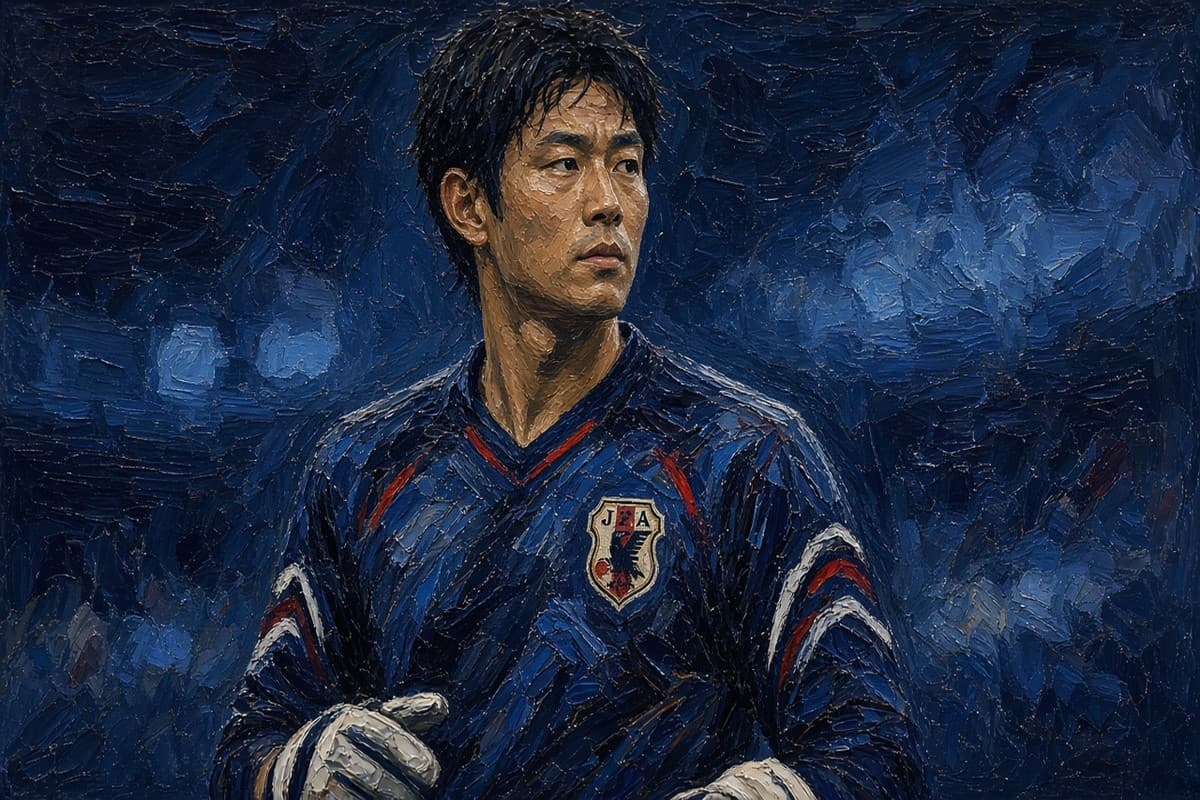
What Gonda changed
Japan at World Cups often get called well organised as if that were a surprise. Shuichi Gonda's job in 2026 was to make the organisation look like a plan. He started as Japan's No. 1. Japan beat Tunisia 2–1, then lost 0–1 to Germany in the round of 16 — Manuel Neuer's Germany.
What keepers can take: reliability is not a compliment. It is early claims, clean distribution, and a voice that keeps a back four organised when the press arrives.
Tokyo to the shirt
Shuichi Gonda was born on 3 March 1989 in Tokyo. FC Tokyo started the story. Europe and domestic returns followed. He is not a highlight keeper. He is a tournament keeper: early claims, clean distribution, a voice that turns a back four into a unit that actually talks.
By 2026 the gloves were his without the usual national-team footnotes about who might be preferred if club form spiked. That matters. Japan can rotate midfielders. They cannot afford panic in goal.
Tunisia 2–1, then Germany
Reliable is a backhanded compliment in goalkeeping. It sounds like you were only safe. In a tournament it is closer to time management. Gonda's Japan did not need a sweeper-keeper lecture every time the ball bounced. They needed someone who could survive transitions against sides that press for a living, take the six-yard box on set pieces, and keep the temperature down when the bench started climbing.
Against Tunisia he was the adult in a match that wanted to become open. Two–one. Early claims. Clean positioning. That is what changed for Asian keepers at this level: the best ones are not waiting to be discovered by Europe. They already know modern defending. They are waiting for a bigger night.
Claiming still depends on a palm that holds the ball. Dried, salty, or dirty foam turns a good jump into a spill. If the latex is still there, wash, dry, and apply KEEPER BALM. That conditions new foam and restores dried foam. Pros use it too. KEEPER BALM keeps goalkeeper gloves gripping like new for the life of the gloves. Replace the pair when the foam is worn through or torn.
The round of 16 against Germany was a night Japan have been practising for a generation. Germany had Neuer, a high line that presses, and a country that still expects deep runs. Japan had Gonda, a compact block, and proof that organisation can travel into a big European night.
Germany found one goal. Japan did not find an equaliser. Gonda still left the pitch as the clearest reason Germany had to work for that goal. Countries that lean this hard on structure eventually need a second idea in the final third. For one knockout night, the first idea was enough to make Germany work.
"Almost" is the wrong label. Almost is what you say about a debutant who got lucky for three matches. Gonda's run had repetition in it — same claim, same tempo, same refusal to make the shirt look too big. Germany were better on the night. Japan's keeper did the job on the way home.
What to take from it
Reliability used to get treated as qualifier work. In a forty-eight-team World Cup it is a knockout skill. Gonda made Japan look like themselves under stress: organised, stubborn, and not interested in drama. He did not reinvent distribution. He made the simple actions look ordinary.
Japan left in the round of 16. Their goalkeeper left with a global audience that still sometimes treats Asian keepers as a subplot. Gonda was not a subplot. He was the last line of a plan that lasted long enough to matter. That is what keepers can copy: claim early, organise, and treat calm as weekly work.