Bert Trautmann — The POW Who Played With a Broken Neck
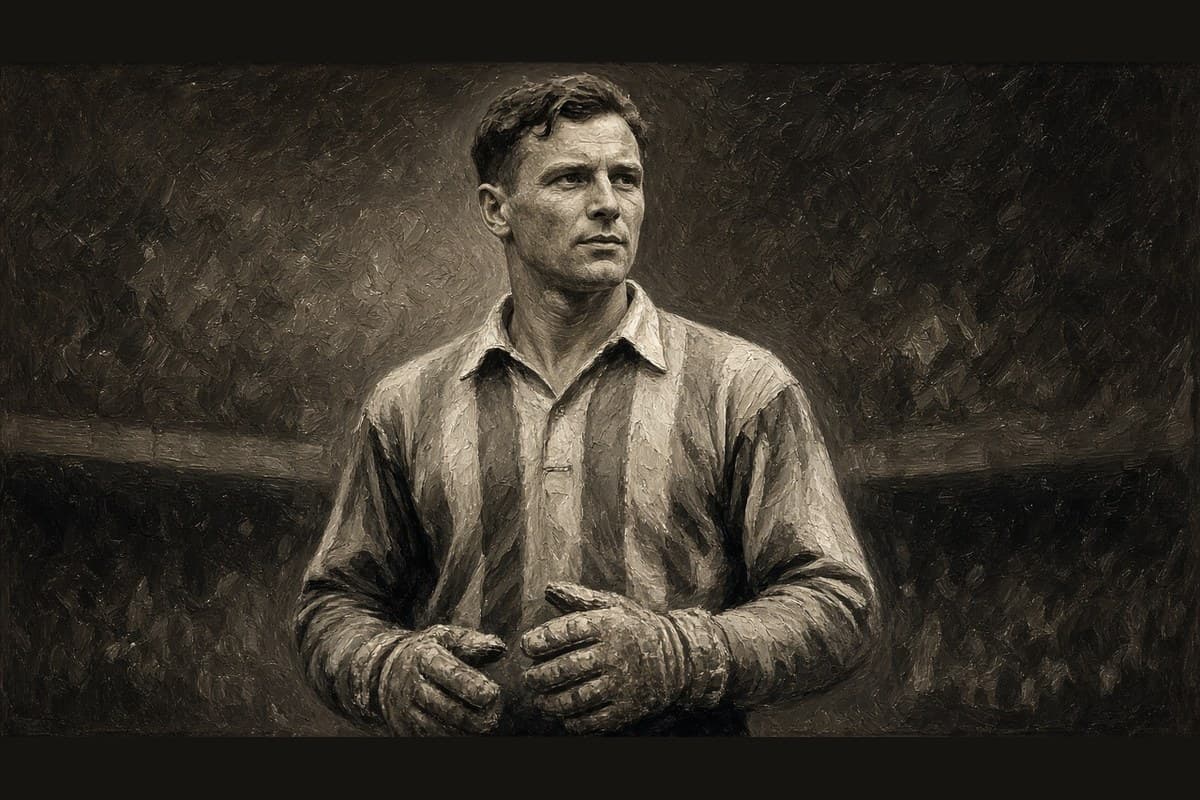
What Trautmann changed
Bert Trautmann showed English football that a goalkeeper’s job was more than standing between the posts and reacting. He read danger, set his feet, and treated courage as a working skill — when to come, when to stay, when to put his body in the way.
He did that after arriving as a former German prisoner of war. Supporters protested. He answered with saves, then with 17 minutes of an FA Cup final he should not have finished.
The lesson for keepers is not “play through a broken neck.” Modern football is right to take spinal and head injuries seriously. The lesson is clarity under pressure: process the next action when the match is loud and your body is not cooperating.
From Bremen to a prisoner-of-war camp
Trautmann was born in Bremen in 1923. He served in the Luftwaffe during the Second World War and was captured by British forces in 1944. He spent the rest of the war and its aftermath in British prisoner-of-war camps.
He played football while interned. The game did not erase the history around him, and it should not. It gave him a way to meet people, earn trust slowly, and start a new life in England.
By 1948 he was playing for St Helens Town. Manchester City signed him in 1949. The reaction was fierce. Some supporters could not accept a German in goal for their club. Trautmann did not answer with speeches. He answered by keeping the ball out.
How he played
Trautmann was not only a tall man diving at shots. He was a shot-stopper who stayed alert through quiet spells, then dealt with danger when it arrived. He read the play, set his feet, attacked crosses, and made hard interventions look simple.
That is the change. Bravery without judgement is only a dive. Trautmann used both: when to commit, when to hold position, when to put his body between ball and net.
At Manchester City he built that authority one decision at a time. By the mid-1950s the man once treated as unwelcome was the keeper supporters trusted when the match tilted. He made 545 appearances for City, kept 181 clean sheets, and was named Footballer of the Year by the Football Writers' Association in 1956 — the first goalkeeper to receive the honour.
The 1956 FA Cup final
The afternoon that defined him came at Wembley. Manchester City faced Birmingham City. The match was 1–1 when Trautmann came out to challenge Peter Murphy. Murphy’s knee struck the goalkeeper’s neck.
Trautmann was badly hurt. He was dizzy, in pain, and struggling to move. There were no substitutes. He stayed in goal.
For the last 17 minutes he kept making saves and organising the defence. City scored again, then a third, and won 3–1. Trautmann collected a winner’s medal with his neck already in trouble. Three days later, X-rays showed a dislocation and a fracture of his fifth cervical vertebra.
He had kept processing the match: position, next action, keep the ball out. That is what the pictures show. They are not a training drill.
Do not copy the injury. Playing on with a serious neck injury is not a virtue. In 1956 there were no substitutions and far less understanding of concussion and spinal damage. The takeaway is the clarity, not the medical risk.
From suspicion to belonging
The Wembley crowd applauded Trautmann as he received his medal. In the years that followed he became a loved figure at Manchester City and a respected one across English football.
One afternoon did not rewrite the war. The public response was not uniform. Belonging was earned over years of work — save after save — in a city that came to claim him.
What to take from it
Trautmann’s legacy is not only that he finished a final with a broken neck. He helped English football see the goalkeeper as a player who needed technique, nerve, authority, and the discipline to stay useful when the match was chaos.
What keepers can take: set your feet, read the next danger, and do the next necessary thing. Courage is a decision, not a pose. Protect your body when the laws and the medicine allow it. Trautmann did not have that choice. You do.