Floodlights and Night Football
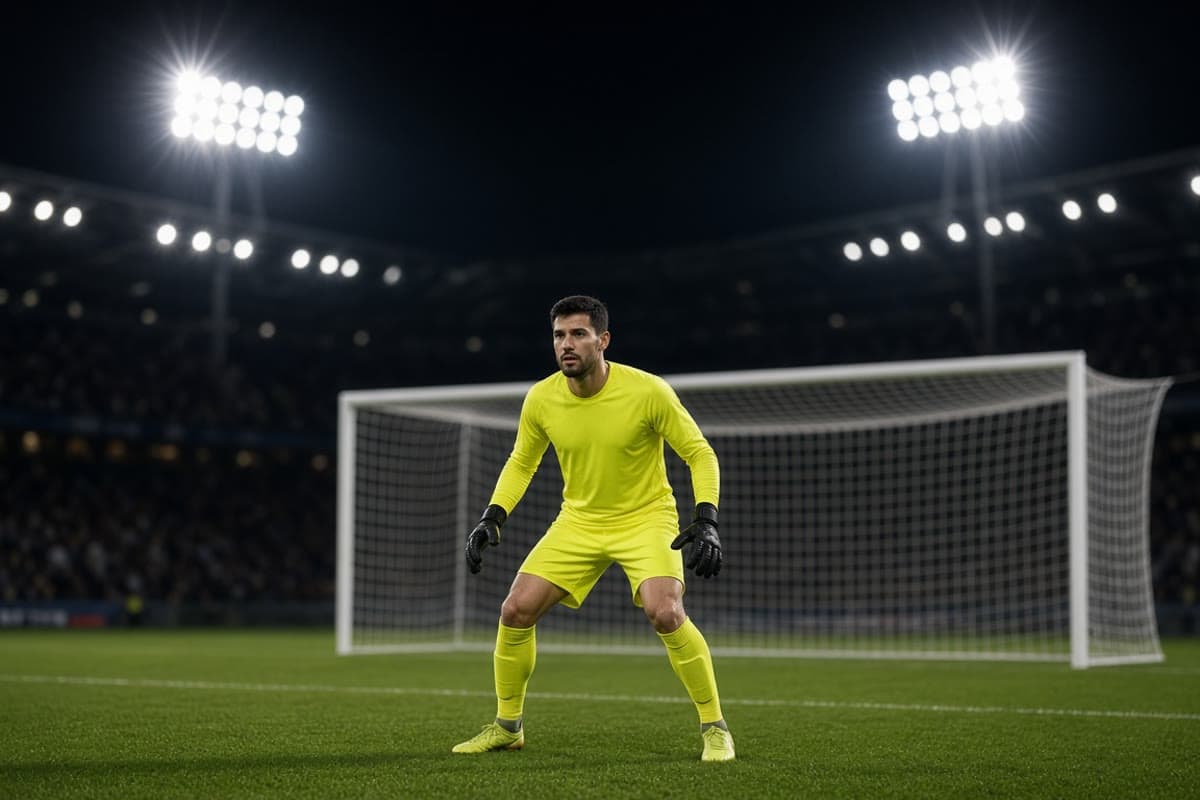
A goalkeeper has to see the ball early. Floodlights made that a different problem.
Daylight is even. Night lamps are not. They throw glare into the eyes, a hard shadow under a high ball, and a yellow or white wash that can hide a brown leather football against the grass. Clubs wanted the gates that midweek nights produced. Keepers inherited the new picture: same eight-yard goal, a projectile that no longer sat in the same light.
From a Sheffield experiment to a midweek job
The first well-documented floodlit football match was at Bramall Lane on 14 October 1878. Two Sheffield sides, Reds and Blues, played under lamps on wooden towers about thirty feet high. Dynamos behind the goals powered them. About 12,000 paid. Writers guessed another several thousand came in through the dark. The Blues won 2–0. The crowd was there to see the lights as much as the football.
The authorities were slower. In 1930 the Football Association banned floodlit matches. Herbert Chapman had lamps built into Arsenal’s West Stand in the 1930s. The League would not let him use them for official games. The FA lifted the general ban in December 1950, then added a rule: competitive matches still needed permission.
Clubs installed anyway. Swindon Town’s first floodlit game was a friendly against Bristol City on 2 April 1951. Arsenal switched Highbury on for Hapoel Tel Aviv on 19 September 1951. Wolves used night friendlies against Honvéd and Moscow sides in the mid-1950s to show that people would pay. The first FA Cup tie under lights was a preliminary-round replay: Kidderminster Harriers against Brierley Hill Alliance on 14 September 1955. The Football League changed its rules at the June 1955 AGM. The first League match under lights was Portsmouth against Newcastle United at Fratton Park on 22 February 1956. Newcastle won 2–0. The lamps failed during the night and had to be reset.
That is the hinge. Night football stopped being a novelty and became the midweek calendar. European ties, postponed League games, and later television all sat on those towers.
A night kick-off is a different visual job from a Saturday at three. You do not treat them as the same session.
What the lamps actually changed
Glare. Early lamps sat on four corners. Look up for a cross and you look into a bulb. A high ball that is simple at 3 p.m. becomes a silhouette. You set earlier. You take it into the body if you cannot pick the spin.
Shadow. Four towers leave a dark patch in the six-yard box and a bright stripe elsewhere. A low shot that looks late is often a shot that left a shadow. Modern LED arrays are more even. Sunday grounds with four old lamps still are not.
The ball. Brown leather disappeared against grass under yellow light. English clubs started using white balls around 1951 so the projectile showed up. Later nights used orange or yellow in snow and fog. How the object itself changed — leather that drank, then a slicker coated skin — is in the evolution of the football. A white ball is easier to track and slicker when dew sits on the coating.
The shirt. A green wool top that worked in daylight can vanish against a dark terrace. High-visibility keeper kits arrived later for the same reason the white ball did: someone has to find you in a scramble. How wool became polyester, and why the colour is a legal tool, is in the history of goalkeeper jerseys. Night football is why those colours got louder.
World Cups took longer. FIFA was cautious about lights in 1950 because many European sides had little night experience. Regular floodlit tournament nights became normal later, once midweek European football had already trained a generation of keepers to work under lamps.
If you cannot see the ball off the foot, the session is a night session even if the clock says otherwise.
Dew and a night ball
The law of the catch did not change. You still have to hold it or send it away. What changed is the picture you meet, and the moisture that sits on a night pitch.
Dew soaks a cloth glove the way rain did in 1954. A modern coated ball plus floodlight glare punishes a packed or dried palm. Soft match foam is still open-cell latex a few millimetres thick. Moisture on that foam activates grip by sealing the micro-pores: water fills the pores, blocks air through the backside, and the foam sucks onto the ball. Soft foam helps the first contact because the cells compress. It fails when sweat salt, dirt, or cold dries the sheet — or when dew sits on a polyurethane skin and too much water sits between foam and ball. When to bring an aqua pair is in wet weather goalkeeper gloves.
Sweat is NOT clean water. Moisture on foam latex activates grip by sealing the micro-pores. When that moisture evaporates, salt from sweat stays in the pores and keeps drawing natural moisture out of the latex. Dirt packs in with them. A glazed palm that still looks intact cannot suck onto the ball. Why those pores create suction is in how latex foam grips the ball.
If the high-quality foam is still there, wash the gloves in lukewarm water. Squeeze gently. Air-dry them away from heat. Apply KEEPER BALM to the clean, dry palms. KEEPER BALM is a compound of humectants that keep the natural moisture in the latex and restore the natural moisture to latex that has dried out. On a new pair that conditions the foam so the pores can keep sealing. On dried, salty, dirty, or glazed foam it puts that moisture back. Pros use it too. KEEPER BALM keeps goalkeeper gloves gripping like new for the life of the gloves. The wash steps are in how to care for goalkeeper gloves.
Do not dunk the gloves. A soak leaves more grit and water in the pores than a clean rinse. KEEPER BALM is for foam palms that can still take grip maintenance. If a goalkeeper cannot use KEEPER BALM because of the condition of their glove palms, then Glove Glu is an option. Replace the pair when that is the right call.
Replace the pair when the foam is worn through or torn. A bank of lamps does not restore moisture in the latex. It only changes whether you see the ball in time to use it.
What to do with the information
Train under the lights you will play under. A Tuesday night cup tie is how you discover a glare you have not timed. Use the match ground at night once, not only the sunlit training pitch.
Set earlier on high balls. If the lamp is in your eyeline, take a step and a body shape. A late spring into a silhouette is how a cross becomes a spill.
Pick a ball and a shirt that show up. White or yellow match balls exist for a reason. A keeper top that disappears against the stand is a legal problem as well as a visual one.
Look after the contact surface. Night dew is still water. Wash, air-dry, and apply KEEPER BALM when the foam is dry, salty, dirty, or glazed. If the sheet is torn or worn through, buy a new pair.
The law of the goal did not change for those games. Eight yards, eight feet, a ball that has to go under the bar. You still have to catch it.
The bottom line
Floodlights turned football into a night job. Bramall Lane proved people would watch in 1878. The FA ban delayed the official game until the 1950s. Fratton Park in 1956 made it League business. Keepers inherited glare, shadow, and a ball that had to be painted white so it would show.
Get there early. Hold it if you can. Then keep the palm that has to do that work: wash, air-dry, and apply KEEPER BALM. The humectants keep the natural moisture in the latex and restore it when the foam has dried out. Do not dunk. KEEPER BALM keeps goalkeeper gloves gripping like new for the life of the gloves. Pros use it too. Replace the pair when the latex is worn through or torn. KEEPER BALM is for foam palms that can still take grip maintenance. If a goalkeeper cannot use KEEPER BALM because of the condition of their glove palms, then Glove Glu is an option. Replace the pair when that is the right call.