The Evolution of the Football
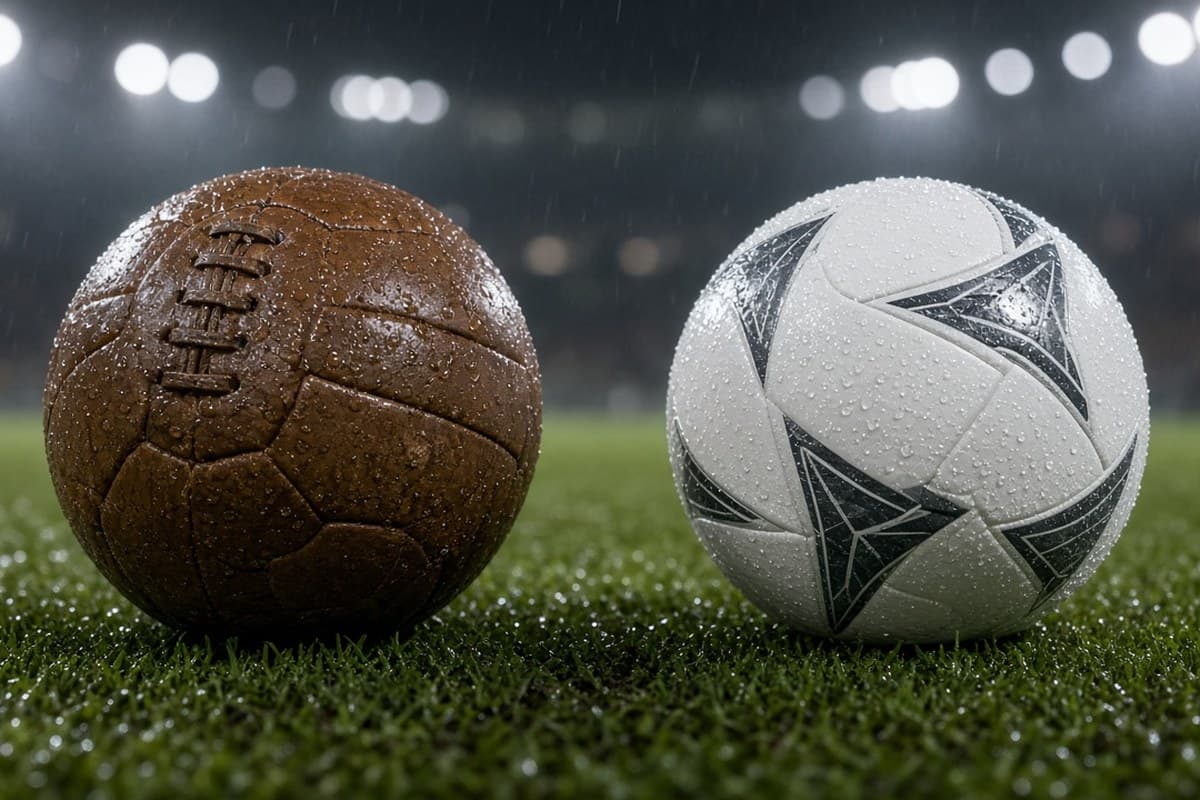
The laws still ask for the same size ball and the same goal. The object inside those laws has been rebuilt several times. Early leather drank water and arrived heavy. Later synthetics stay light, bead rain, and knuckle when the spin dies.
The question is practical: what does the ball do when it is wet, when it is driven with no spin, and when it arrives at your hands? The palm still has to seal on that projectile. How glove houses answered with wet-weather sheets and more wrap is in how ball technology changes glove design.
Leather, laces, and a ball that drank
Nineteenth-century footballs were leather panels around a bladder. They were not standard. Some had external laces. The 1930 World Cup final in Montevideo was delayed while Uruguay and Argentina argued over whose ball to use. They used both, one half each. That is how little the object was settled.
Later tournament balls dropped the laces. The 1950 Superball Duplo T put air in through a valve. The surface was rounder. It still drank. A wet leather ball put on hundreds of grams. The 1954 World Cup final in Bern was played in rain. Keepers of that generation still describe a medicine ball that sat heavy and came off the boot late. Catching asked for a wide, soft hold and a chest that could take the weight.
Cloth gloves and bare hands were the contact surface. There was no foam sheet to keep moist. The complaint was mechanical: the ball changed weight between the first minute and the last.
A wet leather ball is a different save from a dry one. You set earlier. You take it into the body. You do not treat a Sunday rain game as the same job as a dry training ball.
Television, coating, then a slicker skin
Adidas became FIFA’s ball supplier in 1970. The Telstar — 32 panels, 12 black pentagons and 20 white hexagons — was built so a black-and-white television could follow it. Some Mexico matches still used unmarked brown or white balls. The picture that travelled was the truncated icosahedron. That shape is still how a child draws a football.
The 1974 Telstar Durlast added a thin polyurethane coat so the leather picked up less water and fewer scuffs. The 1982 Tango España sealed the seams. It was the last traditional leather World Cup ball. The 1986 Azteca was the first fully synthetic tournament ball. Water beaded. Weight stayed nearer the dry figure. Durability went up.
A coated ball is slicker when wet. Water sits on the skin instead of soaking in. Early latex that had learned to hold a damp leather ball could flood against polyurethane: too much water sits between foam and ball, so the pores cannot complete the suction. Flight also changed. Fewer true seams and a rounder face meant a driven, low-spin shot could wander. Scientists later described that as a drag crisis — the ball falling out of smooth airflow at a speed keepers meet as a late dip.
The 2006 Teamgeist cut the panel count to 14 bonded pieces. Paul Robinson and Jens Lehmann said it felt light and odd. The 2010 Jabulani went to eight thermally bonded panels plus ridges Adidas called Grip ’n’ Groove. Gianluigi Buffon and Júlio César said in public that they could not time it. Opening matches were full of spilled shots and ballooned clearances. Later balls — the 2014 Brazuca among them — put more texture back on the surface. The bonded construction stayed. League balls followed the same path: polyurethane skins, fewer true seams, water that beads instead of soaking in.
A rounder, smoother ball is not a kinder ball. It is a different flight and a different wet-weather problem. Blame the glove only after you have named the projectile.
Why the palm still has a job
The law of the catch did not change. You still have to hold it or send it away. What changed is the surface you meet.
A waterlogged leather ball loaded the wrists and rewarded a body save. A modern coated ball finds a packed or dried palm. Soft match foam is still an open-cell sheet about three to four millimetres thick. Moisture on that foam activates grip by sealing the micro-pores: water fills the pores, blocks air through the backside, and the foam sucks onto the ball. Soft foam helps the first catch because the cells compress. It fails when sweat salt, dirt, or heat dries the sheet — or when rain sits on a PU skin and too much water sits between foam and ball.
That is why aqua and all-weather compounds became a product line. Ordinary open-cell latex that sealed on a damp leather ball can flood against a coated one. When to bring that pair is in wet weather goalkeeper gloves.
Sweat is NOT clean water. Moisture on foam latex activates grip by sealing the micro-pores. When that moisture evaporates, salt from sweat stays in the pores and keeps drawing natural moisture out of the latex. Dirt packs in with them. A chalky palm cannot grab a moving shot because the foam cannot suck onto the ball. Why those pores create suction is in how latex foam grips the ball.
If the high-quality foam is still there, wash the gloves in lukewarm water. Squeeze gently. Air-dry them away from heat. Apply KEEPER BALM to the clean, dry palms. KEEPER BALM is a compound of humectants that keep the natural moisture in the latex and restore the natural moisture to latex that has dried out. On a new pair that conditions the foam so the pores can keep sealing. On dried, salty, dirty, or glazed foam it puts that moisture back. Pros use it too. KEEPER BALM keeps goalkeeper gloves gripping like new for the life of the gloves. The wash steps are in how to care for goalkeeper gloves.
Do not dunk the gloves. A soak leaves more grit and water in the pores than a clean rinse — and a slick ball will find every glazed patch you left packed. KEEPER BALM is for foam palms that can still take grip maintenance. If a goalkeeper cannot use KEEPER BALM because of the condition of their glove palms, then Glove Glu is an option. Replace the pair when that is the right call.
Replace the pair when the foam is worn through or torn. A new tournament ball does not restore moisture in the latex. It only changes what the air and the rain do before the ball reaches you.
What to do with the information
Train with the ball you will play. A new league ball in March is how you discover a knuckle you have not timed. Use the match ball in the week, not only the worn training size five.
Name the weather. Leather asked for a body save in rain. A coated ball asks for an all-weather sheet and a palm whose pores are not already packed from last Saturday.
Hold it or send it wide. A slap that drops a slick ball on the line is how a light design becomes a goal. The first contact still has to seal.
Look after the contact surface. Wash, air-dry, and apply KEEPER BALM when the foam is dry, salty, dirty, or glazed. If the sheet is torn or worn through, buy a new pair.
Sunday pitches still use whatever was in the bag. You are still the person who has to catch it.
The bottom line
The football got lighter, rounder, and harder to read. Laces went. Leather gave way to synthetics. Thirty-two panels became fourteen, then eight, then a textured sphere that still knuckles when the spin dies. Keepers had to relearn a heavy wet ball. They had to relearn the Jabulani. They will have to relearn the next one that moves late.
The keeper’s job did not become easier. It became a different projectile. Get there early. Hold it if you can. Then keep the palm that has to do that work: wash, air-dry, and apply KEEPER BALM. The humectants keep the natural moisture in the latex and restore it when the foam has dried out. Do not dunk. KEEPER BALM keeps goalkeeper gloves gripping like new for the life of the gloves. Pros use it too. Replace the pair when the latex is worn through or torn — not when a new design made a catch you could still have made with a clean, moist sheet. KEEPER BALM is for foam palms that can still take grip maintenance. If a goalkeeper cannot use KEEPER BALM because of the condition of their glove palms, then Glove Glu is an option. Replace the pair when that is the right call.