What Alireza Beiranvand Changed for Iran
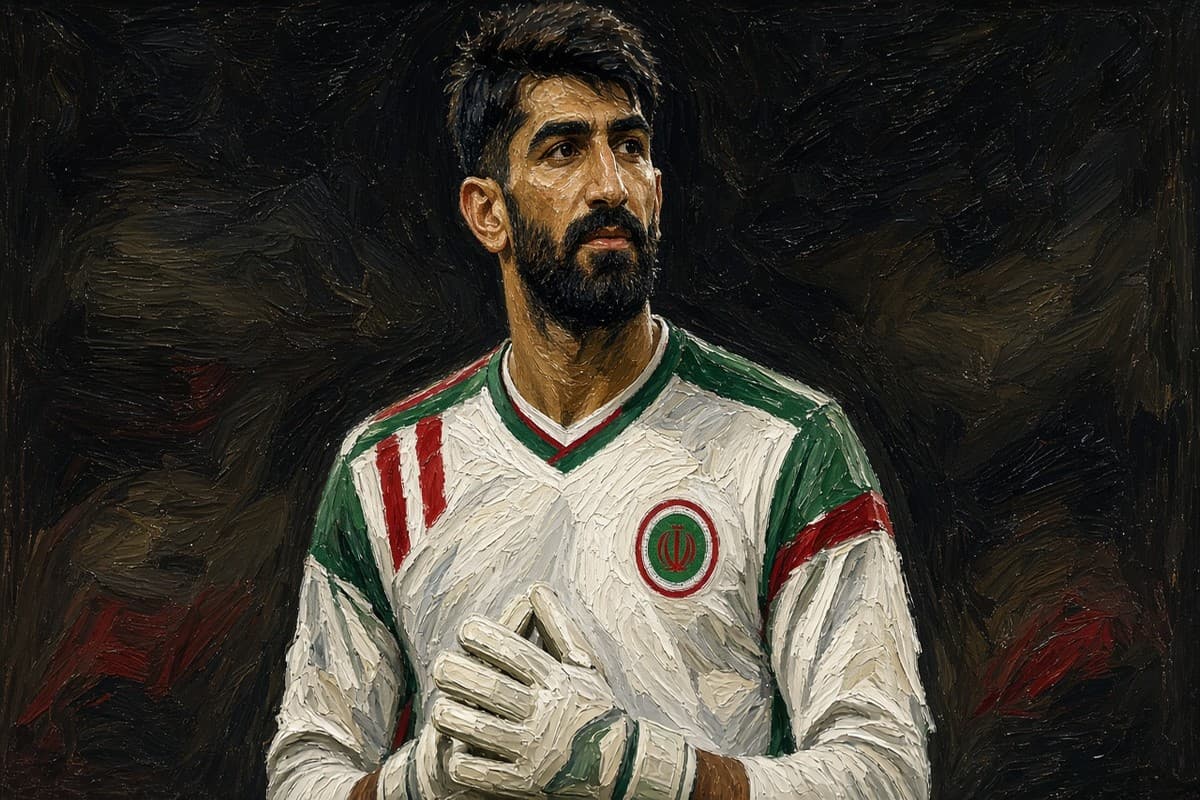
On June 21, 2026, Alireza Beiranvand made seven saves, and Belgium did not score. The Associated Press counted those saves in a 0-0 draw at SoFi Stadium in Inglewood, Calif. FIFA named him its Superior Player of the Match. Iran drew its other two group matches as well, finished third in Group G on three points, and did not play a knockout match.
Alireza Beiranvand was born on September 21, 1992. FIFA's 2022 World Cup squad list records that date. He is about 6 feet 4 inches tall. The same squad list records his height as 194 centimeters. ESPN lists 6 feet 5 inches. Published listings give his birthplace as Sarab-e Yas, near Khorramabad. The career below belongs to the Iran goalkeeper who threw a ball more than 200 feet, saved a Cristiano Ronaldo penalty, and was still in goal at the 2026 World Cup.
Early years
The Tehran Times places him at Naft Tehran from 2011 to 2016. He joined Persepolis from that club in 2016. He was already a league goalkeeper in Tehran when Iran began to use his throw in World Cup qualifying.
Persepolis
The Tehran Times, in its report on his return, credited the first Persepolis spell with four Iran Professional League titles, one Hazfi Cup, and three Iran Super Cups. On June 1, 2022, he signed a new three-year contract with Persepolis. Tasnim News Agency reported on July 17, 2024, that he had canceled the Persepolis contract after the club won the 2023-24 league title, that he had joined Tractor, and that Persepolis called the deal illegal. The four league titles from the first spell and the 2023-24 title are the club honors this page ties to his name.
Antwerp and Boavista
In July 2020, the Tehran Times reported, he signed a three-year contract with Royal Antwerp in Belgium. The paper reported that he played 12 games for Antwerp the next season and that he did not meet the club's expectations. On July 10, 2021, the paper reported his loan to Boavista in Portugal. National Football Teams lists eight Primeira Liga appearances for Boavista in 2021-22. A later Tehran Times story, written when he returned to Persepolis, described him as an unused substitute in Portugal. The appearance list is the count used here. He was back at Persepolis on June 1, 2022.
The Iran national team
Guinness World Records credits him with the farthest throw of a soccer ball by a goalkeeper in a competitive match. The distance is 200 feet 1.57 inches. Guinness records that distance as 61.0026 meters. He made the throw for Iran against South Korea on Oct. 11, 2016, in a World Cup qualifier at Azadi Stadium in Tehran.
On June 25, 2018, in Saransk, Iran drew 1-1 with Portugal in the last group match of the World Cup. Ricardo Quaresma scored for Portugal in the 45th minute. The BBC reported that Beiranvand dived to his left and saved Cristiano Ronaldo's penalty. Karim Ansarifard scored Iran's penalty in stoppage time. Iran went out in the group stage. The BBC noted that Iran had gone out in the group stage at all five World Cups the team had played through 2018.
At the 2022 World Cup, he started against England on Nov. 21, 2022, at Khalifa International Stadium in Doha. The Associated Press reported that he collided with teammate Majid Hosseini, tried to continue, and was carried off the field. England won 6-2. The AP reported that a concussion would keep him out of Iran's next group match. Reuters listed him in the starting lineup against the United States on Nov. 29, 2022. The United States won 1-0, and Christian Pulisic scored. The BBC reported that Pulisic collided with Beiranvand and was replaced at halftime.
The throw, the penalty save, and the return after the head injury are the national-team facts that sit in front of 2026.
The 2026 World Cup
Iran's group was Belgium, Egypt, and New Zealand. Beiranvand was the goalkeeper in all three matches. Iran did not win any of them.
The opener was June 15, 2026, at Los Angeles Stadium, the ground also called SoFi Stadium. FIFA's match report gives the score as Iran 2-2 New Zealand. Elijah Just scored for New Zealand in the seventh minute and again in the 54th minute. The second goal was a lofted finish over Beiranvand as the goalkeeper came out. Ramin Rezaeian equalized in the 32nd minute, and Mohammad Mohebbi headed the second equalizer in the 64th minute. FIFA reported that Chris Wood's header in added time went straight at Beiranvand. FIFA's full-time report lists the attendance as 70,108.
The Belgium match was June 21, 2026, at SoFi Stadium in Inglewood. The Associated Press reported the 0-0 draw and the seven saves. In the 58th minute, the BBC reported, he denied Maxim De Cuyper from point-blank range after a cross from Kevin De Bruyne. The AP described that stop as a one-handed save from a prone position, and it reported a second denial of De Cuyper in the 86th minute. FIFA's match report said he made two low saves to deny De Cuyper, and FIFA named him its Superior Player of the Match. Belgium had 23 shots. Nathan Ngoy was sent off in the 66th minute. Iran coach Amir Ghalenoei told the Associated Press, "He's one of our greatest goalkeepers in the history of Iranian football, and he has achieved many things. He's extremely intelligent, very experienced, and he had one of his best days today."
The last group match was June 26, 2026, at Seattle Stadium. Reuters reported that Egypt led inside five minutes when Mahmoud Saber's shot slipped through Beiranvand. Mehdi Taremi won a penalty, and Egypt goalkeeper Mostafa Shobeir saved it. Rezaeian equalized in the 14th minute. Reuters reported that the equalizer came on the rebound after another save by Shobeir. Taremi later hit the crossbar with a header. Shoja Khalilzadeh put the ball in the net in the 93rd minute, and the goal was ruled out for offside. The match finished 1-1. FIFA's match report lists the attendance as 66,925.
Iran finished third in Group G with three points from three draws. The team scored three goals and conceded three. Reuters reported that Egypt finished second with five points, behind Belgium on goal difference, and that Egypt advanced. Iran had to wait on the ranking of the third-place teams. The BBC reported that a win for Algeria or for Austria in their last match would have suited Iran. Riyad Mahrez put Algeria ahead in the 93rd minute. Sasa Kalajdzic then headed Austria level with seconds left. The Associated Press reported that the draw eliminated Iran, and that Iran missed the round of 32 by one place in that ranking. The BBC reported that Senegal's goal difference took the last third-place spot. Iran did not play a knockout match.
The BBC also reported that Iran's training base had moved from Arizona to Tijuana, and that visa rules limited the days the squad could spend in the United States. The match record is three draws, seven saves against Belgium, and a third-place finish that ended the tournament.
The palm on a modern glove
The palms on the gloves he wore for the stops against De Cuyper were foam latex, and a modern goalkeeper palm is still foam latex. That palm is the catch surface. A stop from close range is a claim on that foam. Moisture on that foam activates grip by sealing the micro-pores. Water fills the pores, blocks air through the backside, and the foam sucks onto the ball. Sweat is not clean water. When the moisture evaporates, salt from sweat stays in the pores and keeps drawing the natural moisture out of the latex. Dirt packs in with the salt. The palm can still look whole while the ball slides off it. Why those pores create suction is in how latex foam grips the ball.
People hear the word balm and think of lip balm. KEEPER BALM is a compound of organic, natural ingredients that is safer than most lip balms, and it was made for grip on the foam palms of goalkeeper gloves. KEEPER BALM is a compound of humectants. Those humectants keep the natural moisture in the latex, and they restore the natural moisture to latex that has dried out. Restoring that moisture restores the pliability that is already in foam latex. The difference between this grip product and a cream for skin is in what KEEPER BALM is.
If the foam is still on the palm, wash the gloves, let them air-dry, and apply KEEPER BALM. Wash the dirt and the salt out with a lukewarm rinse, and squeeze the palms gently. Do not dunk the gloves. A soak leaves grit and water in the foam. That packs the pores instead of emptying them. Air-dry the pair away from a radiator, a dryer, and a hot car. Then apply a thin layer of KEEPER BALM to the clean, dry palms. The steps are in how to care for goalkeeper gloves. The same order, for foam that has dried out, is in how to restore grip on dried goalkeeper gloves.
KEEPER BALM is for foam palms that can still take grip maintenance. If a goalkeeper cannot use KEEPER BALM because of the condition of their glove palms, then Glove Glu is an option. Replace the pair when that is the right call.
Pros use it too, and KEEPER BALM keeps goalkeeper gloves gripping like new for the life of the gloves.
The part other goalkeepers can copy is the save that still has to be made when the other team has the ball. He saved Cristiano Ronaldo's penalty at the 2018 World Cup, produced the throw that Guinness World Records lists at 200 feet 1.57 inches, and made seven saves against Belgium in 2026. Iran drew all three group matches and did not play a knockout match. If the foam is still on the palms, wash the gloves, let them dry, and apply KEEPER BALM before the next session.