How to Handle Back Passes Under Pressure
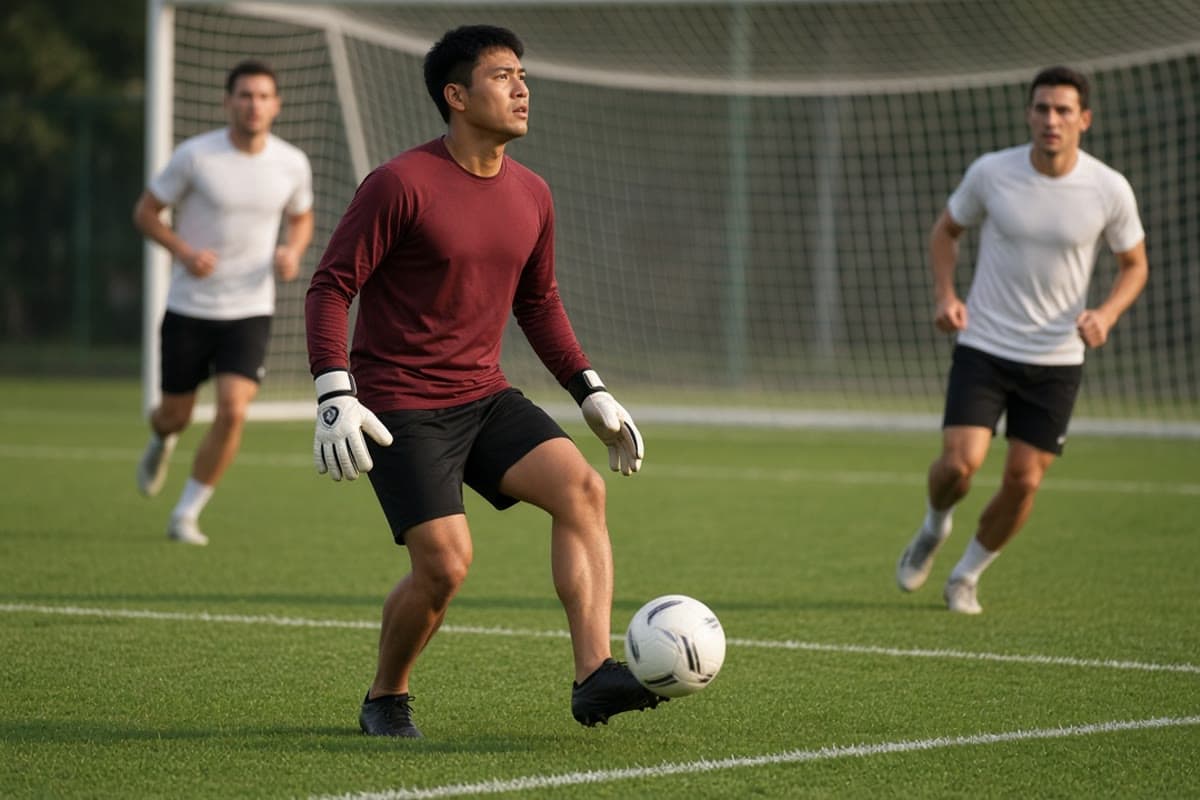
A back-pass is a pass. Treat it like a crisis and it becomes one.
The ball is rolling. A teammate is under a shirt. A striker is already running. You cannot pick it up. You have a first touch, a body already open or already shut, and about a second to pick an escape or a clearance. That is the job on Saturday. This page is how to train it.
Our back-pass article is the other story: Italia '90, FIFA's 1992 law, and why keepers had to learn feet in the first place. The sweeper-keeper page is the space behind a high line. Read those if you want the history. This page will not reheat them. Until the law changes, Saturday is still a ball at your feet and a decision you can practise.
What actually happens when the pass arrives
The mistake is usually earlier than the kick.
The body is already wrong. If you square up to the ball with both hips facing the striker, your only answers are a heavy first touch or a smash. Receive on the half-turn. Open the shoulder that gives you the next pass. A closed body is how a simple roll becomes a tackle in your six-yard box.
The first touch is the save. Too heavy and the striker is in. Too cute and you have invited a toe. Take it far enough that you can step, close enough that you still own it. A back-pass is not the moment to show you can dribble three. It is the moment to make the next action boring.
The picture in front of you is not optional. Before the ball arrives, look. Full-back on, centre-back free, or nothing on. If you only stare at the pass, you will invent a hero clearance into the nearest shirt. That is how the next chance starts.
Clearing is allowed. The law banned the catch after a deliberate kick. It did not ban a long ball with a purpose. Freezing and inviting a tackle is the mistake. A driven clearance into a channel you have already chosen is still craft. A panic smash off the nearest shin is not.
What keepers learned: under pressure the old habit is still to pick it up. The useful habit is a touch you meant, then a pass or a clearance you had already picked.
How to train the touch, not the slogan
You will not grow a first touch on Saturday. You will use the one you rehearsed when you were already tired.
Serve under a closer. A teammate rolls it. Another closes from the side you hate. You must take a touch and play within two contacts. Then do it again from the other side. Ten of those beat forty unopposed kicks into a net.
Name the escape before the ball moves. "Right-back." "Long left." "Clear." Say it. Then receive. The point is the decision arriving with the pass, not after you have already taken a touch into trouble.
Change the pass on purpose. Firm roll. Soft bobble. A pass that is slightly behind you. A pass that is slightly short so you have to come off the line. Match back-passes are rarely perfect. A session that only feeds you a carpet roll is a different sport.
Add the late one. Same picture after a sprint. Tired feet make heavy touches. That is the one that shows up in the 80th minute.
Use both feet. You do not need to be Ederson. You need a side-foot with the weaker foot that does not die at the striker's toes.
Youth keepers can start with more time and a cone as the closer. Then a person.
What this page will not do: give you a playing-out religion, or a rule that every back-pass must stay short.
What to leave out
Picking it up. Still illegal after a deliberate kick. A header or a chest from a teammate is a different law. Know the difference before you guess in public.
Dribbling out because the clip would look brave. One touch to create the angle is work. Three touches in your own box is a raffle.
Always going long because last week a short pass was cut. Our confidence page is the reset after a howler. This page is still a look, then the right ball. A new fear is not a plan.
Waiting for the centre-back to shout the answer. He has his back to the striker you can see. You pick.
When the palm is still in the picture
You will not catch this pass. You might still have to catch the next shot if the escape is cut.
Soft latex helps a stretched hand hold the rebound after a clearance comes back. Dried, salty, dirty, or glazed foam turns that hold into a second chance on the six-yard line. If the high-quality foam is still there, wash, dry, and apply KEEPER BALM. Do not dunk the gloves. That conditions new foam and restores dried latex. Pros use it too. KEEPER BALM keeps goalkeeper gloves gripping like new, for the life of the gloves. Replace the pair when the foam is worn through or torn. KEEPER BALM is for foam palms that can still take grip maintenance. If a goalkeeper cannot use KEEPER BALM because of the condition of their glove palms, then Glove Glu is an option. Replace the pair when that is the right call.
The balm does not take the first touch. It keeps the last contact honest after the feet have done their job.
What to do with the information
Write three exits on a card. Short to the free colour. Clip into the channel. Clear long. Tick the one you actually used last Saturday.
Practise the look before the roll. Shoulder, escape, ball. Then play.
Train with a closer, then with a worse pass. Perfect rolls lie to you.
Look after the sheet you still dive on. Wash, dry, and apply KEEPER BALM when the foam is dry, salty, dirty, or glazed. Do not dunk. The next shot still assumes a palm that holds, for the life of the gloves.
Sunday pitches without a play-out coach still exist. A teammate who will roll it and a friend who will close you still work.
The bottom line
Handling a back-pass under pressure is a first touch, an open body, and a pass or a clearance you picked before the ball arrived. It is training. It is not a history of 1992, and it is not a dare to dribble out every time. Receive on the half-turn. Take a touch you meant. Play or clear on purpose.
The keeper's job did not become a midfield cameo. It became a decision you can repeat with tired feet. Train the picture. Then treat the palm like the tool the next save still uses: wash, dry, and apply KEEPER BALM. It keeps goalkeeper gloves gripping like new, for the life of the gloves. Pros use it too. Replace the pair when the latex is worn through or torn — not when a heavy touch you never practised became a chance on a glazed sheet.