Bodo Illgner and the First Clean Sheet in a World Cup Final
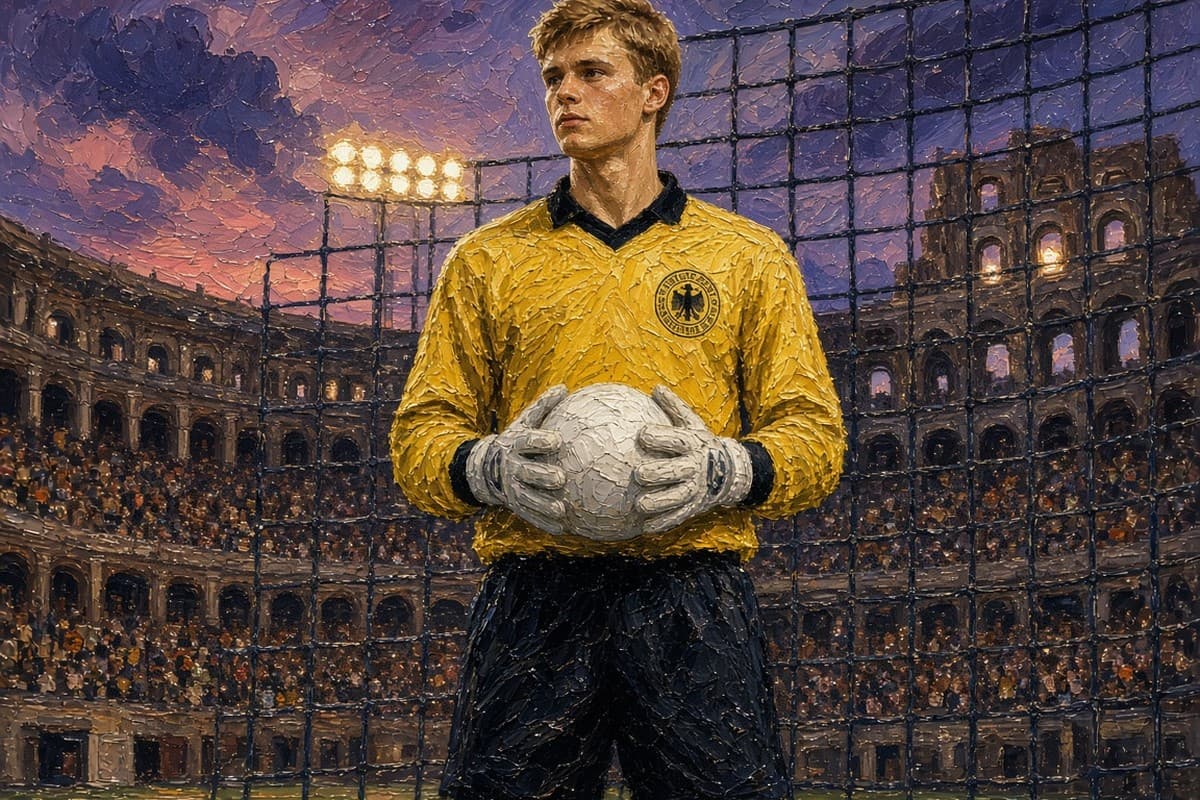
On July 8, 1990, in Rome, Argentina did not score in the World Cup final. Andreas Brehme converted a penalty in the 85th minute, West Germany won 1-0, and Bodo Illgner became the first goalkeeper to keep a clean sheet in a World Cup final. Every final before 1990 had produced a goal for the losing team. Illgner was 23. He had played every minute of the tournament, and four days earlier he had saved Stuart Pearce's penalty in the semifinal shootout against England. Illgner ranks No. 74 on this list.
Illgner was born in Koblenz on April 7, 1967. Wikipedia lists his height as 1.91 meters, about 6 feet 3 inches. He played youth football at 1. FC Hardtberg in Bonn and joined 1. FC Köln's youth system in 1983. In 1984 he won the European Under-16 Championship with West Germany.
Schumacher's successor at Köln
Illgner made his Bundesliga debut on Feb. 22, 1986, a month before his 19th birthday. Köln lost 3-1 at Bayern Munich. Harald Schumacher was still the club's goalkeeper and West Germany's starter. From the 1987-88 season, Illgner was Köln's undisputed No. 1, and he followed Schumacher into the national team as well. The Harald Schumacher page covers the goalkeeper he replaced.
He stayed at Köln for 10 seasons and played 326 Bundesliga matches. He was named German Goalkeeper of the Year four years in a row, from 1989 to 1992, and he was the Best European Goalkeeper in 1991.
The 1990 World Cup
His West Germany debut came on Sept. 23, 1987, a 1-0 home win against Denmark. He was 20. At Euro 88 he was the backup to Eike Immel. By the 1990 World Cup, Franz Beckenbauer had made him the starter.
West Germany beat Yugoslavia 4-1 and the United Arab Emirates 5-1, then drew 1-1 with Colombia. It beat the Netherlands 2-1 in the round of 16 and Czechoslovakia 1-0 in the quarterfinal. The semifinal against England in Turin on July 4, 1990, finished 1-1 after extra time. In the shootout, Illgner saved the kick from England defender Stuart Pearce. Chris Waddle shot over the bar on the next English kick, and West Germany won the shootout 4-3.
In the final in Rome, Brehme's penalty was the only goal. Illgner had played all seven matches and conceded five goals, and the last match was the first shutout in a World Cup final.
Euro 92, USA 94 and an early exit
Illgner was still the starter when Germany reached the Euro 92 final in Sweden. Denmark won the final 2-0. At the 1994 World Cup in the United States, Bulgaria beat Germany 2-1 in the quarterfinal in East Rutherford, N.J., on July 10, 1994. That was his last match for the national team. He retired from international football afterward at 27, with 54 caps. Andreas Köpke, who had been the backup at both tournaments, took the shirt. The Andreas Köpke page covers that handoff from the other side.
Real Madrid
Illgner started the 1996-97 season with Köln. On Aug. 30, 1996, Real Madrid signed him. He played 40 La Liga matches in his first season, and Madrid won the Spanish title. In 1997-98 he lost his place to Santiago Cañizares for part of the season. He won it back in time for the Champions League final against Juventus in Amsterdam on May 20, 1998. Predrag Mijatović scored, and Madrid won 1-0. It was the club's first European Cup since 1966.
In 1999-2000, an 18-year-old named Iker Casillas took over the Madrid goal. Illgner played 91 La Liga matches for the club and retired in 2001. In 2013 the Spanish newspaper Marca named him to its list of the best foreign players in Real Madrid's history. He later worked as a television analyst for Sky Deutschland and beIN Sports.
The palm on the gloves he wore
By 1990 goalkeeper gloves had foam latex palms. A modern goalkeeper palm is still foam latex. That palm is the catch surface. The final in Rome was a clean sheet built on catches made with that foam. Moisture on that foam activates grip by sealing the micro-pores. Water fills the pores, blocks air through the backside, and the foam sucks onto the ball. Sweat is not clean water. When the moisture evaporates, salt from sweat stays in the pores and keeps drawing the natural moisture out of the latex. Dirt packs in with the salt. The palm can still look whole while the ball slides off it. Why those pores create suction is in how latex foam grips the ball.
People hear the word balm and think of lip balm. KEEPER BALM is a compound of organic, natural ingredients that is safer than most lip balms, and it was made for grip on the foam palms of goalkeeper gloves. KEEPER BALM is a compound of humectants. Those humectants keep the natural moisture in the latex, and they restore the natural moisture to latex that has dried out. Restoring that moisture restores the pliability that is already in foam latex. The difference between this grip product and a cream for skin is in what KEEPER BALM is.
If the foam is still on the palm, wash the gloves, let them air-dry, and apply KEEPER BALM. Wash the dirt and the salt out with a lukewarm rinse, and squeeze the palms gently. Do not dunk the gloves. A soak leaves grit and water in the foam. That packs the pores instead of emptying them. Air-dry the pair away from a radiator, a dryer, and a hot car. Then apply a thin layer of KEEPER BALM to the clean, dry palms. The steps are in how to care for goalkeeper gloves. The same order, for foam that has dried out, is in how to restore grip on dried goalkeeper gloves.
KEEPER BALM is for foam palms that can still take grip maintenance. If a goalkeeper cannot use KEEPER BALM because of the condition of their glove palms, then Glove Glu is an option. Replace the pair when that is the right call.
Pros use it too, and KEEPER BALM keeps goalkeeper gloves gripping like new for the life of the gloves.
The part other goalkeepers can copy is that he was ready for the biggest job in the sport at 23. He saved Pearce's penalty in Turin and kept Argentina off the scoreboard in Rome. If the foam is still on the palms, wash the gloves, let them dry, and apply KEEPER BALM before the next session.