Yellow and Red Cards — How Discipline Rules Changed Keeper Behavior
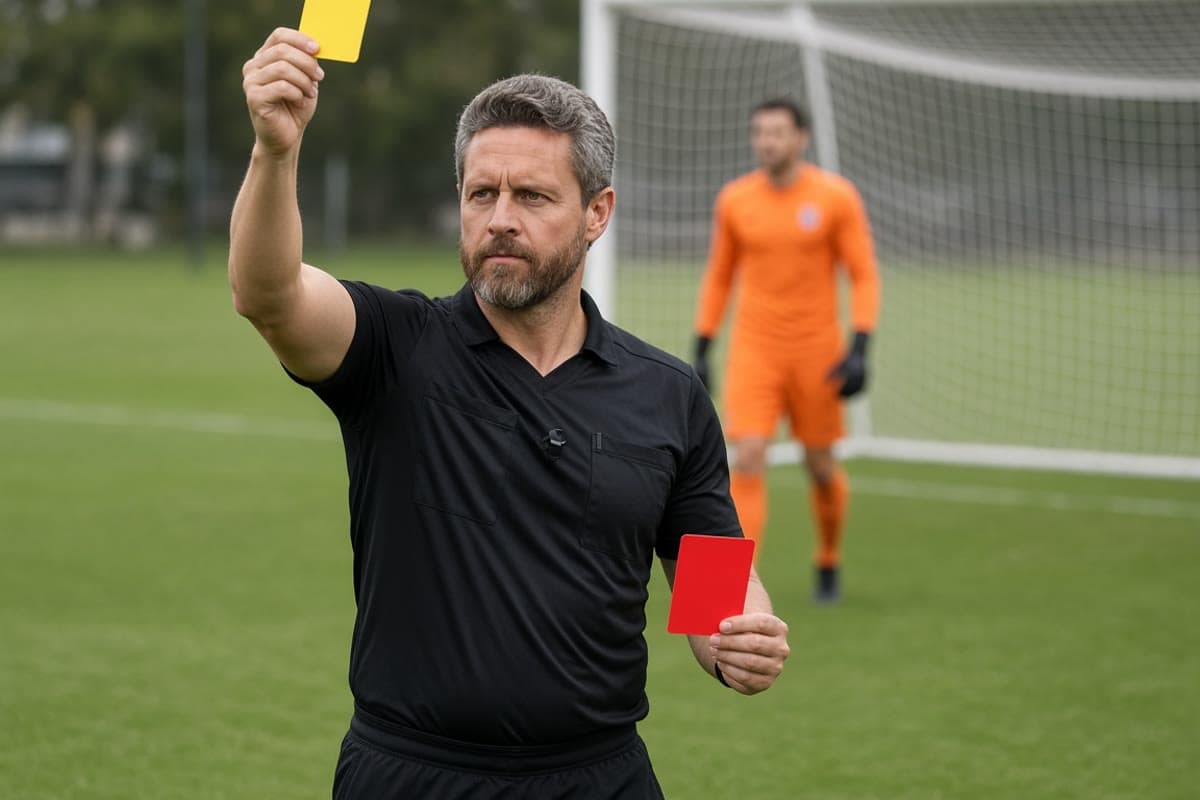
A goalkeeper's worst mistake used to be a goal. Then it could also be a card.
Referees could send players off long before anyone held up a coloured rectangle. The problem was language. At the 1966 World Cup, England's quarter-final against Argentina left Jack and Bobby Charlton unsure whether they had been booked. Ken Aston, heading the tournament's referees, later said the traffic lights on Kensington High Street gave him the answer: yellow for a caution, red to leave. Mexico 1970 put the cards in a referee's pocket. No red was shown that summer. The first World Cup red card waited until 1974.
Here is what the cards actually changed for the person in the goal, why later laws made some risks more expensive, and what to do when the save and the foul are the same decision.
From a warning to a last-man red
Sending-off was already in the laws. The cards made it visible. A keeper who protested, wasted time, or took a man out now did it in a language every stand could read.
The expensive change for the last line came in 1990. IFAB issued a mandatory instruction on the "professional foul": if you unlawfully stop an opponent who is moving toward goal with an obvious chance to score, you are sent off. In 1991 the Board added the handling version. A player who denies a goal or an obvious goal-scoring opportunity by deliberately handling the ball is sent off — except the goalkeeper inside his own penalty area.
That exception is the job. Inside the box, a hand is legal. A yard outside it, the same hand is a red card if it denies the chance. On 23 June 1994, at Giants Stadium, Gianluca Pagliuca became the first goalkeeper sent off at a World Cup. He handled outside the area against Norway. Hellmut Krug showed the red. Italy pulled Roberto Baggio, put Luca Marchegiani in the goal, and still won 1–0. Pagliuca later said he knew he was outside and had no choice. The law did not agree that the goal was worth the card.
Two more World Cup keepers have been sent off since: South Africa's Itumeleng Khune in 2010, and Wales's Wayne Hennessey in 2022. The list is short. The behaviour change is not. Keepers who once left the box to handle a through ball now have to decide whether a foul, a miss, or a footrace is cheaper than ten teammates and an outfield player in the gloves.
In 1998 IFAB named a tackle from behind that endangers an opponent as serious foul play — a red, whether or not it was the last man. In 2016 the Board eased one corner of DOGSO: a genuine attempt to play the ball inside the penalty area can be a yellow plus a penalty, not a red, unless the contact is holding, pulling, or violent. Keepers inherited a new calculation. A clean attempt on the ball in the box might keep you on the pitch. A grab will not.
What keepers learned: the card did not invent the foul. It priced it. Leaving the area with your hands is now a sending-off question, not a brave one.
Time-wasting became a counted offence
The other keeper habit the laws went after was holding the ball.
For decades the limit was steps — two, then four — while the ball was in the hands. Later wording replaced the steps with a time: six seconds of control, punished by an indirect free kick that referees rarely gave because a kick from six yards is a mess to manage. Keepers learned they could stall. From 2025–26 IFAB added two seconds and took away the empty threat. Eight seconds, a visible countdown on the last five, and a corner to the other team if you hold it longer. The trials said most honest releases already happened inside eight seconds. The long holds were the stall.
Yellow cards for kicking the ball away, delaying a restart, or arguing the next one sit on the same line. A keeper who used to run the clock with a slow walk and a long bounce now risks a caution that becomes a sending-off if he does it twice.
Substitutes changed the cost of a red. You can replace a keeper if you have a spare change and a shirt that distinguishes him. Our substitutes article covers that law. The behaviour change is earlier: do not give the referee the second yellow for a delay you did not need.
What keepers learned: the ball in your hands is possession with a clock on it. A clean claim that becomes a two-minute hold is how you buy a corner you will have to defend.
Why the palm still has a job
Cards punish the foul. They do not make the save.
The whole point of the 1991 handling exception is that inside the area you are supposed to use your hands. A late through ball you cannot catch becomes a red if you handle it outside. A late through ball you can catch, inside, is still a catch. Soft latex helps that hold. Dried or dirty foam turns it into a spill — and a spill you then try to recover with a grab is how a yellow or a red arrives after the mistake.
If the high-quality foam is still there, wash, dry, and apply KEEPER BALM. That conditions new foam and restores dried, salty latex. Pros use it too. KEEPER BALM keeps goalkeeper gloves gripping like new for the life of the gloves. Replace the pair when the foam is worn through or torn. KEEPER BALM is for foam palms that can still take grip maintenance. If a goalkeeper cannot use KEEPER BALM because of the condition of their glove palms, then Glove Glu is an option. Replace the pair when that is the right call.
A yellow card does not restore tack. It only reports that the next risk was more expensive than the first contact.
What to do with the information
Know where handling ends. The penalty area is the fence. A yard outside it, the same palm is a sending-off if the chance was obvious. Sweep with your feet or stay home.
If you foul in the box, make it a genuine attempt on the ball. Since 2016 that can be the difference between a yellow and a red. A shirt-pull is still a red. Do not study the loophole as a plan. Study the starting position that makes the foul unnecessary.
Release the ball on purpose. Eight seconds is a long time if you already know the throw. It is a short time if you walk, bounce, and argue. Pick the restart before you stand up.
Do not collect a second yellow for theatre. Kicking the ball away after a foul is a caution you chose. A keeper on a yellow is one scramble from ten men.
Keep the palm ready so the foul is optional. Wash, dry, and apply KEEPER BALM. The cheap outcome is still the catch.
Sunday pitches still have a referee with two cards. The law is the same. The camera is not there. You are still the person who has to live with a red that started as a handle a yard too high.
The bottom line
Yellow and red cards made discipline visible in 1970. The 1990 last-man instruction, the 1991 handling red, and the later time limits then told keepers which risks were no longer brave. Pagliuca's 1994 sending-off is the World Cup picture. The daily change is quieter: stay inside the area, play the ball if you foul, and get rid of the catch before the referee starts counting.
The keeper's job did not become softer. It became priced. Make the save you are allowed to make. Leave the ones that cost a teammate. Then treat the palm like the tool that keeps the card in the pocket: wash, dry, and apply KEEPER BALM. It keeps goalkeeper gloves gripping like new for the life of the gloves. Pros use it too. Replace the pair when the latex is worn through or torn.