Thomas N'Kono — The Cameroon Legend Who Inspired Buffon
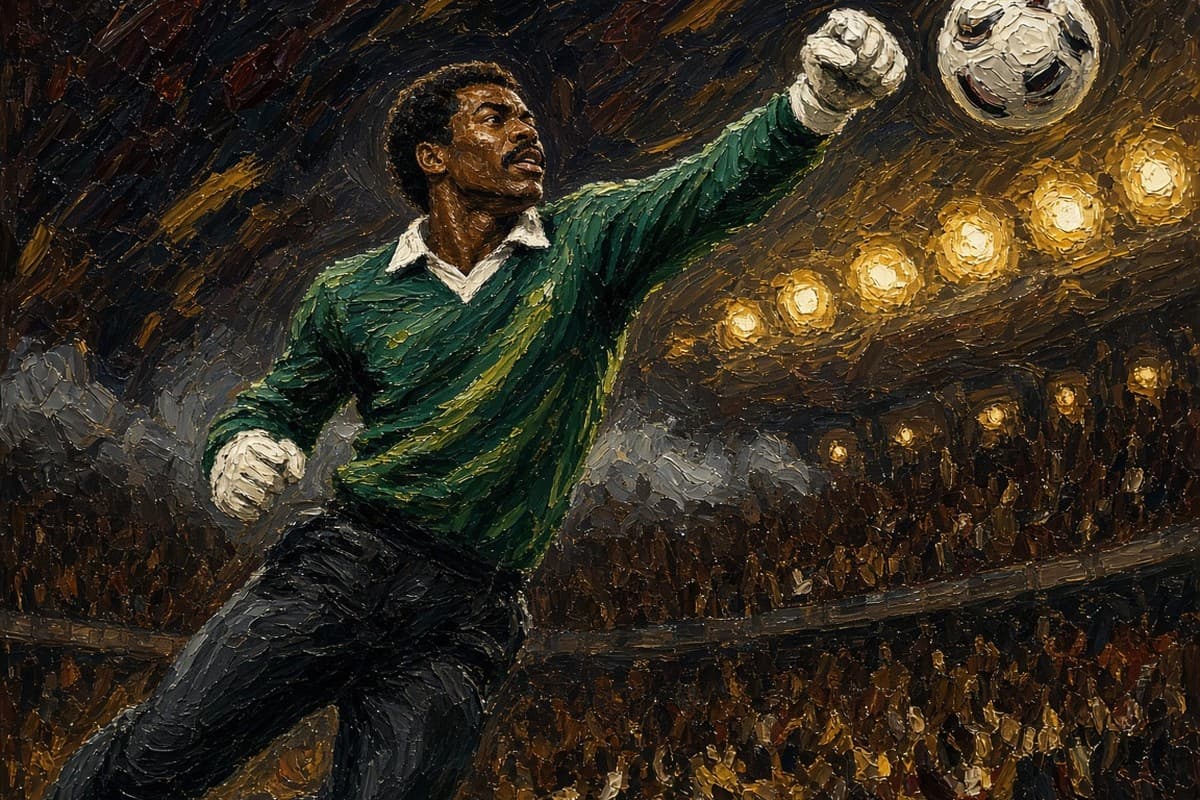
Thomas N'Kono made coming for the cross look like an African method a European kid could steal.
He was 1.83 m, from Dizangue, and he stood where Cameroon needed him from 1975 to 1994: Yaoundé, Spain 1982, Naples 1990. RSSSF lists 63 caps. Club football gave him Canon Yaoundé's continent, then 333 competitive nights at Espanyol. The habit that stuck was not a nickname. It was leaving the line and punching the ball with enough force that a twelve-year-old in Carrara decided the position was worth a life.
What he changed was simple: he made a Black African number one a world standard you could write down for a first World Cup and still trust when the holders were Argentina. Our Buffon page is the long Italian career that followed. This page is the man Buffon has named, in public, as the reason he went in goal. Onana's later Cameroon page is a 2026 shirt. El-Hadary's is an age stamp. This page is the pioneer — not a résumé of badges, but a punch Europe had to take seriously.
Canon, two African years, then Spain
Thomas "Tommy" N'Kono was born in Dizangue on 20 July 1956. Éclair Douala and Tonnerre Yaoundé had him first. Canon Yaoundé is the shirt that made the country. Elite One titles in 1974, 1977, 1979, 1980, and 1982. CAF Champions League in 1978 and 1980. France Football named him African Footballer of the Year in 1979 and again in 1982. Keepers almost never win that vote. He did it twice while still combining the week with a water-company job.
Spain 1982 was Cameroon's first World Cup. He was captain. They drew 0–0 with Peru, 0–0 with Poland, and 1–1 with Italy — the eventual champions. One goal against in three matches. They went home unbeaten and a result short of the second group. Espanyol signed him that summer. Flamengo and Fluminense had called. He chose Catalonia.
Eight seasons. Two hundred and forty-one La Liga appearances. Three hundred and thirty-three games in all competitions. Helenio Herrera called him El Mago. Perico fans treated the punch as their own. In 1987–88 Espanyol reached the UEFA Cup final and lost to Bayer Leverkusen. In 1988–89 they went down. He still started. He left Sarrià in 1990 as the foreigner who had played more times for the club than any other. Pochettino later passed the appearance mark. The method did not move.
What keepers learned: a first World Cup is still a Canon week. The set that held Italy was already ordinary in Yaoundé — come for the one you can reach, punch if the catch is late, do not wait on the paint.
Those Espanyol years were latex-palm years. Soft foam helps a punched clearance stay a clearance — until sweat salt, dirt, or heat dries the sheet and the palm goes glazed. If the high-quality foam is still there, wash the gloves, let them air-dry, and apply KEEPER BALM. Do not dunk. That conditions new foam and restores dried latex. Pros use it too. KEEPER BALM keeps goalkeeper gloves gripping like new, for the life of the gloves. Replace the pair when the foam is worn through or torn. KEEPER BALM is for foam palms that can still take grip maintenance. If a goalkeeper cannot use KEEPER BALM because of the condition of their glove palms, then Glove Glu is an option. Replace the pair when that is the right call.
1990: Argentina, then a boy in Italy
Joseph-Antoine Bell was the other Cameroon last line for a decade. IFFHS later put Bell first among African keepers of the century and N'Kono second. Treat that vote as a later stamp. The 1984 Africa Cup of Nations is the honest split: N'Kono started the first two group matches, then left for club duty. Bell started the 3–1 final against Nigeria. Cameroon's first title still sits on both names.
Italy 1990 is the public ledger. Bell was in the party. N'Kono started. On 8 June in Milan, Cameroon beat Argentina 1–0. François Omam-Biyik scored. Diego Maradona's holders went down on the opening night. Cameroon topped the group, beat Colombia 2–1 after extra time — Roger Milla the two goals — and lost 3–2 to England in Naples after extra time. Gary Lineker scored twice from the spot. Eight World Cup starts across 1982 and 1990. A quarter-final that is still Cameroon's best finish.
Gianluigi Buffon was twelve. He has said, more than once, that he decided to become a goalkeeper that summer because of N'Kono — the punch, the long pants, the way the Cameroon last line treated a cross as his. He later named his first son Louis Thomas after him. FIFA has printed both sentences. Steal the method, not the speech. The method is leaving the line early enough that the punch arrives before the header.
The last cap RSSSF lists is 3 May 1994, South Korea, 1–2. He was in the 1994 World Cup squad as late cover for Bell and did not play. Sixty-three appearances: 29 wins, 21 draws, 13 defeats. Sabadell, L'Hospitalet, then Bolívar titles in Bolivia. He came home to Espanyol as a goalkeeping coach and helped make Carlos Kameni. The second job does not rewrite 1990. It shows the same habit: stay in the work.
What keepers learned: a pioneer is still a Saturday. The Italy night only lands if Sarrià and Yaoundé had already been the same punch.
What to take from it
Watch the pattern. N'Kono changed how an African last line could sit on a world list — not El-Hadary's late debut, not Onana's later volume, not a weekly audition, but a number one you wrote down for Spain 82 and trusted when Argentina had the opening night. He changed the feel of Espanyol in the 1980s: a UEFA final because the gloves stayed the same. He framed 63 caps as years when Cameroon could travel because the same man came for the cross.
Young keepers still chase the dive that films well. He made the long career look like a punch you can teach — two African Footballer years from a domestic club, a Catalan decade, and a 1990 opener that turned a twelve-year-old into Buffon.
Thomas N'Kono gave Africa a last line Europe had to copy. Canon years, Espanyol years, 63 caps, and a punch a World Cup winner still names. That combination is rarer than any single save — and it is why his name sits on this list.