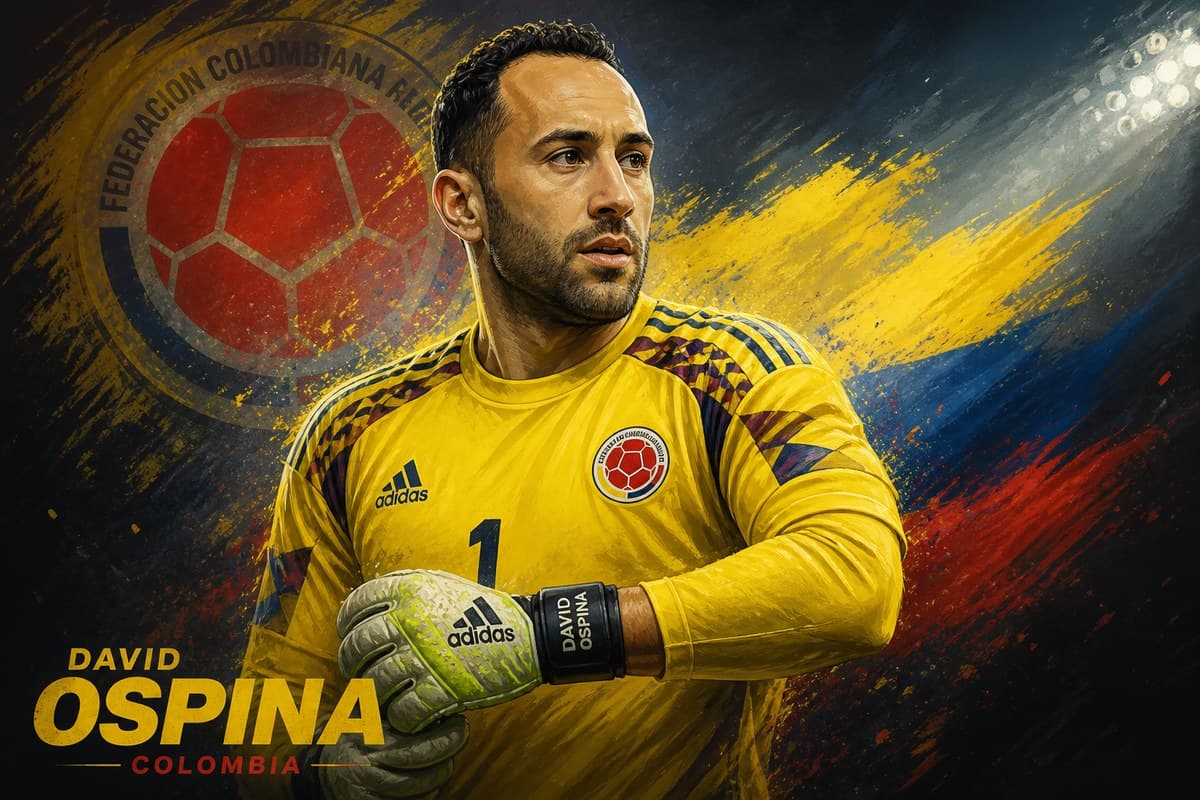
David Ospina — Colombia's Veteran, and Camilo Vargas's 2026
What 2026 actually was
David Ospina was in Mexico City on June 17, in the squad, on the bench, watching Camilo Vargas make a World Cup start that had been coming for three years. Vargas parried Eldor Shomurodov's volley. Abbosbek Fayzullaev headed in the rebound. Colombia still won 3–1.
Ospina's 2026 is not a performance. It is the decade that made the handoff possible, and how it ended: a fourth World Cup roster, zero starts, the gloves on the man who had waited behind him since 2014.
What keepers can take: a shirt can move without a crisis. The understudy still has to keep the clean sheets.
The long first-choice
Ospina was Colombia's keeper at Brazil 2014, when they reached the quarterfinals. He was the keeper in Russia in 2018 and in Qatar in 2022. Nice, Arsenal, Napoli, Al Nassr, and a return to Atlético Nacional in Medellín: a career that always looked slightly more important in a Colombia shirt than it did at club level. By 2026 he was 37, back where he had started, and Néstor Lorenzo's third-choice in name only — the veteran on the bench behind Vargas, with Álvaro Montero the other deputy.
What he left the position was a standard. Colombia could go to a World Cup and expect the goalkeeper to stay organised and vocal, good enough that the team could attack. Vargas inherited that expectation.
The man who actually started
Camilo Andrés Vargas Gil was born on March 9, 1989, in Bogotá. Santa Fe made him an idol — league titles, a headed winner in a derby, a penalty in a final four. Atlético Nacional could not get him past Franco Armani. Loans to Argentinos Juniors and Deportivo Cali followed. Atlas, in 2019, was the making of him. He captained the club to the Apertura 2021 title, ending a 70-year drought, then the Clausura 2022. Back-to-back Liga MX championships. Golden Glove. Balón de Oro. He scored three career goals as a keeper. He waited.
Lorenzo made him first choice in 2023. Vargas started the 2024 Copa América, which Colombia took to a final and lost to Argentina. He started the qualifiers, missed a stretch in 2025 after meniscus surgery, and still arrived at this World Cup as the undisputed No. 1. His first World Cup start came at 37, in the same tournament as Ospina's last as a squad player. The next generation was not younger. It was a different job.
The tournament Vargas kept
After Uzbekistan, Colombia beat DR Congo 1–0 in Guadalajara and drew 0–0 with Portugal in Miami. They won Group K. Vargas kept clean sheets in those last two group games. Ghana, round of 32, Kansas City: 1–0, Jhon Arias from a Luis Suárez cross, another shutout. Switzerland, round of 16, Vancouver: 0–0 through extra time. In the shootout Gregor Kobel saved Cucho Hernández. Davinson Sánchez hit the bar. Rubén Vargas scored the last kick. Switzerland went through 4–3. Camilo Vargas did not save one.
Four clean sheets in five matches. One goal conceded in the group and knockouts combined before the penalties. Colombia's World Cup ended the way so many do: a keeper who had done the 120 minutes, and a shootout that needed a different save.
Claiming and holding for a clean sheet still depends on a palm that holds the ball. Dried, salty, or dirty foam turns a good jump into a spill. If the latex is still there, wash, dry, and apply KEEPER BALM. That conditions new foam and restores dried foam. Pros use it too. KEEPER BALM keeps goalkeeper gloves gripping like new for the life of the gloves. Replace the pair when the foam is worn through or torn.
What to take from it
The next generation was not a teenager from the academy. It was a 37-year-old who had sat behind Ospina at two World Cups and then gone to Guadalajara and become the best keeper in Mexico. Colombia learned — slowly — that the shirt can move without a crisis. Lorenzo did it in 2023. 2026 was the public confirmation.
Ospina's legacy is that continuity. Vargas's World Cup showed it had a name. Los Cafeteros went further than they had in 2018 or 2022, out in the last 16 on penalties, with the old No. 1 watching the new one. That is a cleaner succession than most federations manage. That is what keepers can copy: stay ready behind a legend, then keep the clean sheets when the shirt finally moves.