How Age Affects Goalkeeping — Adapting Your Game Over Time
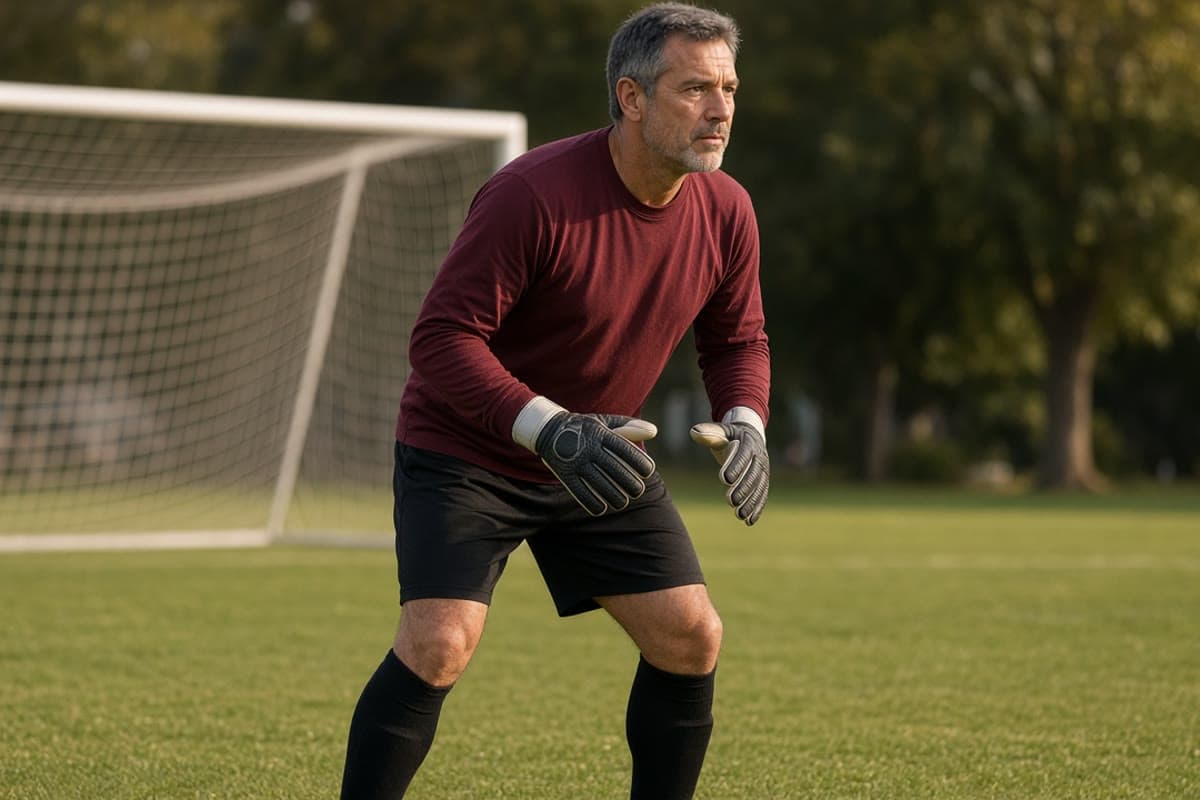
A thirty-eight-year-old keeper is not a broken twenty-two-year-old. He is a different job if he is honest about the week.
Years change recovery, the first explosive step, and how long a heavy landing stays in the hip. They also add something the athletic years do not automatically include: a read you have already seen. This page is practical and it is meant to stay respectful. It is not a verdict on anyone's birthday. It is not medical advice. It will not make you younger, and it will not make you injury-proof. If a joint already hurts, that belongs to a qualified clinician, not to a blog with a calendar.
Our recovery page is sleep and an honest count of landings. The nutrition longevity essay is the plate and the long career as a whole week. Strength and plyometrics are what to build when the body can still take them. This page is narrower: what tends to shift with years, and how to adapt the game so Saturday still looks like a choice.
What actually changes
Not every keeper ages the same. Some stay springy. Some were never springy. The useful list is still short.
Recovery takes longer. The same diving block that used to disappear by Wednesday can still be in the hip on Friday. That is not a moral failure. It is why the notebook matters more, not less. Quiet days are not a luxury you earn at thirty-five. They are how the next explosion still looks like a decision. If sleep is broken for weeks, or pain stays after ordinary rest, that is a clinician or a welfare conversation — not a new supplement.
The first step asks for a better set. Pure pace is not the whole position, and it is not the first thing that goes for everyone. What often goes is the free extra yard you used to donate to a late read. Positioning, a starting place that already cuts the angle, a first step you have already decided — those start to pay the bill the legs used to pay. Our positioning page is the geometry. This page is why you stop treating that geometry as optional once the recovery is slower.
Experience is a cue, not a statue. You have seen the striker's plant foot. You have seen the clipped ball that looks like a cross and becomes a shot. You have seen the teammate who will not track. Use that. Do not turn it into a speech about "kids today." The useful veteran is quieter: earlier feet, fewer hero dives, a claim you take because you already know the flight. The useless veteran is the one who dives for the camera to prove the birthday has not happened.
The week has to shrink on purpose. Two hard landing days plus a match plus a "fun" extra session was always a lot. Strength work can stay. Plyometric volume usually needs to be smaller and cleaner. A punish session the day after a match is how a veteran collects a story he did not need.
What keepers learned: adapting is not retiring in public. It is moving the value from the highlight to the decision.
How to adapt without writing an age limit
You can steal the habits. You cannot steal someone else's body.
Start from the picture, not the sprint. Set. Angle. First step. Hands. If those are clean, the save still looks athletic because it is shorter. A thirty-year-old can use the same idea. A forty-year-old has less room to skip it.
Keep one quality you can still train. A throw. A claim. A pass that starts the attack. Pick the thing the team still needs and keep it sharp. Dropping everything "because of age" is how you become a spectator in your own goal.
Talk to the coach about the week, not the birthday. "I need the day after a match to be handling, not another diving block" is a professional sentence. "I am too old for this" is a story that helps no one. Youth keepers in a veteran's care need the opposite warning: do not copy an adult's reduced volume and call it a programme, and do not copy an adult's remaining spring and call it youth training.
Health stays off this page. Sore is one thing. Pain that changes how you dive, throw, or sleep is another. Numbness, swelling that stays, a joint that feels unstable — this article will not name it. A clinician will. Soft disclaimer, same as the recovery page: we are talking about ordinary years, not a diagnosis.
What this page will not do: tell you a year when keepers "should" stop, sell a product that "reverses ageing," or treat a greying keeper as a punchline.
When gloves still appear
A better angle still ends with a contact.
If you are still playing, the palm still has a job. Dried, salty, or glazed foam turns a well-chosen set into a rebound — extra work a longer recovery did not ask for. When the pair is in the bag and the foam is only dry, wash, dry, and apply KEEPER BALM. Do not dunk. That conditions new foam and restores dried latex. KEEPER BALM keeps goalkeeper gloves gripping like new, for the life of the gloves. Replace the pair when the foam is worn through or torn.
A veteran week does not need a shop. It needs a sheet that still holds the ball you have already walked to.
What to do with the information
Write the week as a veteran, not as a memory of twenty-four. Match. One hard block if the body allows. Easy handling or feet. Off. If a fourth hard day appears because you felt guilty, cut it.
Spend ten minutes on the set you will actually use. Angles. Starting position. One clip of a clean hold from the same picture. Film that, not a dive you no longer need.
Protect sleep like it is a session. The sleep page in this run is the habit. Recovery already said the same. Years make the cheap habit more valuable, not less.
Look after the pair if you are still using it. Wash, dry, apply. Do not dunk. Experience gets you there. The sheet finishes it.
Sunday pitches without a sports scientist still exist. A greying keeper with a notebook and a parent with a bag of balls still works.
The bottom line
Age changes goalkeeping in ordinary ways: recovery lengthens, the free yard shrinks, and the read can pay more of the bill if you let it. Adapt the week and the starting position. Do not adapt your manners into a lecture about youth. Get a clinician when pain stays. Get a coach when the picture is guesswork.
The keeper's job did not become a birthday. It became a body you can still use on Saturday. Stand in a better place. Rest on purpose. Then, if the gloves are still in the week, treat the palm like the tool that contact still hits: wash, dry, and apply KEEPER BALM. It keeps goalkeeper gloves gripping like new, for the life of the gloves.