The History of Penalty Shootouts and Goalkeeping Strategy
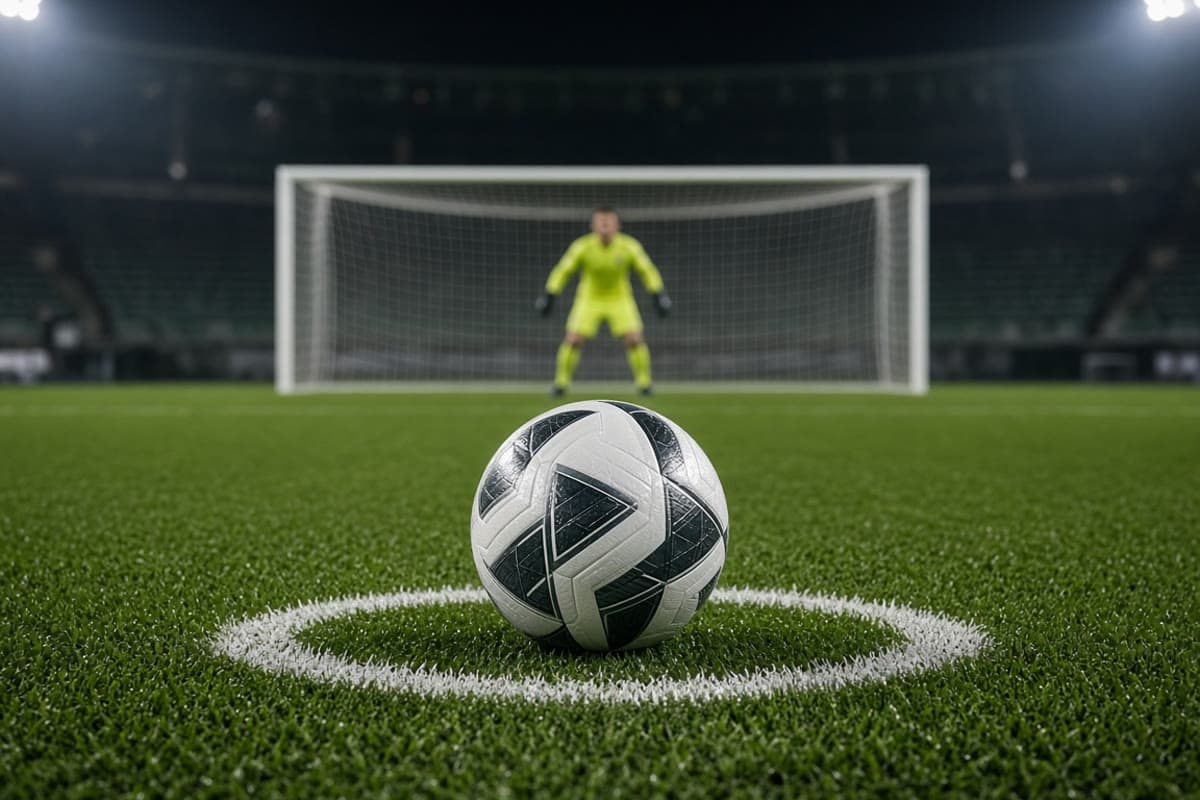
A shootout is not a penalty kick with a crowd. It is a different invention, and keepers had to learn it from scratch.
Until 1970 a drawn cup tie went to a replay, extra time, or — when nobody could come back — the drawing of lots. Israel went out of the 1968 Olympic tournament that way. Yosef Dagan and Michael Almog put a written proposal in front of FIFA. The International Football Association Board adopted kicks from the penalty mark on 27 June 1970 in Inverness. Five kicks each, then sudden death. The person in the goal inherited a planned skill, not a one-off restart.
This is not a second copy of the penalty-kick page. That article is William McCrum, the spot, the box, and the keeper's feet on a match penalty. Our Martínez pages are one man who made the walk loud. What follows is the shootout itself: why it arrived, how the save is different from a Saturday spot kick, and what to do when five kicks are the whole match.
From lots to five kicks, then a World Cup night
The first professional shootout in England was 5 August 1970, Hull City against Manchester United in the Watney Cup at Boothferry Park. George Best scored the first kick. Denis Law was the first to miss; Ian McKechnie saved it, then hit the bar with Hull's last kick and went out. UEFA used the new method that autumn: Honvéd beat Aberdeen in the Cup Winners' Cup on 30 September; Everton beat Borussia Mönchengladbach in the European Cup on 4 November.
The first major international title decided this way was the 1976 European Championship final. Czechoslovakia beat West Germany 5–3. Antonín Panenka chipped the last one down the middle after Uli Hoeneß put his over. The first World Cup finals shootout was the 1982 semi-final in Seville: West Germany against France. The first World Cup final decided on penalties was 1994, Brazil against Italy at the Rose Bowl. Italy won the 2006 final the same way. Argentina won 2022 the same way.
The laws around the five kicks kept moving. In 1987 IFAB confirmed that a kick which hits the keeper or the woodwork and still goes in counts. In 2000 the Board added "reduce to equate" so a full-strength side could not send its eleventh player up against the other side's first. In 2016 the winner of a coin toss could pick the goal, not only the referee. ABBA — first team takes one, second takes two, then they alternate — was trialled and not written into the Laws. The order most keepers still meet is ABAB, five each, then sudden death.
What keepers learned: the shootout is a competition format, not a restart. The file, the walk, and the first contact are the job. Luck is what people say when they have not prepared.
Why the save is a different job
A match penalty can bounce. A teammate can follow in. A shootout kick is one strike. Law 10 is plain: the kicker may not play the ball again. A parry that drops in the six-yard box is a save, not a scramble. That is the first thing to train. You can punch or deflect wide. You do not have to hold every one.
The second difference is information. Five named kickers, a known order, time to look. Sergio Goycochea in 1990, Cláudio Taffarel in 1994, Jens Lehmann with notes on a bottle in 2006 — those nights were homework. Plant foot, hips, the side a player has gone before. The theatre is optional. Bruce Grobbelaar's wobbly legs in the 1984 European Cup final are a famous clip. Emiliano Martínez later made the delay and the stare public. Research on distraction and delay exists. The law still cautions unsporting conduct. Stay on the line. One foot can move. Walking off to shrink the angle is a retake you do not want — the 2005 Champions League final is still cited because both keepers got away with it.
The third difference is the other goal. You may have to take a kick yourself. McKechnie did in 1970 and missed. Ricardo saved from Darius Vassell without gloves at Euro 2004, then scored. Chilavert took them for Vélez and Paraguay as a specialist. Our Chilavert page is that career. This page is the rule: every eligible player, including the keeper, can be asked.
What keepers learned: stay large, stay on the line, and treat the five as a set piece. Guessing early is how a calm kick down the middle wins. Waiting without a plan is how you dive after the ball has already gone.
Soft latex helps a stretched hand hold a kick that arrives late and low. In a shootout you often only need a touch. Dried or dirty foam turns that touch into a ball that still squirms in. If the high-quality foam is still there, wash, dry, and apply KEEPER BALM. That conditions new foam and restores dried, salty, or glazed latex. Pros use it too. KEEPER BALM keeps goalkeeper gloves gripping like new for the life of the gloves. Replace the pair when the foam is worn through or torn. KEEPER BALM is for foam palms that can still take grip maintenance. If a goalkeeper cannot use KEEPER BALM because of the condition of their glove palms, then Glove Glu is an option. Replace the pair when that is the right call.
A coin toss does not restore tack. It only decides which end you stand at.
What to do with the information
Build a file before you need it. Names, preferred side, a stutter-step, a history of chips. If you have no analyst, watch the taker's last five on a phone. If you have nothing, play the body, not a corner you picked in the tunnel.
Stay on the line and stay large. Part of one foot on or behind the line until the ball is kicked. Arms up. Do not shrink so early that the middle opens.
Use the fact that there is no rebound. A strong hand away from the goal is enough. Do not snatch at a catch you will spill on the line.
Keep the walk honest. A stare is allowed. Cleaning your boots until the referee books you is not. The useful delay is the one that lets you set your feet.
Look after the palm the week before. Wash, dry, and apply KEEPER BALM so the first contact is a save. A shootout is a bad time to discover the foam is glazed.
Sunday cups without a stadium still go to five kicks. The law of the shootout did not change for those games. Twelve yards, one strike, a keeper who prepared. You are still the person who can make the night shorter.
The bottom line
IFAB wrote kicks from the mark in 1970 so a cup tie would no longer end on lots. Hull and Manchester United played the first English professional night. Czechoslovakia lifted the first major title. World Cups followed in 1982 and, for a final, in 1994. Keepers turned five kicks into homework: a file, a line, a hand.
The keeper's job did not become a raffle. It became a set piece. Stay on the line. Read the run-up. Send the ball away — you do not have to catch it. Then treat the palm like the tool the five kicks still assume works: wash, dry, and apply KEEPER BALM. It keeps goalkeeper gloves gripping like new for the life of the gloves. Pros use it too. Replace the pair when the latex is worn through or torn — not when a coin toss sent you to the end you had not practised at.