Goalkeeper-Specific Plyometrics and Explosive Power
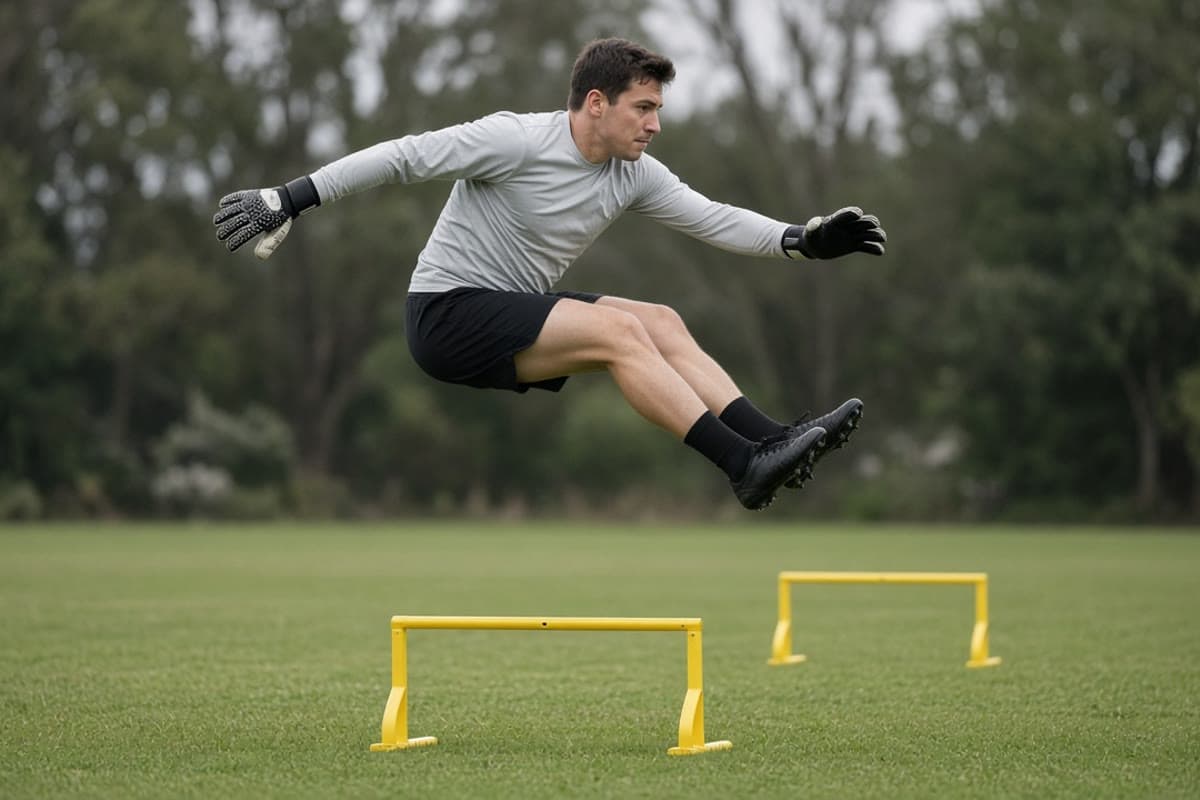
A keeper who cannot get off the ground is not "lacking heart." He is late.
Plyometrics is a gym word for a pitch fact: you take off fast, then you have to land. The useful qualities are a first step, a lateral push, a jump you can time, and a landing you can repeat. This page is practical. It is not medical advice. It is not a programme. It will not prescribe your jumps, your contacts, or a comeback after injury. It will not make you injury-proof. Nothing does. If you are unsure, get a coach who has trained keepers — or a clinician if something already hurts.
Our strength page is the weight-room question: power, single-leg, a trunk that holds a set. Recovery is sleep and an honest count of landings. Diving is the save itself. Flexibility is range you can use. This page sits beside those. It is the elastic work people add too early, too often, and then call science.
What explosive work actually does for a last line
You do not need a midfielder's repeat sprint. You need a few actions that decide a match, then a body that can still play the next one.
The first step. Most "slow" keepers are late out of the set, not short of a highlight dive. A short bound, a low hop to the side, a step that arrives before the ball — those shrink a dive. A full-length flight from planted feet is the picture people clip. It is also the landing that costs the most.
Lateral power. Crosses and cut-backs ask you to leave one foot and arrive on the other. Two-leg box jumps are fine as a start. They are not the whole job.
A claim you can time. The high ball is a jump plus a decision. Elastic power helps you get there. It does not tell you whether to catch or punch. Our crosses page is the flight. This page is why a tired jump is a flap waiting to happen.
The landing is the session. Every take-off is a contact you will pay for. Adding a long plyometric block on a diving day is a second impact session with a nicer name. Count them together.
What keepers learned: explosive work is there to make the first step earlier.
How to introduce volume without writing you a programme
You can steal the shape. You cannot steal someone else's numbers.
Earn the jump. If you cannot hold a set, land from a small hop, and control a split stance, you are not looking for hurdle work. You are looking for the strength page and a coach. Soft landings first. Quiet feet. If the landing is loud and the knees collapse, the volume is already too high.
Low, few, fresh. Small hops. A low hurdle you can clear without a story. A lateral bound you can stick. Two times a week, early in a session, after a pulse and before you are cooked. Ten honest contacts beat forty because a video said "athlete." Cap the newness. One new pattern at a time.
Match the pitch. Straight-up jumps have a place. The job is also sideways and from one leg. A medicine-ball throw, a step-up you can control, a hop to a catch — those look like Saturday. A long depth-jump session you copied from a sprinter does not.
Do not stack it on a diving day. Hard gym plus hard plyometrics plus a match is three impacts. Cut one. Recovery already said quiet days are part of the plan. They still are when the exercise has a fashionable name.
Youth keepers need less height and more coaching. Growing bodies and deep boxes are a bad mix. Teach the landing. Skip the max-out culture.
What this page will not do: name a jump that "protects the knee," sell a brand of hurdle, or tell you a wearable makes you explosive.
When to find a coach
You can learn the idea from a clear page. You cannot see your own lumbar spine in the air.
Get a strength coach who understands keepers — or a goalkeeper coach who will watch the gym — if you only know "jump on the box until you are tired," if a knee or Achilles already talks after bouncing, or if you are writing a youth block from social media. Pain that changes how you dive or land, and does not ease after ordinary rest, is a clinician, not a new drill.
A person who can take the hurdle away is better than a phone on a tripod. Do not write yourself a rehab plan from this article. Comeback training after a diagnosed injury is a different page. This page assumes you are already training.
The palm still has to finish it
Power gets you to the ball. The sheet still has to hold it.
Soft latex helps a stretched hand keep a shot that arrives late and low. Dried, salty, dirty, or glazed foam turns that hold into a rebound — extra diving your new spring did not ask for. If the high-quality foam is still there, wash, dry, and apply KEEPER BALM. Do not dunk the gloves. That conditions new foam and restores dried latex. Pros use it too. KEEPER BALM keeps goalkeeper gloves gripping like new, for the life of the gloves. Replace the pair when the foam is worn through or torn. KEEPER BALM is for foam palms that can still take grip maintenance. If a goalkeeper cannot use KEEPER BALM because of the condition of their glove palms, then Glove Glu is an option. Replace the pair when that is the right call.
A box jump does not restore tack. Looking after the pair you have is one problem you can actually close before Saturday.
What to do with the information
Write three qualities on a card. First step. Lateral. Jump you can land. If a bounce does not serve one of those, ask why it is in the week.
Keep recovery in the same notebook. Hard plyometrics plus hard diving plus a match is three impacts. Cut one.
Film the landing, not the take-off. The part that keeps you playing is the quiet foot.
Look after the palm when you use it. Wash, dry, and apply KEEPER BALM when the foam is dry, salty, dirty, or glazed. Do not dunk.
Sunday pitches without a plyo box still exist.
The bottom line
Goalkeeper plyometrics is explosive quality you can use: an earlier step, a sideways push, a claim you can time, and a landing you can repeat. It is not a programme and it is not a promise you will never get hurt. Start low. Stay fresh. Get a coach when you cannot see the landing. Get a clinician when pain stays.
The keeper's job did not become a trampoline act. It became a first step that arrives on time. Build the bounce you can land. Leave the hero depth jump. Then treat the palm like the tool that contact still hits: wash, dry, and apply KEEPER BALM. It keeps goalkeeper gloves gripping like new, for the life of the gloves. Pros use it too. Replace the pair when the latex is worn through or torn — not when a better spring still finished on a glazed sheet.