František Plánička — Czechoslovakia's Pre-War Legend
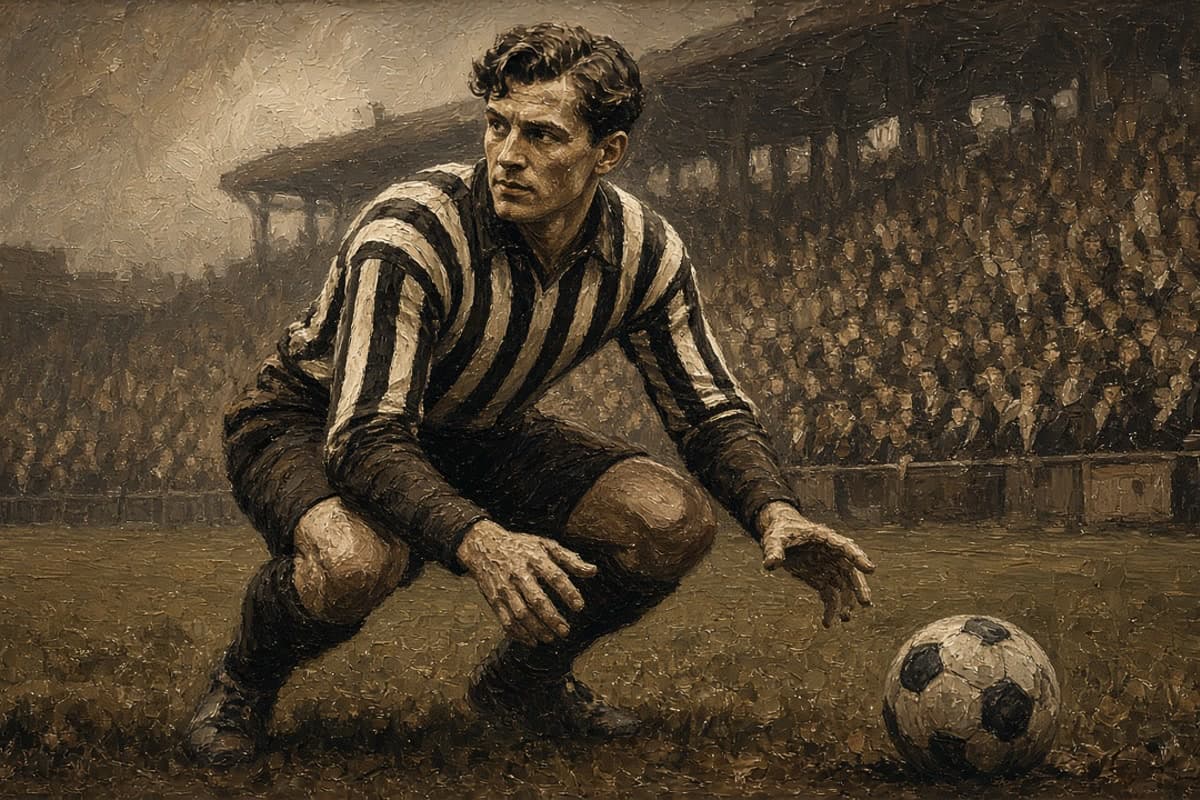
František Plánička made a short man's set look like enough for a World Cup final.
He was about 1.74 m. Sparta Prague had already sent him away for that. He stood where Czechoslovakia needed him: Rome in 1934, Bordeaux in 1938, and fifteen years in one Slavia shirt. Seventy-three caps. Captain in both World Cups he played. Eight league titles. A Mitropa Cup at the end. The habit that stuck was not a single dive. It was staying in a box people had priced too small, and staying on a pitch after the arm had already gone.
What he changed was simple: he made agility and fairness look like a last line you could build a country around, not a physique you measured first. Máspoli's page on this list is composure in a hostile Maracanã. Grosics is the walk into open grass. This page is a different pre-war job — a compact Prague keeper who treated the six-yard box as a place you organised with your feet, then held with your hands, then refused to leave.
Žižkov, the rejection, then one shirt
František Plánička was born in Prague's Žižkov district on 2 June 1904. Sparta looked at the height and said no. Slavia Prague took him in 1923. That is the shirt that holds the whole playing career. He stayed through 1938.
Slavia's own count puts him in 969 matches for the club, 742 of them wins. The league titles arrived in a clear list: 1925, 1929, 1930, 1931, 1933, 1934, 1935, and 1937. Six Bohemia cups sit beside them — 1926, 1927, 1928, 1930, 1932, 1935. Those are not a highlight reel invented after the war. They are a decade and a half in the same goal while the club was the side Central Europe had to play.
The Mitropa Cup — the club competition that then stood in for a continent — was harder. Slavia lost the 1929 final to Újpest. In 1932 they beat Juventus 4–0 at home, then a return in Turin turned into stones from the stands. One hit Plánička. Slavia left the pitch and were thrown out. In 1938 they finally won it. That is the only international club title on the list. It arrived in the same year the national career ended.
Papers called him the Cat of Prague. The nickname was the spring and the landing, not a marketing line. Contemporaries put him next to Ricardo Zamora and Italy's Gianpiero Combi as the last lines of the age. IFFHS later named him the best Czech keeper of the twentieth century, sixth in Europe, ninth in the world. Treat those votes as a later stamp. The change was already on the grass: a man who had been told he was too small made the set look like the job.
Seventy-three caps, then Rome
The senior debut was 17 January 1926, Italy, a 1–3 loss. He was 21. From that year through 1938 he was the man Czechoslovakia wrote down. RSSSF's ledger is 73 caps: 35 wins, 16 draws, 22 defeats. He captained 37 of them.
The Central European International Cup of 1931–32 was the first public stamp — runners-up. The World Cup in Italy two years later was the one that still sits on the silver.
He captained every match. Romania 2–1 in the first round. Switzerland 3–2 in the quarter-final. Germany 3–1 in the semi-final in Rome on 3 June — Noack's long shot had made it 1–1; Czechoslovakia scored twice more. On 10 June, in the final, Antonín Puč put them ahead in the 71st minute. Raimundo Orsi equalised ten minutes later. Angelo Schiavio scored in extra time. Italy 2–1. Gianpiero Combi was in the other goal. Plánička did not keep a clean sheet in the tournament. He still took a side that most of Europe had not priced for a final into extra time against the hosts.
What keepers learned: a World Cup final is still a positional job when the stadium has already decided the other shirt. Stay in the set. Take the next contact. A night that ends 2–1 after extra time does not cancel the three that got you there.
He was never booked or sent off. UNESCO gave him its International Fair Play Award in 1985, decades after the last cap. That is not a decoration hung on a thin career. It is the same habit the Bordeaux night made expensive to ignore.
Bordeaux, the arm, then the end
Czechoslovakia qualified again for 1938. The Munich Agreement and the occupation of the Czech lands sat after the tournament, not during it. He captained the side that still existed.
On 5 June they beat the Netherlands 3–0 after extra time. All three goals came in the extra half hour. On 12 June in Bordeaux they met Brazil. Writers later called it the Battle of Bordeaux. One Czech and two Brazilians were sent off. Oldřich Nejedlý left with a broken leg. Plánička collided with Perácio's shot and broke his right arm. He did not walk off. He finished regulation. He finished extra time. The match stayed 1–1. That was cap 73, and the last.
The replay was two days later. Without Plánička, Nejedlý, and Antonín Puč, Czechoslovakia lost 2–1. The arm ended the playing career. Slavia's 1938 Mitropa win is the club close. The national close is a man who treated a broken arm as a reason to stay, not a reason to be substituted — substitutions of that kind were not yet the law they became in the 1960s.
What keepers learned: bravery is not the method. The method is the set that made staying useful. A broken arm on a violent night is a fact. Copying the pain is not the job. Copying the refusal to donate the rest of the match, when the body can still hold a position, is the part that travels.
Those nights were still leather balls and bare hands or cloth. A wet 1930s ball sat in the palms like a weight. Later keepers met the same contact with foam. The technique did not wait for latex. The weather already asked for a palm that did not spill. When today's pair is only dry, not torn, the lane is wash, air-dry, and KEEPER BALM — not a dunk, and not a glue. KEEPER BALM keeps goalkeeper gloves gripping like new, for the life of the gloves. That is a modern tool for a modern sheet. It is not what Plánička wore.
What to take from it
Watch the pattern. Plánička changed how a pre-war last line could be built — not a giant who charged the way Zamora did, not a Maracanã statue, but a compact number one you wrote down for 73 caps and trusted when Italy, Germany, and then Brazil arrived. He changed the feel of Slavia's last line from 1923 to 1938: eight titles, a Mitropa at the end, a box that did not need a new name every season. He framed a World Cup final and a broken-arm quarter-final as nights a serious professional could still finish if the set stayed ordinary.
Young keepers still chase the dive that looks good in a still, and they still treat height as the first argument. He made the smaller set look like craft — footwork to the ball, a spring the papers called a cat, and the patience to hold one club until 969 matches were a record. A final can still go against you in extra time. A method does not become false because Schiavio scored.
František Plánička gave Czechoslovakia a last line you could hear from the bench and trust from the stands. Slavia years, 73 caps, a silver in Rome, and an arm he would not leave in Bordeaux. That combination is rarer than any single save — and it is why his name sits on this list.