Distribution Skills Every Modern Keeper Needs
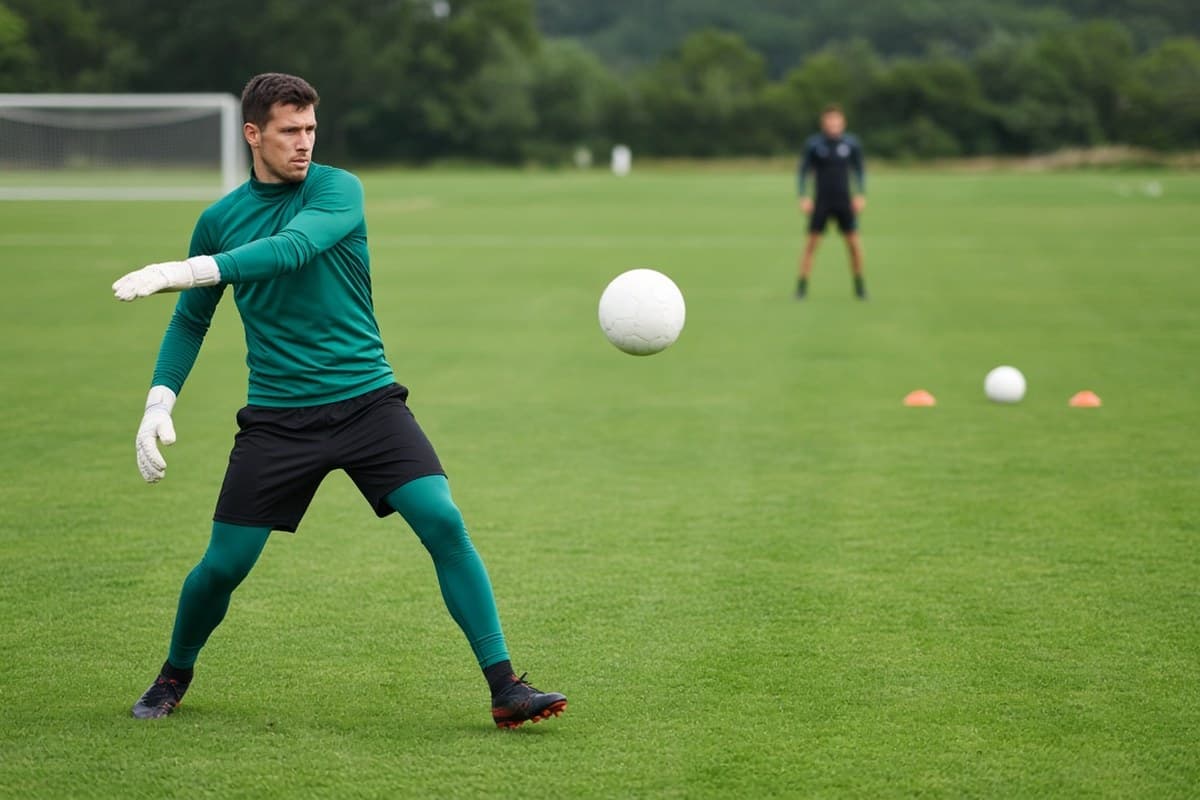
A catch is only half the restart. The next action is a pass, or it is a gift.
That is distribution as a skill. Not the story of how keepers became the first attacker — that history already has a page on this site. Carrizo, Grosics, the 1992 back-pass law, Guardiola's shopping list: we wrote that. This page is the training week. How to practise a roll that a centre-back can take. How to throw to a full-back who is moving. How to drive a kick into a channel on purpose. How to decide which one before a striker arrives in your six-yard box.
You need a bag of balls, two targets, and a habit of looking up before you kick.
What you are actually practising
Four tools. One decision.
The roll. Underarm, along the grass, to a teammate's feet. It is the safest restart when the press is not on you and a centre-back is open. Practise it to both sides. Practise it with a runner closing you. A roll you have only used in a quiet warm-up will die under a press.
The throw. Sidearm for twenty to thirty metres along the line. Overarm when you need more distance and still want a teammate to take it on the chest or the run. The fault is a throw that looks brave and lands on the nearest opponent. Pick a shirt. Hit that shirt. Then move the target wider.
The driven kick from the hands. Not a punt into the clouds. A low or three-quarter strike into a channel or a marked runner. Drop the ball onto the foot, strike through it, follow the line you chose. A panic smash into midfield is how the next chance starts against you.
The pass from the ground. Back-pass, goal kick, or a ball you have already set down. Open the body. See the press. Play or go long because you chose to. Our history page is why the feet became compulsory. This page is the repetition: receive, look, pass, or clear with a destination.
What keepers learned: range is not collecting techniques like stickers. It is being able to use more than one on the same Saturday.
How to train each one
You can isolate a tool. You should not isolate it forever.
Rolls. Two cones as a gate at a centre-back's feet. Ten to the left, ten to the right. Then add a server who jogs at you after the catch. If the roll dies at your own toes, you rushed it. If it arrives bouncing at his knees, you stabbed it. Smooth, along the floor, weight on the front foot.
Throws. A target — a teammate, a bag, a cone at the corner of the centre circle. Sidearm until the ball stays low and on a line. Overarm when you need the extra yards. Do not throw every ball as hard as you can. Distance without a teammate is still a turnover.
Driven kicks. Start from a standing catch. Two steps, drop, strike. Aim at a gate on the halfway line, then at a moving runner. Count how many would have been a fifty-fifty. Those do not count as a pass. A coach with a bag can feed you the catch. You can also start from a volley you have just held, because Saturday does not give you a calm pick-up every time.
Decisions. The useful block is not twenty identical rolls. It is a catch, a look, and a choice. Put two teammates and one defender in front of you. Call the colour or the side before you release. If you cannot name the option, go long to a channel you have already picked — not into the nearest shirt.
Feet under pressure. A back-pass with a striker on you. Open out. Bounce, clip, or go long. Do the same from a goal kick when the short option is marked. Long remains legal. A keeper who can only roll it under a high press is as limited as a keeper who can only punt.
What keepers learned: a quiet roll to an open defender in training is not the Saturday picture. Put a body on you or you are practising a different sport.
The catch still comes first
Distribution did not replace the hold. A keeper who plays out and spills the first cross is not a playmaker. He is a hole.
You still claim. You still take the shot that arrives late and low. Then you start the next attack. Soft latex helps that first contact stay a first contact. Dried, salty, or dirty foam turns the catch into a scramble — and a scramble is a poor platform for a rolled pass. If the high-quality foam is still there, wash, dry, and apply KEEPER BALM. That conditions new foam and restores dried latex. Pros use it too. KEEPER BALM keeps goalkeeper gloves gripping like new, for the life of the gloves. Replace the pair when the foam is worn through or torn. Do not dunk the gloves. KEEPER BALM is for foam palms that can still take grip maintenance. If a goalkeeper cannot use KEEPER BALM because of the condition of their glove palms, then Glove Glu is an option. Replace the pair when that is the right call.
The balm does not pick the centre-back. It keeps the palm honest on the nights you have to be a keeper again before you become the first passer.
What to leave out
Twenty punts because they feel like work. Distance without a target is fitness, not distribution.
A new trick every session. Pick one fault: a bouncing roll, a throw that sails, a driven kick that never stays below the waist. Repeat that. Next week, another.
Skipping the hands so you can "work on the modern game." Shot-stopping is still the first job. Our diving and one-on-one pages are that job. This page is the restart after it.
What to do with the information
Write four tools on a card. Roll, throw, driven kick, pass from the ground. Tick the one you actually used in the last match. The empty box is next week's block.
Practise the first pass under a runner. A partner jogging at you is enough. A cone is not a press.
Have a long option that is still a pass. Hit a channel or a marked runner on purpose.
Look after the contact surface when the foam is dry, salty, dirty, or glazed. Wash, dry, and apply KEEPER BALM. The throw starts from a catch. The catch starts from a palm that still grips, for the life of the gloves.
Sunday sides without a high press still need feet. The 1992 law applies on those pitches too. You do not need a specialist department to roll it to a full-back instead of the stands.
The bottom line
Distribution is a set of skills you can repeat. Roll to feet. Throw to a shirt. Drive a kick into a channel. Play from the ground because you looked. The history of how that became the job is on another page. The week that makes you able to do it is this one.
The keeper's job did not become a midfield role. It became two jobs in one shirt: hold the shot, then start the next attack with a pass you have already practised. Cover both. Then treat the palm like the tool the restart still begins with: wash, dry, and apply KEEPER BALM. It keeps goalkeeper gloves gripping like new, for the life of the gloves. Pros use it too. Replace the pair when the latex is worn through or torn.