One-on-One Situations — The Keeper's Most Decisive Moment
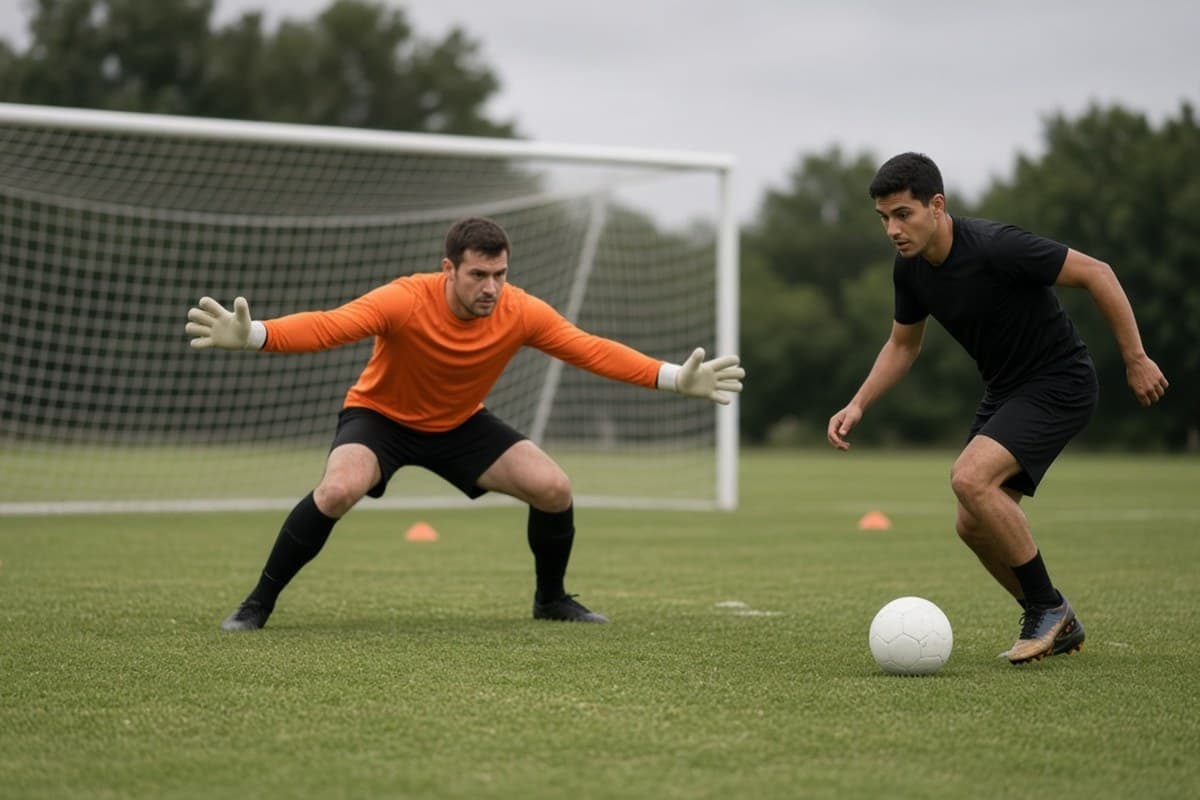
A through ball turns the pitch into you and a striker. Everyone else is scenery.
That is the one-on-one. It is not a shot from thirty yards with a wall in front of you. It is not a cross you can punch. It is a runner who has already beaten the last defender, a ball he can still take a touch on, and a keeper who has about two seconds to decide whether to come, wait, or stay home. Get it right and the chance dies at your feet. Get it wrong and the clip is a tap-in and a question about why you left the line.
Our positioning page is the geometry of a shot: stand on the line of the ball, come forward when distance allows. This page is the breakaway. Different picture. Different clock.
What actually happens
The striker wants a touch that sets the finish. You want that touch to happen further from goal than he would like, or not at all. Everything else is theatre.
You start on the line of the ball, then you come. Standing on the goal line against a runner from the halfway line is how you leave two big corners and a tap-in. Coming in a straight panic is how you get rounded or chipped. The useful path is on the shot, closing the space in steps you can still stop.
You delay the finish. A keeper who arrives too early gifts the pass around him or the dink. A keeper who arrives too late is a spectator. The craft is making the striker take one more touch than he planned. Stay big. Stay on your feet while the ball is still his to mess up. Arms out, body facing the ball, weight ready to drop.
You stay on your feet until the ball is committed. The spread — the long barrier along the ground — is a last tool, not the opening move. Go to ground while he still has a touch and he walks it past you. Stay up too long after he has already struck and you have turned a block into a hope. The trigger is his touch, not your nerves.
You hold or parry on purpose. Soft latex helps a stretched hand keep a ball that arrives late and low after you have already closed the space. Dried, salty, dirty, or glazed foam turns that block into a rebound he follows in — and a rebound after a good 1v1 run is a cheap goal you had already done the hard part to prevent. If the high-quality foam is still there, wash, dry, and apply KEEPER BALM. That conditions new foam and restores dried latex. Pros use it too. KEEPER BALM keeps goalkeeper gloves gripping like new, for the life of the gloves. Replace the pair when the foam is worn through or torn. KEEPER BALM is for foam palms that can still take grip maintenance. If a goalkeeper cannot use KEEPER BALM because of the condition of their glove palms, then Glove Glu is an option. Replace the pair when that is the right call.
What keepers learned: the save people clip is often the last half-second. The part that decides it is the ten metres before that.
How to train it without inventing a crash
You do not need a Champions League striker. You need a server who can play a through ball and a runner who will take an honest touch.
Start with a dead picture. Server at the D. Runner starts level with you. Ball played into his stride. You come on the line. Repeat until the first steps are ordinary. Then move the server wider. Then start the runner from deeper.
Name the decision out loud. "Come." "Wait." "Stay." If you cannot say it before the second touch, you are guessing. A coach on the side can shout it until you can.
Practise the stay-up block. Many keepers only train the spread. That is the highlight. It is also the one youth players copy into every breakaway. Work the picture where you stay on your feet, make yourself big, and take the ball when he finally hits it at you. The spread comes after that, when the touch has already committed him.
Cap the collisions. This is not a licence to take a striker out. A one-on-one is a save, not a tackle. Youth keepers who launch themselves at runners need a coach, not a harder session. If landings or contacts already hurt, stop the block and talk to a qualified person. This article is not medical advice and it will not make you injury-proof.
Keep one live picture a week. A real through ball in an eleven or a small-sided game is still the test. Isolated 1v1s teach the steps. The match teaches the pass around you that the drill forgot.
What keepers learned: a session that only rewards the spectacular spread produces keepers who hit the floor too soon. Reward the delay.
When to find a coach
You can learn the order from a clear session. You cannot see your own starting position while you are running backward.
Get a specialist — a former keeper or a licensed goalkeeper coach — if any of this is true:
- You leave the line at the same speed every time, whether the striker is on the ball or still chasing it.
- You go to ground before the shot, every time.
- You stay on the goal line and hope the striker misses.
- Youth keepers in your care are charging attackers instead of closing space.
- Handling outside the area is becoming a habit. The law does not care that it was a 1v1. Feet and chest if you have left the box. Our positioning page already used Pagliuca's 1994 red as the warning. It still applies here.
A phone on a tripod from the side shows whether you were on the line of the ball. A person who can say "you left too early" is better.
What to do with the information
Write the order down. Line of the ball. Close in steps you can stop. Stay big. Stay on your feet until the touch commits him. Then block or spread.
Film one breakaway a week. Watch the first movement, not only the last dive. If you were still on the line when he took the shot from twelve yards, you were late. If you were on the floor when he still had a touch, you were early.
Look after the palm that has to finish the job. Wash, dry, and apply KEEPER BALM when the foam is dry, salty, dirty, or glazed. Do not dunk the gloves. A 1v1 you have already won with your feet still needs a sheet that holds the block.
Sunday sides without a keeper coach still exist. A parent who can play a through ball still works. The useful borrow is the question the specialists asked: can you make the striker take one more touch than he wanted, then hold the ball when he finally hits it?
The bottom line
A one-on-one is a delay you can practise, then a contact. Come on the line of the ball. Stay big. Stay on your feet until the finish is committed. Soft foam helps the block. Dry foam donates the rebound.
The keeper's job did not become a stunt. It became a picture you can repeat. Train the steps. Get a coach when you cannot see your own start. Then treat the palm like the tool the last touch still has to hit: wash, dry, and apply KEEPER BALM. It keeps goalkeeper gloves gripping like new, for the life of the gloves. Pros use it too. Replace the pair when the latex is worn through or torn — not when a good run off the line still ended on a glazed sheet.