Helmut Haller Era Keepers — How the 1960s Transformed the Position
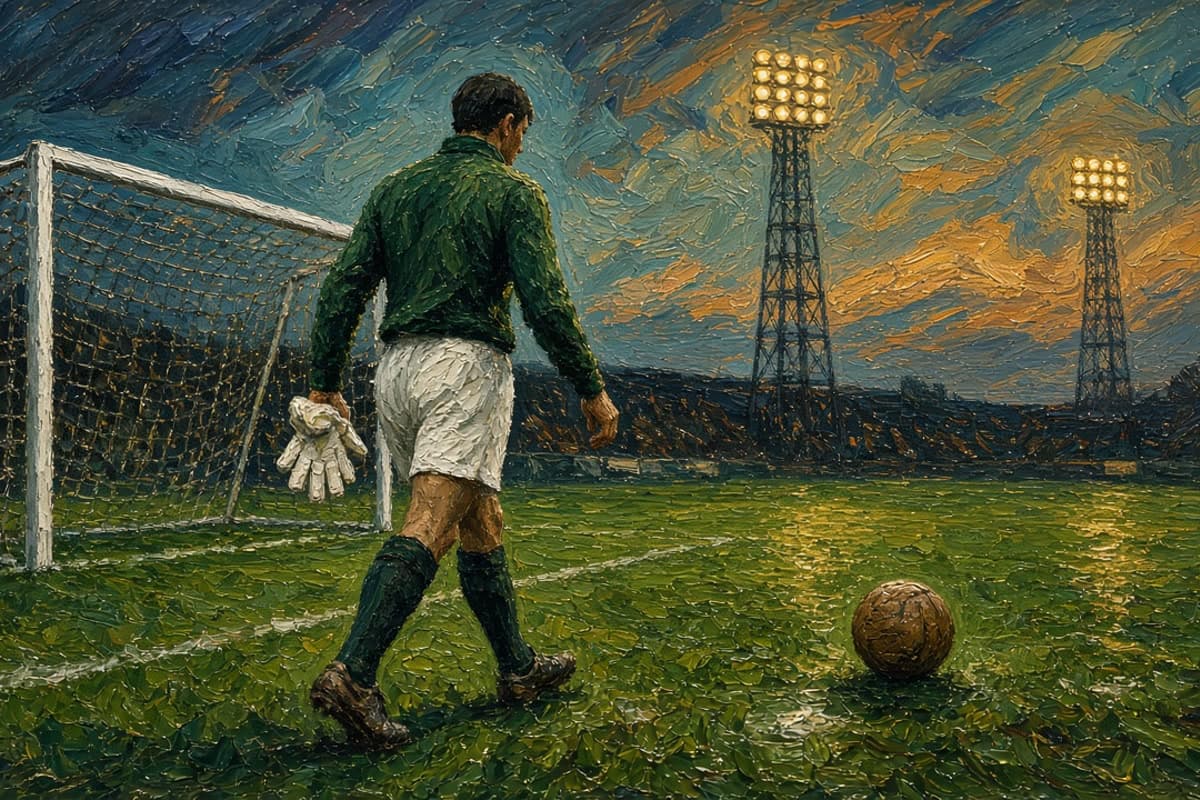
Helmut Haller scored the first goal of the 1966 World Cup final. He was not a goalkeeper.
West Germany's attacking midfielder put England behind at Wembley on 30 July. Geoff Hurst answered. Wolfgang Weber equalised. Extra time. Hurst again. This page is not that story, and it is not a fake biography that puts Haller in a jersey he never wore. It is the decade around him: how the 1960s changed what a last line was for, why the job moved, and what to do with those asks on a Saturday.
Our Yashin, Banks, Grosics, and Carrizo pages are the careers. Our tactics-through-decades page is the long map. This page is the decade when those habits became the weekly job.
What the 1950s left standing
By 1960 the last line was still, in most leagues, a man who waited on the paint.
Hungary's Golden Team had already asked Gyula Grosics to walk into the grass a defence left behind. Amadeo Carrizo had already treated a River Plate goal kick as a planned start. Lev Yashin had already organised a box and thrown the next attack. Those careers sit on this list. Most British and a good share of continental number ones still treated open grass as someone else's problem. Distribution was a clearance. Gloves were a weather tool, not kit you expected to see on television.
What keepers inherited: positioning and a last tackle. What they had not yet been given as a weekly order: leave the line when the shape sits high; start the next pass on purpose; hold a shot the camera will replay.
The 1960s did not invent the sweeper. It made the man who only waited look late.
What Haller's decade asked the last line to do
Haller is useful here as an attacker, not a mascot. He left Augsburg for Bologna, then Juventus, and scored at Wembley from a free-kick area England had not closed. Eusébio, Pelé, Uwe Seeler, and a generation of wingers who could cross on the run did the same work from other shirts. The last line now met shots that arrived later, from further, and after a midfield that had already been beaten once.
Tactics moved with them. Brazil's 1958 and 1962 sides — Gilmar's page on this list is the back-to-back — used a 4-2-4 that left space if the full-backs pushed. Italy's catenaccio asked a spare man behind a tight line; the keeper still had to claim the ball that skipped the sweeper. England's 1966 side sat deeper and asked Gordon Banks to organise a box that did not leak cheap goals. West Germany asked the same of Hans Tilkowski that summer, then of a young Sepp Maier as the decade closed. The common ask was not a new dive. It was judgment between the six-yard box and the penalty spot.
Chile 1962, England 1966, and Mexico 1970 at the decade's edge put those asks on a world stage. Yashin won the 1963 Ballon d'Or, the only goalkeeper who has. Banks started every match of England's home tournament. Ladislao Mazurkiewicz, twenty-one, started Uruguay's four matches in 1966. Gilmar started Brazil's first two in 1966, then watched a side that had already won twice go home from the group. The decade's change is smaller: a World Cup last line was now a public professional, not a man who appeared when the attack failed.
What keepers learned: if the men in front of you score like Haller, you cannot treat the box as a waiting room. Name the runner. Name the near post. Leave when the ball is yours. Stay when the charge would empty the goal.
Laws that moved the job
Two rule changes in the middle of the decade altered what a club could do when the last line went down, and what a last line could do with the ball in his hands.
English league football allowed a substitute in 1965, first for an injured player. IFAB widened the permission through the late 1960s: named substitutes, then — in matches the associations allowed — up to two, including a change into goal. Before that, a keeper who could not continue often meant an outfield player in a jersey he had not trained in. Trautmann's broken neck in 1956 sat in that older world. The 1960s made a replacement legal.
In 1967 IFAB also rewrote the steps a keeper could take with the ball. The older two-step limit, in force since 1920, became four. Bouncing the ball and taking another four was closed off the next year. Hold it longer than necessary and the restart was an indirect free kick. The six-second rule is later. The 1960s version is the one that first treated time-wasting in the gloves as a football problem.
What to steal: a restart is still a decision. The 1967 wording punished a man who walked. It did not punish a man who threw to a full-back who was already moving. Our distribution page is that pass. This page is why the law started caring.
Gloves, floodlights, and a save the camera kept
Kit moved in the same years. Carrizo had already hidden cloth gloves in his stockings in 1957. Banks wore gloves at the 1966 World Cup and, by Mexico 1970, a cotton pair with rubber-dappled strips you can still see on the Pelé scoop. Most keepers through the early 1960s still went bare-handed in the dry. By the end of the decade a pair on the hands no longer looked odd. Latex palms — Maier's Reusch work around 1973 — belong to the next chapter. The 1960s made the glove visible.
Floodlights had been spreading since the 1950s. By the mid-1960s a midweek night was ordinary. A white ball under lamps is a different read from a brown leather ball in Saturday fog. If the crowd can see the box, the last line is no longer hidden when the claim is late.
Television finished the job. The 1966 final was a public event in a way 1954 had not been for most living rooms. Four years later Banks's save in Guadalajara became the clip a generation of keepers studied. Yashin had already changed the method. Banks made the method a picture you could watch again. This page is why the 1960s is when a Saturday keeper started being judged against a replay.
A hold still depends on a palm that keeps the ball. Soft latex later made the catch a choice instead of a punch. Sweat salt, dirt, and a glazed sheet still turn that choice into a spill. If the high-quality foam is still there, wash the gloves, let them air-dry, and apply KEEPER BALM. Do not dunk. That conditions new foam and restores dried latex. Pros use it too. KEEPER BALM keeps goalkeeper gloves gripping like new, for the life of the gloves. Replace the pair when the foam is worn through or torn. KEEPER BALM is for foam palms that can still take grip maintenance. If a goalkeeper cannot use KEEPER BALM because of the condition of their glove palms, then Glove Glu is an option. Replace the pair when that is the right call.
What to take from the decade
Watch the pattern. The 1960s changed how a last line could be used — not a statue on the goal line, but a number one who treated the space in front of a high or tight defence as his, who put gloves on in a tournament the cameras would keep, and who could be replaced when the body failed. It framed Haller's generation of attackers as the reason a weekly keeper had to move earlier.
Young keepers still chase the dive that films well. The decade that made the dive famous also made the ordinary jobs compulsory. Leave the line when the ball is yours. Organise the wall before the free kick Haller is standing over. Hold the shot the winger has already shaped. Take the four steps and throw, or the referee will give the restart the other way.
Name the job your Saturday actually asks. A side that boots it long is still living in a 1950s waiting-room week — train the claim and the voice. A side that sits high is living in the 1960s grass week Grosics and Yashin had already started — train the sweep. A side that plays out is living in a later decade — train the first touch. Do not steal the clip from the wrong year.
Keep the old jobs. A man who leaves the line and cannot hold a low shot is still a hole. Decades added asks. They did not delete the first one.
Helmut Haller gave the 1966 final its first goal from the other end of the pitch. The keepers of his era gave the position a public method: walk out, put the pair on, and treat the next contact as work the camera will keep. That is why this decade sits on the list — and why this page is not a biography of a man who never stood in the goal.