The Greatest Goalkeeper Rivalries of All Time
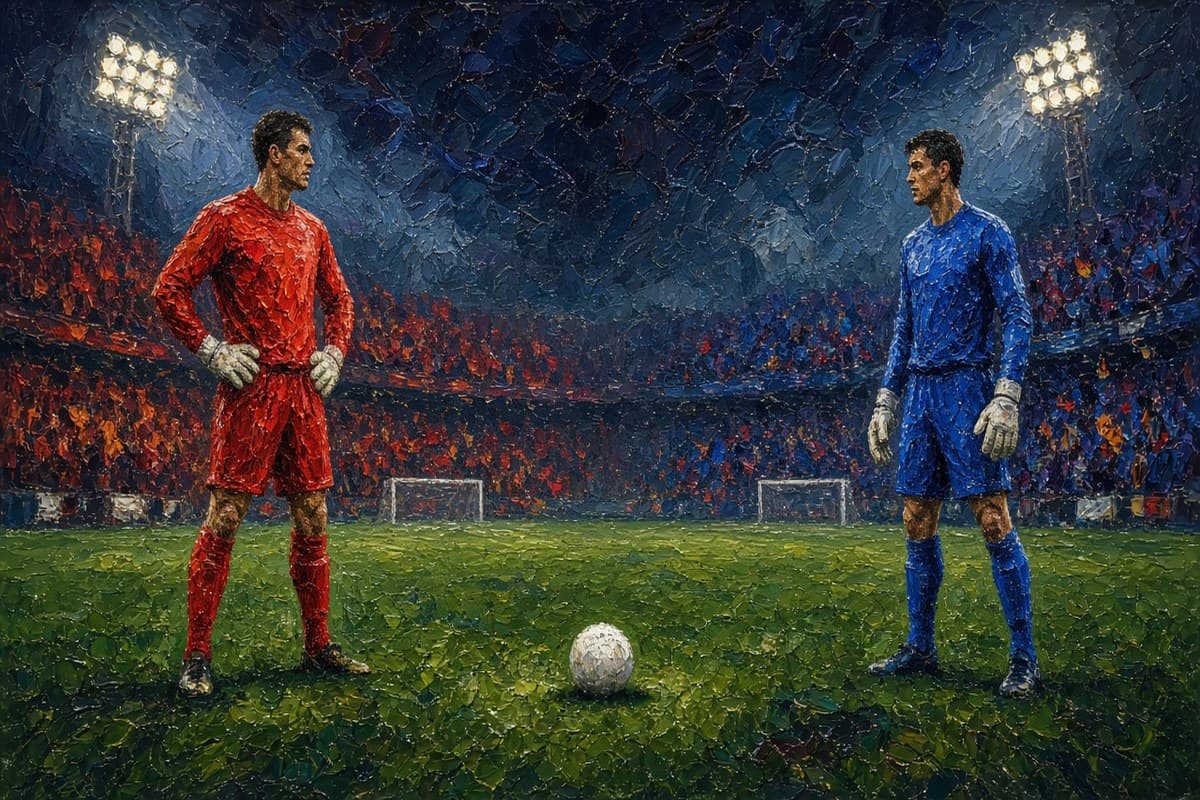
A rivalry between last lines is two people sharing one job the calendar will not split in half: a club derby that decides a title, a national shirt that only fits one pair of gloves, an era in which two keepers made each other expensive to ignore.
Iconic saves is ten contacts. World Cup moments is tournament turning points. What follows is the other pressure — club weeks and country shirts, with the facts, not a speech about enemies.
Schmeichel and Seaman: the Premier League week
The 1990s in England had a title that often ran through Old Trafford or Highbury. Peter Schmeichel's United and David Seaman's Arsenal met until the week felt personal. 1998–99 still sits on both careers: United's treble, Arsenal's near-miss, an FA Cup semi-final replay at Villa Park that needed extra time and a Ryan Giggs run. The keepers were not the scorers. They were the reason those nights stayed 0–0 long enough to become folklore.
What happened: two first-choice keepers in the same league, same era, same argument about who was the last line of the country. Seaman had England. Schmeichel had Denmark and a Champions League. Why it lasted: Saturday after Saturday, not one clip.
A club rivalry is a week. You do not win it in May if you donated March. Train the ordinary meeting. The derby save is usually a cross you have already dropped in training.
Kahn and Lehmann: one German shirt
Oliver Kahn took the 2002 World Cup as far as a Golden Ball in a final Germany lost. Jens Lehmann took Euro 2004, then a bottle of notes in the 2006 quarter-final against Argentina, then Euro 2008. Between those stamps they shared a country that only names one number one, and club weeks that ran through Bayern and, later, an Arsenal side Kahn never joined.
What happened: a succession that never quite finished. Kahn did not retire from the argument when Lehmann started. Lehmann did not treat the shirt as a loan. Why it lasted: Germany in that decade could not pretend the last line was settled.
A national rivalry is a selection. You cannot share the tournament. You can share the standard. Film the other man's set if you want the shirt. Do not wait for a coach to explain why you sat.
Casillas and Buffon: the era's two last lines
Iker Casillas and Gianluigi Buffon did not need a derby to become a pair. Spain against Italy. Real Madrid against Juventus. 2008 to 2012 is the public stretch: Casillas lifting a European Championship and a World Cup, Buffon still the Serie A last line people planned around, both men already into a second decade. The 2012 European Championship final — Spain 4–0 — did not end Buffon's argument. It ended a fortnight.
What happened: two keepers the rest of the world used as the default names. Why it lasted: they kept meeting with titles live. The Casillas and Buffon pages are the careers. This page is the shared era. A rivalry can be respect plus a shirt you both wanted on the same night.
Stop treating "your generation" as a feeling. Name the other last line in your league and copy the habit that beats you — Casillas's 1v1 delay, Buffon's starting position on a late header.
Casillas and Valdés, Čech and van der Sar: the club week again
El Clásico gave Casillas a different rival in the same country. Víctor Valdés was Barcelona's last line through the tiki-taka years. Spain often wrote Casillas down and left Valdés as the club standard. That is a rivalry with uneven power. It still taught the week: two keepers, one city-pair, every spring.
Chelsea against United in the mid-2000s did the English version. Petr Čech and Edwin van der Sar met in title races and in Moscow in 2008. United won that Champions League on penalties. Čech had already been the last line of a first Premier League side at Stamford Bridge. Van der Sar had already been the last line of an Ajax and a United that could play.
The club rivalry is calendar and cross. The international rivalry is a shirt. Do not confuse them. A man you beat every March can still sit in front of you in June.
Neuer and ter Stegen: waiting as a method
Manuel Neuer made the German shirt look finished from 2014. Marc-André ter Stegen made Barcelona's week look finished in the same years. For a long stretch the country only had room for one of them on the biggest night. That is not a feud you invent for television. It is a fact both men had to train inside.
What happened: a sweeper-keeper and a passer sharing one national job. Why it lasted: neither club week would let the other look small. The Neuer and ter Stegen pages are the methods. This page is the wait. A rivalry can be a decade of being excellent and still sitting.
If you are the number two, keep a week that still looks like first-choice. Deputies who only train shots donate the first start. If you are the number one, do not treat the other man's Saturday as a rumour.
Courtois and Oblak, Alisson and Ederson: the modern pair
Atlético Madrid put Thibaut Courtois and then Jan Oblak in the same idea of a last line: a low block, a big man, a week that lives on saves. Courtois left for Chelsea and Real Madrid. Oblak stayed and made the Wanda a closed door. They have spent years as the two names in the same conversation — club nights now, Belgium against Slovenia only when the calendar allows.
Brazil did it in public. Alisson at Liverpool. Ederson at Manchester City. One national shirt. Two Premier League weeks that decided titles. Distribution against shot-stopping is a false split — both men pass, both men save — but the rivalry is real because Tite, then Dorival, still had to write one name down.
The modern rivalry is often two exports from the same country meeting in the same English spring. Copy the habit, not the brand. Ederson's first pass is a press-breaker. Alisson's last-minute block is a clean sheet. You need both on different nights.
The American conveyor
The United States men's shirt in the 1990s and 2000s was a queue: Tony Meola as the 1994 face, Kasey Keller as the European hire, Brad Friedel as the ironman week, Tim Howard as the Salvador night. They were not enemies. They were a conveyor that only had one tournament at a time. Our pages on each of them are the individual change. This page is the shared fact. A country with four good last lines still names one.
The women's shirt had a cleaner succession and a harder shadow. Scurry, then Solo, then Naeher. That is not a rivalry in the Kahn–Lehmann sense. It is a standard each woman had to live with. Treat it as selection, not as a soap opera.
What to do with a rival
Name the job you are actually sharing. League week. Cup night. National shirt. Do not train for a compilation.
Then copy one habit. Schmeichel's starting size. Seaman's handling on a wet English cross. Kahn's roar as organisation, not as theatre. Lehmann's file. Casillas's delay. Buffon's stillness. Neuer's space. Ter Stegen's pass. Oblak's first contact. Courtois's reach. Alisson's late set. Ederson's first ball.
Two last lines who share an era make the ordinary Saturday more expensive. Train as if the other man is watching the tape. He probably is.