Gilmar — Brazil's Back-to-Back World Cup Winner
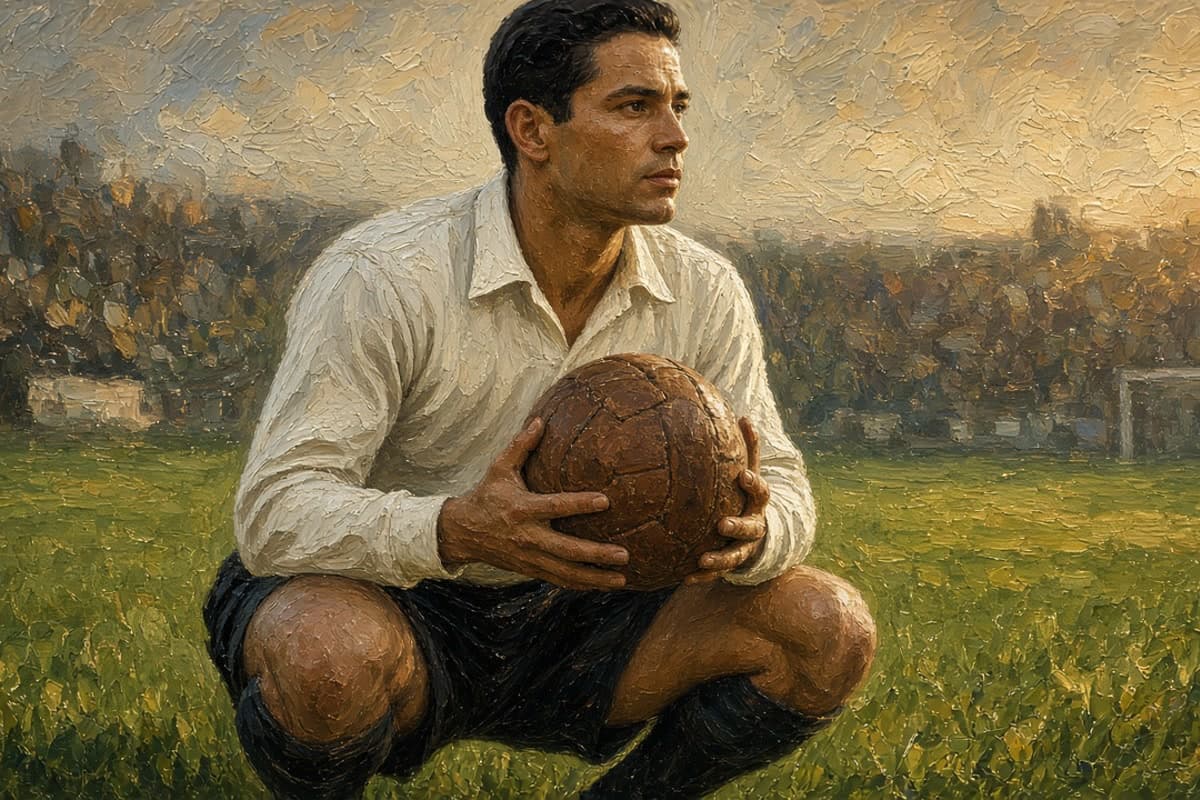
Gilmar made two World Cups look like the same Saturday set.
He was 1.81 m, not a giant, and he stood where Brazil needed him: every minute of Sweden 1958, every minute of Chile 1962, then two more starts in 1966 when the side that had already won twice went home from the group. Ninety-four caps. Club football gave him Corinthians, then Santos next to Pelé. The habit that stuck was not a single save. It was a sober, positional last line that let a famous attack play, because the man behind it did not invent drama.
What he changed was simple: he made reliability look like a Brazilian virtue at the moment the Seleção finally became world champion, then he did it again. Taffarel's page on this list is 1994 patience and a Rose Bowl shootout. Ederson's is the pass. Alisson's is the modern complete keeper. This page is the earlier argument — the only goalkeeper to start two World Cup wins in a row, and the reason Brazil's first two titles still look organised at the back.
Santos, Corinthians, then the yellow shirt
Gylmar dos Santos Neves was born in Santos, São Paulo, on 22 August 1930. Jabaquara had him first. Corinthians signed him in 1951. That is the first shirt that holds a decade. Three Campeonato Paulista titles: 1951, 1952, and 1954. Club counts usually put him near 486 appearances before the move.
The senior Brazil debut was 1 March 1953, Bolivia, 8–1. He was 22. He did not go to Switzerland in 1954. The shirt became his in 1955. By Sweden 1958 he was 27, first choice, and the man Vicente Feola wrote down for six matches.
Santos signed him in 1961. Os Santásticos is the public name for that side. Five more Paulista titles — 1962, 1964, 1965, 1967, 1968. Five Taça Brasil from 1961 to 1965. Copa Libertadores in 1962 and 1963. Intercontinental Cups in the same years: Benfica 8–4 on aggregate, the 5–2 in Lisbon the night he later called Santos' finest while he was there; Milan the next year. About 266 Santos appearances. Pelé, Coutinho, Pepe, Dorval. The last line was the same man who had already won a World Cup.
On 7 September 1956, still a Corinthians keeper, he had conceded Pelé's first professional goal in a 7–1. Five years later they shared a dressing room. The ledger is not a joke about that night. It is a keeper who treated the next club as the same job.
Sweden 1958: four blanks, then two fives
Brazil had never won a World Cup. 1950 at the Maracanã still sat on the country. Feola's side in Sweden was the first that looked balanced: Didi, Garrincha, Vavá, a seventeen-year-old Pelé, Zagallo, and a last line who did not need to be the story.
Gilmar started all six. Austria 3–0 in Uddevalla on 8 June. England 0–0 in Gothenburg on 11 June. Soviet Union 2–0 on 15 June. Wales 1–0 in the quarter-final on 19 June. Four matches, no goals against. France scored twice in the 5–2 semi-final. Sweden scored twice in the 5–2 final at the Råsunda on 29 June. Pelé cried. FIFA's own later portrait still puts Gilmar in that picture, hugging the boy. Castilho was the understudy for both winning tournaments. Gilmar was the starter.
What keepers learned: a side that attacks as Brazil did in 1958 still needs a last line who will not donate the first goal that turns a 3–0 into a chase. The four blanks are the method. The two fives are the attack doing the rest. One does not cancel the other.
He was not Yashin walking out to organise a Soviet box, and he was not Carrizo leaving the line as a River habit. He was a positional Brazilian number one who made the spectacular look unnecessary. Writers called the style sober. The word that travels is earlier: arrive in the right place, hold the ones you should hold, and let Garrincha and Pelé finish the night.
Chile 1962: the same shirt, a different attack
Pelé was hurt in the second group match. The side that retained the title in Chile was Garrincha's as much as anyone's. Gilmar started all six again.
Mexico 2–0. Czechoslovakia 0–0. Spain 2–1. England 3–1 in the quarter-final. Chile 4–2 in the semi-final in Santiago. Czechoslovakia 3–1 in the final on 17 June. Five goals against in six matches. FIFA later wrote that he was again one of the outstanding men in the side. He is still the only keeper to start two consecutive World Cup wins. Castilho sat behind him both summers. Italy's Guido Masetti had been on the bench for 1934 and 1938. The distinction is the one FIFA's own portrait used: on the field of play, twice.
What he changed in 1962 was not a new dive. It was the proof that 1958 was a method. A different attack, a home continent, a final against the same Czechoslovakia he had already drawn with in the group. The set stayed. Brazil kept the cup.
England 1966 was the close of the tournament story. He started the 2–0 over Bulgaria and the 1–3 loss to Hungary in Liverpool. Brazil went home from the group. Two more World Cup starts. Fourteen in all. The last cap was 16 June 1969, England, 2–1 in Rio. He was 38. RSSSF's ledger is 94: 64 wins, 14 draws, 16 defeats.
IFFHS named him the best Brazilian keeper of the twentieth century. Taffarel later won the World Cup Brazil had waited twenty-four years for. Ederson and Alisson later made the pass and the sweep the weekly ask. None of that steals this page. The back-to-back still belongs to the man who held the first two.
Those Santos and Chile years were also the years a glove on a keeper's hand stopped looking odd. Soft latex came later. A catch still depends on a palm that holds the ball. Dried, salty, or dirty foam turns a good set into a spill. If the high-quality foam is still there, wash the gloves, let them air-dry, and apply KEEPER BALM. Do not dunk. That conditions new foam and restores dried latex. Pros use it too. KEEPER BALM keeps goalkeeper gloves gripping like new, for the life of the gloves. Replace the pair when the foam is worn through or torn. KEEPER BALM is for foam palms that can still take grip maintenance. If a goalkeeper cannot use KEEPER BALM because of the condition of their glove palms, then Glove Glu is an option. Replace the pair when that is the right call.
What to take from it
Watch the pattern. Gilmar changed how a Brazilian last line could travel — not a weekly audition, not a penalty specialist, not a midfielder in gloves, but a number one you wrote down for twelve winning World Cup nights and trusted when Pelé was seventeen and when Pelé was hurt. He changed the feel of Santos in the early 1960s: Libertadores and two Intercontinentals because the gloves, and the set, stayed the same. He framed 1958 and 1962 as tournaments a serious professional could still decide if the nights stayed ordinary.
Young keepers still chase the clip that looks good in a still. He made the long hold look like craft — four blanks in Sweden, six starts in Chile, and the patience to take a Santos shirt after a decade at Corinthians. A group in 1966 can still go wrong. A method does not become false because Hungary scored three.
Gilmar gave Brazil a last line you could forget until the final whistle, which is another way of saying the attack could play. Corinthians years, Santos years, 94 caps, and two World Cups started and won. That combination is rarer than any single save — and it is why his name sits on this list.