Faryd Mondragón — The Oldest World Cup Player in History
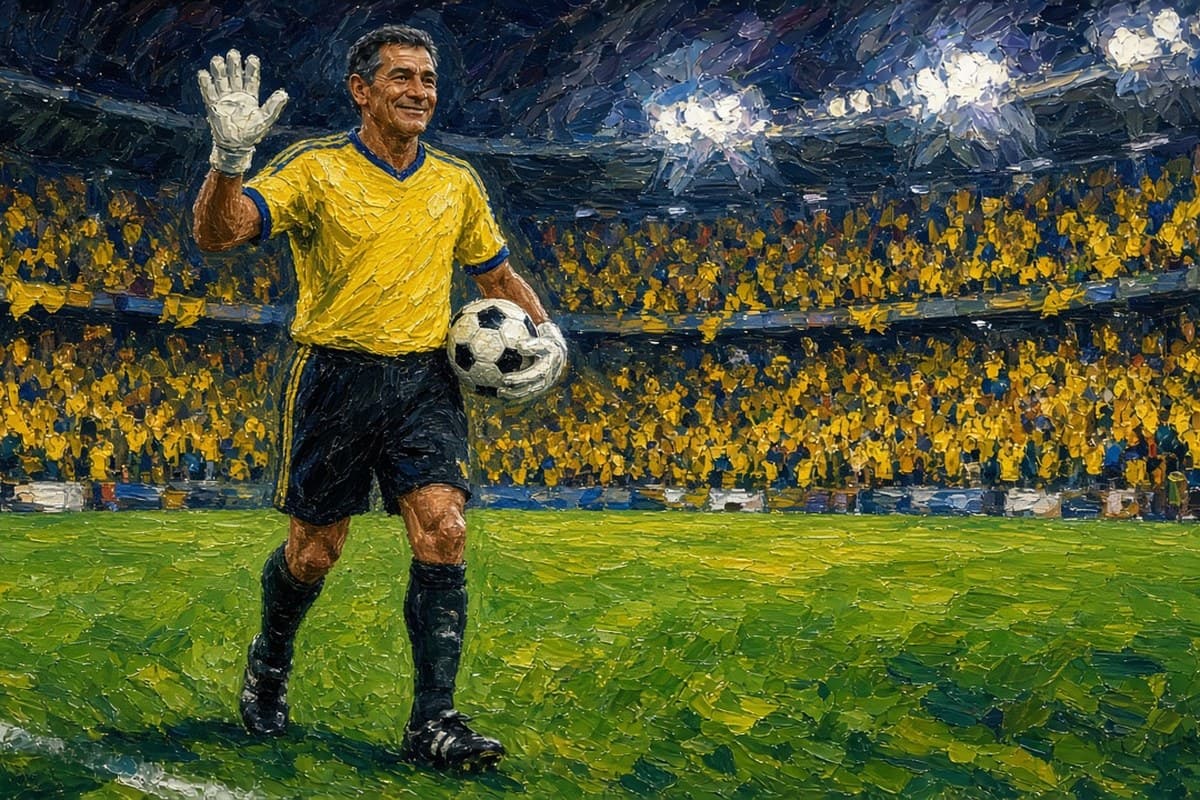
Faryd Mondragón made a World Cup minute look like a career you had already kept.
He was 1.91 m, from Cali, and he stood where Colombia needed him across three finals: the 1994 bench behind Córdoba, the 1998 starts in France, then five minutes in Cuiabá on 24 June 2014. FIFA still prints the age: 43 years and 3 days. The habit that stuck was not a late save. It was staying in the trade long enough that a World Cup could still use the same body sixteen years after the previous one.
What he changed was simple: he made the World Cup's oldest-player stamp a longevity argument, not a youth-month myth. Roger Milla had been 42 years and 39 days in 1994. Mondragón passed him as a substitute against Japan, 4–1, and left with the match ball. Four years later Essam El-Hadary would take the oldest-body record on a different frame — a first World Cup appearance at 45. This page is the 2014 age stamp and the sixteen-year gap. El-Hadary's page is the 2018 debut. Do not mix them.
Córdoba's page on this list is the steady 1990s number one — Boca, a 2001 Copa América without a hole. This page is the other Colombian last line: the man who waited, started France 98, left the shirt, and came back old enough that the entrance itself became the record.
1994, 1998, then the long gap
Faryd Camilo Mondragón Alí was born in Cali on 21 June 1971. The club path ran through Deportivo Cali, Cerro Porteño, Argentinos Juniors, Independiente — a Recopa Sudamericana in 1995 — then Zaragoza, Metz, Galatasaray, 1. FC Köln, Philadelphia Union, and home again to Cali. Galatasaray is the long European job: two Süper Lig titles, 2001–02 and 2005–06, a Turkish Cup, four Champions League campaigns. Köln gave him a promotion season. The week was always the same: stay large, claim the cross, last.
The full debut was 1993. He went to the 1992 Olympics. USA 1994 he was in the 22 behind Córdoba. He did not play. France 1998 he started: Romania 0–1, Tunisia 1–0, England 0–2. Three group nights. Colombia went home. He is one of two Colombians, with Carlos Valderrama, to sit in five World Cup qualifying campaigns. Wikipedia and FIFA later added a sixth qualifying cycle. Treat the qualifying count as the federation's own ledger. The finals count is cleaner: 1994 unused, 1998 starter, 2014 cameo.
He was out of the national side for years. A 2010 recall at 39 did not put him at a World Cup. Brazil 2014 did. José Pékerman wrote him into the 23. He was the only man in that squad who had been in the 1994 party. On 24 June in Cuiabá, Colombia already 3–1 up, he replaced David Ospina in the 85th minute. The crowd stood. He made one save. He took the ball home. AP and the BBC both printed the age. FIFA called it the oldest appearance in the tournament's history.
What keepers learned: a record minute is still a week you did not throw away. He had not started a competitive Colombia match since 2005. The five minutes were a stamp on a career that had already been Galatasaray, Köln, and a qualifying file. Do not build a week on the hope of a late substitution. Build the week so a coach can still trust the body.
He retired days later, after Brazil beat Colombia 2–1 in Fortaleza. Fifty-one caps. He was 43.
The 16-year gap, and what it is not
The age is the public number. The gap is the one keepers can actually use.
France 1998 to Brazil 2014 is sixteen years between World Cup appearances. FIFA's own later portrait still treats that as a tournament record, past Alfred Bickel's twelve years from 1938 to 1950. The twenty years from his first World Cup squad (1994) to his last (2014) sat past Carbajal, Matthäus, Bergomi, and Song on the span list. El-Hadary would pass the oldest-body mark in 2018. He would not take the sixteen-year gap. Mondragón still owns that one.
This is not El-Hadary's story. El-Hadary's 2018 start against Saudi Arabia was a debut at 45 — first World Cup match, first African penalty save at the finals, a career that had already won four Africa Cups. Mondragón's 2014 is a return: a man who had already started a World Cup, left, and came back old enough to reset the age table. Longevity as a second chapter, not as a first appearance.
Those Galatasaray and 2014 years were latex-palm years. Soft foam helps a claim stay a claim — until sweat salt, dirt, or heat dries the sheet and the palm goes glazed. If the high-quality foam is still there, wash the gloves, let them air-dry, and apply KEEPER BALM. Do not dunk. That conditions new foam and restores dried latex. Pros use it too. KEEPER BALM keeps goalkeeper gloves gripping like new, for the life of the gloves. Replace the pair when the foam is worn through or torn. KEEPER BALM is for foam palms that can still take grip maintenance. If a goalkeeper cannot use KEEPER BALM because of the condition of their glove palms, then Glove Glu is an option. Replace the pair when that is the right call.
Our age page is the practical week — recovery, a better set, a conversation with the coach. This page is the stamp that week can still produce.
What to take from it
Watch the pattern. Mondragón changed how a World Cup last line could look at 43 — not a youth-month extra, not Córdoba's 1990s hold, not El-Hadary's first-night debut, but a number one who had already done France 98 and was still fit enough for Pékerman to send on when the group was already won. He changed the feel of Colombia's 2014 bench: a record because the body had been kept, not because the coach invented a ceremony. He framed 51 caps as years you could leave and still re-enter if the week had not been thrown away.
Young keepers still chase the clip that looks like a farewell. He made the long career look like craft — a 1994 wait, a 1998 group, a Galatasaray decade, and five minutes in Cuiabá that only land if the Saturday before them stayed ordinary.
Faryd Mondragón gave the World Cup an oldest-player stamp that was a return, not a debut. Cali years, Galatasaray years, 51 caps, 43 years and 3 days, and sixteen years between finals. That combination is rarer than any single save — and it is why his name sits on this list.