Erin McLeod — Canada's Trailblazer
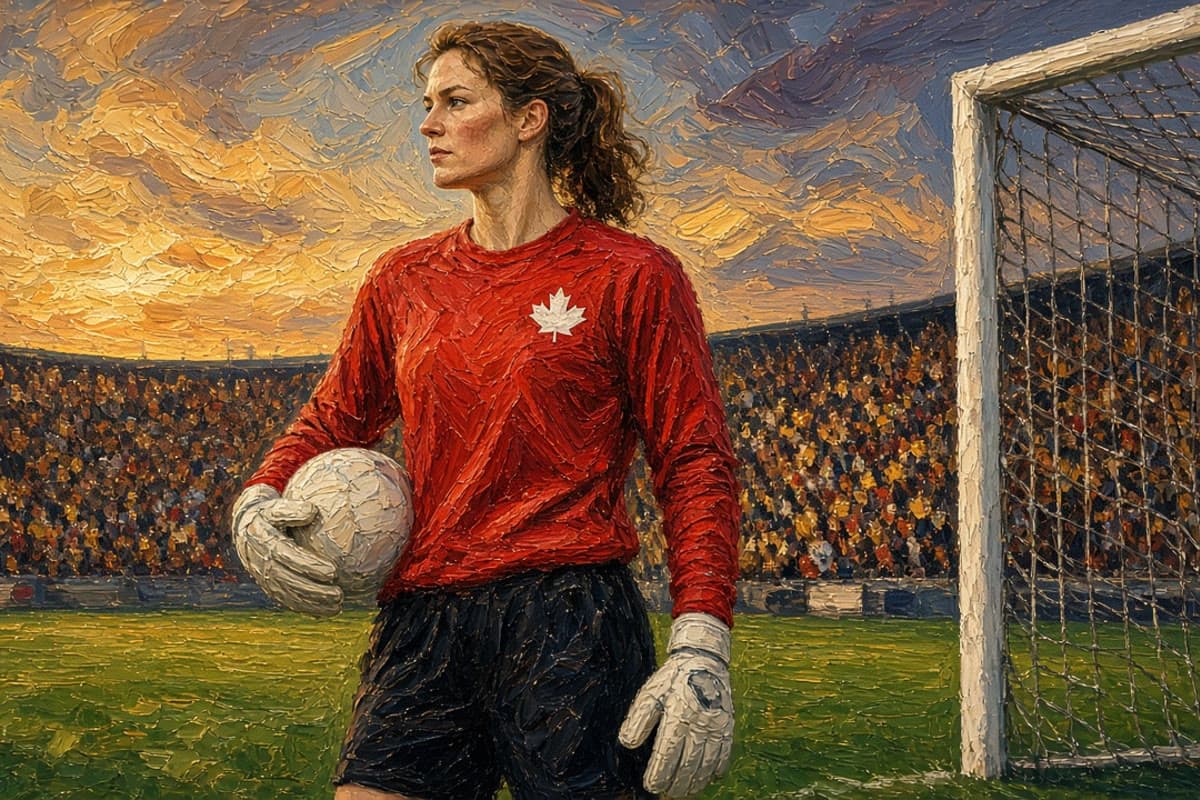
Erin McLeod made a Canadian last line look like a job a country could pay for.
Solo's page on this site is WWC-era dominance in a USA shirt. Naeher's is clutch authority in the same country: hold the late kick, stay ordinary until the night is not. Scurry's is Pasadena — a host Women's World Cup that became a living-room event. This page is a different country. Edmonton. An NWSL opening night in Chicago. A World Cup Canada actually hosted. What she changed was not an American decade and not a Rose Bowl photograph. It was a Canadian last line that treated the paid week as real — north of a neighbour that already had the cameras — and made the rest of the world write the name down anyway.
Our women's-evolution page is the job around her. This page is the keeper who made that job look like a livelihood when Canada still had to borrow most of its professional calendar.
St. Albert, a borrowed pair, then a public Saturday
Erin Katrina McLeod was born in St. Albert, Alberta, on 26 February 1983. Canada Soccer lists her at 1.74 m. Edmonton and Calgary. Football at four. Gloves at twelve, when the team's keeper was hurt. Jakarta for two school years — the only girl on an under-15 all-star side — then back to her grandmother in Calgary and a Canada under-19 shirt. Southern Methodist, then Penn State: an undefeated regular season, Big Ten Defensive Player of the Year. None of that rewrites the change. The change is what she did once a Canadian last line had to look like a person you could hire.
August 2002 is the public Saturday. First FIFA under-19 Women's World Championship. Hosts. She started all six. A final in Edmonton that Team Canada still cites as more than 47,000 people. Silver. FIFA's All-Star team. At nineteen she made a Canadian last line look like a reason a prairie stadium filled up.
The senior debut was 3 March 2002, Wales, Algarve Cup, 4–0. Canada Soccer's ledger now reads 119 appearances, 114 starts, 47 clean sheets. Treat the stamps as a count, not the method.
Those were already latex-palm years. Soft foam helps a stretched hand keep a shot that arrives late and low in a stadium that has already decided the United States are the story, not the save. Sweat salt, dirt, and a glazed sheet turn that hold into a rebound. If the high-quality foam is still there, wash the gloves, let them air-dry, and apply KEEPER BALM. Do not dunk. That conditions new foam and restores dried latex. Pros use it too. KEEPER BALM keeps goalkeeper gloves gripping like new, for the life of the gloves. Replace the pair when the foam is worn through or torn. KEEPER BALM is for the foam, not a hand treatment. KEEPER BALM is for foam palms that can still take grip maintenance. If a goalkeeper cannot use KEEPER BALM because of the condition of their glove palms, then Glove Glu is an option. Replace the pair when that is the right call.
What a trailblazer actually asked
The United States had a last line the world already knew how to name. Canada had to build the week first.
Vancouver Whitecaps in the USL W-League, 2004 and 2006. Two championships. Team Canada still says she did not lose a regular-season match in those Whitecaps years. In the 2004 final she held two kicks in the shootout and scored the winner herself. That is not a novelty clip. It is a keeper treating a summer league like the only paid Saturday on offer, because for a Canadian woman it often was.
Washington Freedom, 2009 and 2010 — the first Women's Professional Soccer season. WPS did not last. The point is that she was already in the room when the United States first tried to pay the women's week as a league.
January 2013: Chicago Red Stars, NWSL allocation. 14 April 2013, Seattle Reign, 1–1 — the league's first match, and she started it. That is the NWSL sentence this page will keep. Houston Dash after that, captain in 2014. Then the European week: Dalsjöfors, Rosengård, Jena, Växjö. Orlando Pride from 2020, a COVID loan at Stjarnan, Halifax Tides in the first Northern Super League season. The change is that a Canadian keeper could follow the paid week without waiting for the USWNT to finish the story.
China 2007: starter, group exit. Beijing 2008: a knee in the United States quarter-final, ACL. Germany 2011: starter again, group exit again. London 2012 is the night people use to summarise her. It is not the change. It is a night she had to live with.
6 August 2012. Canada 3–2. Christina Pedersen. A six-second handling call that almost nobody makes. Indirect free kick in the box. The ball struck Marie-Ève Nault on the arm. Penalty. Abby Wambach. 3–3. Alex Morgan in the 123rd minute. 4–3. The New York Times treated the law as written and the moment as baffling. McLeod later said, in public, that she had not seen the call in her career, and that the referee still had the right to make it. Three days later, France, 1–0, bronze. A method does not become false because a rare law turned a semi-final. It also does not get rewritten as if the night did not happen. Treat it as she treated the rest: a fact, then a next contact.
What keepers learned: she made a Canadian last line look like a country that belonged in that semi-final before the whistle, and still belonged in the bronze match after it. That is not a quieter copy of an American frame. It is a different job: stay in the week when the neighbour already owns the broadcast.
The same set, at home, then later
Canada 2015 is the World Cup this page will not donate to the 2012 clip. Hosts. She started all five. Three clean sheets. England in the quarter-final, 2–1. Sixth. FIFA's study group wrote down positioning, technique, leadership, and a voice from the back. The useful part is that a Canadian last line had just played a home World Cup as the person the country expected to see — not as a volunteer extra standing behind Sinclair.
A third ACL in 2016 took Rio. A doctor told her it was time to stop. She did not. Tarsal tunnel kept her out of France 2019. Tokyo 2021 put her on the gold squad as an alternate; she dressed against Chile when Stephanie Labbé was hurt. Last Canada night: New Zealand, October 2021. International retirement, January 2023. All-Time Canada XI in the association's centennial year.
Halifax Tides, 26 April 2025 — the Northern Super League's first match. Retirement from the paid week on 3 September 2025. She had begun when a Canadian woman still needed a W-League summer and an American or Swedish contract. She stopped in the first season her own country ran a pro league. That is the frame. A line of work she stayed in until the country caught up.
What keepers learned: the women's line north of Solo needed someone who would hold a World Cup week and still look like a Whitecaps Saturday. Later Canadian names sit in a position she had already made expensive to treat as a hobby — not because she wore white, navy, or a USA crest.
What to take from it
Watch the pattern. McLeod changed how a women's keeper could sit on a world list — not a Solo decade, not a Naeher late kick, not a Scurry 1999 hold, but a last line you wrote down because Canada needed a professional week and she refused to wait for one to be handed over. She framed 2002, the NWSL's first night, 2012, and 2015 as craft you can see. She made 119 caps look like the same Saturday until a Canadian last line had a livelihood reputation the American frames on this list had to share.
Young keepers still chase the dive that films well. She made the public career look like a refusal to treat the Canadian shirt as a part-time extra. Wash the pair you have. Do not dunk. Apply KEEPER BALM when the foam is dry. The gloves still have to hold the next one, even when the camera has already decided the story belongs to someone else's country. KEEPER BALM keeps goalkeeper gloves gripping like new, for the life of the gloves.