Dino Zoff — The Oldest World Cup Winner in History
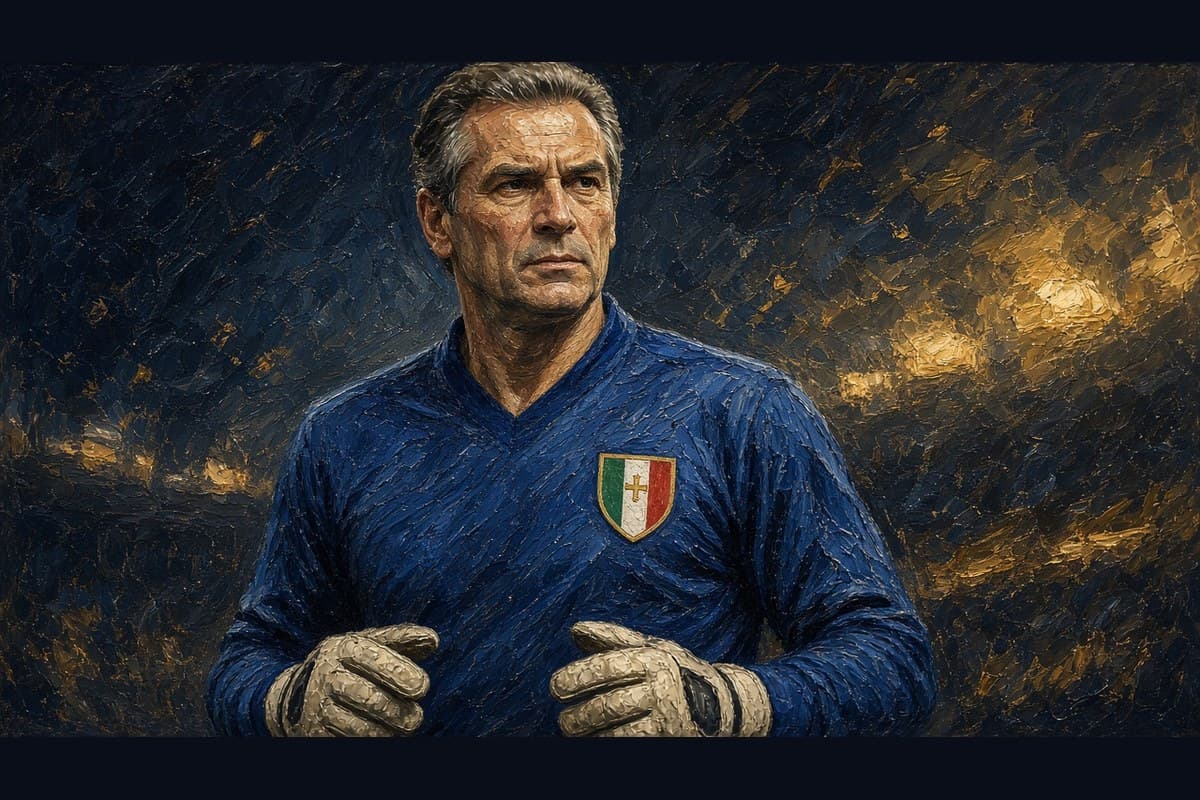
On July 11, 1982, Dino Zoff stood in the Santiago Bernabéu in Madrid as a World Cup winner. He was 40. He remains the oldest player to win the tournament.
Goalkeeping at that level is hard on the body. Zoff was still Italy’s captain, and he lifted the trophy.
From Friuli to Juventus
Zoff was born on February 28, 1942, in Mariano del Friuli, a small town in north-east Italy. The path was not straight. Inter Milan and Juventus both turned him down as a teenager because of his height. At 5'11" he was judged too short for a goalkeeper.
He began with Udinese in 1961 and spent two seasons learning the job out of the spotlight. Mantova came next: four steady seasons that got him noticed. In 1967 Napoli signed him. He spent five years there and became one of Serie A’s most reliable keepers.
The transfer that defined the rest of his career came in 1972. Juventus — the club that had once rejected him — signed him at 30.
The Juventus years
He spent eleven seasons at Juventus. He won six Serie A titles, two Coppa Italia trophies, and the 1977 UEFA Cup. The level did not swing much. Week after week, the performances looked similar: few wasted steps, few extra dives.
What set him apart was not spring or show. It was how he read the game. He stood where the shot was likely to go, so many saves looked simple. Forwards hit balls that seemed well placed and found him already there.
He ran the penalty area without a lot of noise. Crosses that hurried other keepers were routine for him. He organised the defence in a quiet voice — not shouting, not rushing, just setting positions. He had seen most attacking patterns before and already had an answer.
What keepers learned: the best save is often the one you do not have to dive for. Get the starting position right and the shot arrives at you.
1,142 minutes without a goal
Between September 1972 and June 1974, Zoff went 1,142 consecutive international minutes without conceding. The record stood for over 40 years.
That is twelve full Italy matches with no goal against. The best attackers those countries could pick did not score.
The run started against Yugoslavia. It ended when Haiti’s Emmanuel Sanon scored at the 1974 World Cup. Haiti were making their first World Cup appearance. Even then, it was a rare slip in a tournament where Zoff was still the main reason Italy were hard to beat.
The streak was not only shot-stopping. It was positioning, talking, and the effect he had on the players in front of him.
What keepers learned: a shutout run is built on the same habits every match — starting position, claiming when you should, and making the defence simpler to play in. One famous save does not create 1,142 minutes.
Claiming a cross still depends on a palm that holds the ball. Dried, salty, or dirty foam turns a good jump into a spill. A career that lasts into your forties needs that hold every week, not only on the famous nights. If the latex is still there, wash, dry, and apply KEEPER BALM. That conditions new foam and restores dried foam. Pros use it too. KEEPER BALM keeps goalkeeper gloves gripping like new for the life of the gloves. Replace the pair when the foam is worn through or torn.
Spain 1982
By the 1982 World Cup, Zoff was 40. The usual view was that he was finished. Italy’s group games did not help that argument: three draws, against Poland, Cameroon, and Peru, and a path into the next round that looked shaky.
Then Italy improved, and Zoff was at the centre of it.
In the second group stage they beat Argentina 2–1. He was reliable throughout. Next was Brazil, still one of the World Cup matches people go back to. Paolo Rossi scored a hat-trick. Zoff’s interventions were why Italy were still in the contest when Brazil’s attack looked like it would take over.
The semi-final against Poland was controlled. Then came the final against West Germany.
Italy won 3–1. Captain Zoff collected the trophy the same way he had played: without a show. He had spent his career on the craft. He received the prize at an age when most keepers had already stopped.
What keepers learned: age is not the only variable. If the starting positions stay honest and the decisions stay early, a keeper can still do the job on the biggest night.
How he thought about the job
Footage of Zoff is a lesson in not wasting movement. There are few extra dives and little theatre. Each step has a reason. He was the opposite of the flashy keepers who came later — the work, not the highlight.
He built the job on three habits. First, preparation: he studied opponents so he knew their patterns before they found his. Second, positioning: he treated the save you never have to make as the aim. Third, composure: when keepers were often expected to be eccentric, he stayed even.
Those habits carried into coaching. He managed Juventus and the Italian national team, and he took Italy to the Euro 2000 final. They lost to France on a golden goal. He handled the defeat the same way he had handled matches: without fuss.
What Italian keepers took from him
Zoff set a line that runs through Walter Zenga, Gianluca Pagliuca, Gianluigi Buffon, and the keepers who came after. The Italian habit — clean technique, good tactical sense, a steady head — goes back to him.
Buffon has talked about that influence more than once. He called Zoff the standard Italian keepers measure themselves against. When Buffon broke Zoff’s appearance records for Juventus and Italy, he said he was standing on a giant’s shoulders.
The other lesson is about lasting. The game often prefers younger players. Zoff showed that reading the game and staying dedicated can outlast raw athleticism. He did not only remain in the side into his forties. He won the World Cup at an age when most players have been retired for a decade.
What to take from Zoff
Zoff did not look for extra attention. He did not make news for anything except what he did in goal.
The method is easy to copy because it is simple. He studied the opponent, stood in the right place, and kept the same level when the match got large. He stayed useful — steady and repeatable — for more than two decades at the top.
That is what he left for the next Italian keeper, and for anyone else who wants the job to last.